

submersible Alvin
401
Features of Deep-Ocean Basins
Corals are tiny animals that generally
appear in large numbers and when linked
form colonies. Most corals create a hard
external skeleton made of calcium carbonate. Some build large calcium carbonate
structures, called reefs, where new colonies
grow atop the strong skeletons of previous
colonies. Sponges and algae may attach to
the reef, enlarging it further.
Reef-building corals grow best in
waters with an average annual temperature
of about 24 °C (75 °F). They cannot survive prolonged exposure to temperatures
below 18 °C (64 °F) or above 30 °C (86 °F).
In addition, reef-builders require clear,
sunlit water. Consequently, the depth of
most active reef growth is limited to no
more than about 45 meters (150 feet).
The strict environmental conditions
required for coral growth create an
interesting paradox: How can corals—
which require warm, shallow, sunlit water
no deeper than a few dozen meters—create
thick structures such as coral atolls that
extend to great depths?
The naturalist Charles Darwin was one
of the first to formulate a hypothesis on the
origin of ringed-shaped atolls. From 1831
to 1836 he sailed aboard the British ship
HMS Beagle during its famous global
circumnavigation. In various places that
Darwin visited, he noticed a progression
of stages in coral reef development from
(1) a fringing reef along the margins of a
volcano to (2) a barrier reef with a volcano
in the middle to (3) an atoll, consisting
of a continuous or broken ring of coral
reef surrounding a central lagoon. The
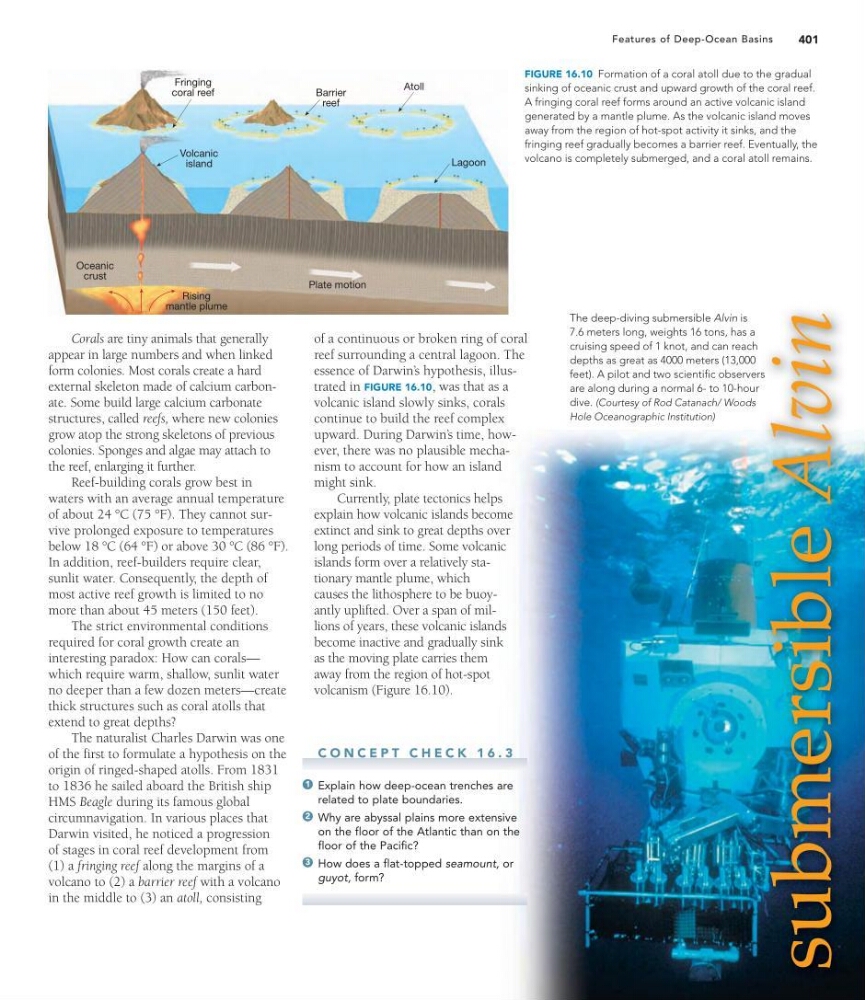
essence of Darwin’ s hypothesis, illustrated in FIGURE 16.10, was that as a
volcanic island slowly sinks, corals
continue to build the reef complex
upward. During Darwin’ s time, however, there was no plausible mechanism to account for how an island
might sink.
Currently, plate tectonics helps
explain how volcanic islands become
extinct and sink to great depths over
long periods of time. Some volcanic
islands form over a relatively stationary mantle plume, which
causes the lithosphere to be buoyantly uplifted. Over a span of millions of years, these volcanic islands
become inactive and gradually sink
as the moving plate carries them
away from the region of hot-spot
volcanism (Figure 16.10).
The deep-diving submersible Alvin is
7.6 meters long, weights 16 tons, has a
cruising speed of 1 knot, and can reach
depths as great as 4000 meters (13,000
feet). A pilot and two scientific observers
are along during a normal 6- to 10-hour
dive. (Courtesy of Rod Catanach/ Woods
Hole Oceanographic Institution)
Fringing
coral reef
Barrier
reef
Atoll
Lagoon
Volcanic
island
Oceanic
crust
Rising
mantle plume
Plate motion
FIGURE 16.10 Formation of a coral atoll due to the gradual
sinking of oceanic crust and upward growth of the coral reef.
A fringing coral reef forms around an active volcanic island
generated by a mantle plume. As the volcanic island moves
away from the region of hot-spot activity it sinks, and the
fringing reef gradually becomes a barrier reef. Eventually, the
volcano is completely submerged, and a coral atoll remains.
C O N C E P T C H E C K 1 6 . 3
Explain how deep-ocean trenches are
related to plate boundaries.
Why are abyssal plains more extensive
on the floor of the Atlantic than on the
floor of the Pacific?
How does a flat-topped seamount, or
guyot, form?
3
2
1
401
Features of Deep-Ocean Basins
Corals are tiny animals that generally
appear in large numbers and when linked
form colonies. Most corals create a hard
external skeleton made of calcium carbonate. Some build large calcium carbonate
structures, called reefs, where new colonies
grow atop the strong skeletons of previous
colonies. Sponges and algae may attach to
the reef, enlarging it further.
Reef-building corals grow best in
waters with an average annual temperature
of about 24 °C (75 °F). They cannot survive prolonged exposure to temperatures
below 18 °C (64 °F) or above 30 °C (86 °F).
In addition, reef-builders require clear,
sunlit water. Consequently, the depth of
most active reef growth is limited to no
more than about 45 meters (150 feet).
The strict environmental conditions
required for coral growth create an
interesting paradox: How can corals—
which require warm, shallow, sunlit water
no deeper than a few dozen meters—create
thick structures such as coral atolls that
extend to great depths?
The naturalist Charles Darwin was one
of the first to formulate a hypothesis on the
origin of ringed-shaped atolls. From 1831
to 1836 he sailed aboard the British ship
HMS Beagle during its famous global
circumnavigation. In various places that
Darwin visited, he noticed a progression
of stages in coral reef development from
(1) a fringing reef along the margins of a
volcano to (2) a barrier reef with a volcano
in the middle to (3) an atoll, consisting
of a continuous or broken ring of coral
reef surrounding a central lagoon. The
essence of Darwin’ s hypothesis, illustrated in FIGURE 16.10, was that as a
volcanic island slowly sinks, corals
continue to build the reef complex
upward. During Darwin’ s time, however, there was no plausible mechanism to account for how an island
might sink.
Currently, plate tectonics helps
explain how volcanic islands become
extinct and sink to great depths over
long periods of time. Some volcanic
islands form over a relatively stationary mantle plume, which
causes the lithosphere to be buoyantly uplifted. Over a span of millions of years, these volcanic islands
become inactive and gradually sink
as the moving plate carries them
away from the region of hot-spot
volcanism (Figure 16.10).
The deep-diving submersible Alvin is
7.6 meters long, weights 16 tons, has a
cruising speed of 1 knot, and can reach
depths as great as 4000 meters (13,000
feet). A pilot and two scientific observers
are along during a normal 6- to 10-hour
dive. (Courtesy of Rod Catanach/ Woods
Hole Oceanographic Institution)
Fringing
coral reef
Barrier
reef
Atoll
Lagoon
Volcanic
island
Oceanic
crust
Rising
mantle plume
Plate motion
FIGURE 16.10 Formation of a coral atoll due to the gradual
sinking of oceanic crust and upward growth of the coral reef.
A fringing coral reef forms around an active volcanic island
generated by a mantle plume. As the volcanic island moves
away from the region of hot-spot activity it sinks, and the
fringing reef gradually becomes a barrier reef. Eventually, the
volcano is completely submerged, and a coral atoll remains.
C O N C E P T C H E C K 1 6 . 3
Explain how deep-ocean trenches are
related to plate boundaries.
Why are abyssal plains more extensive
on the floor of the Atlantic than on the
floor of the Pacific?
How does a flat-topped seamount, or
guyot, form?
3
2
1