

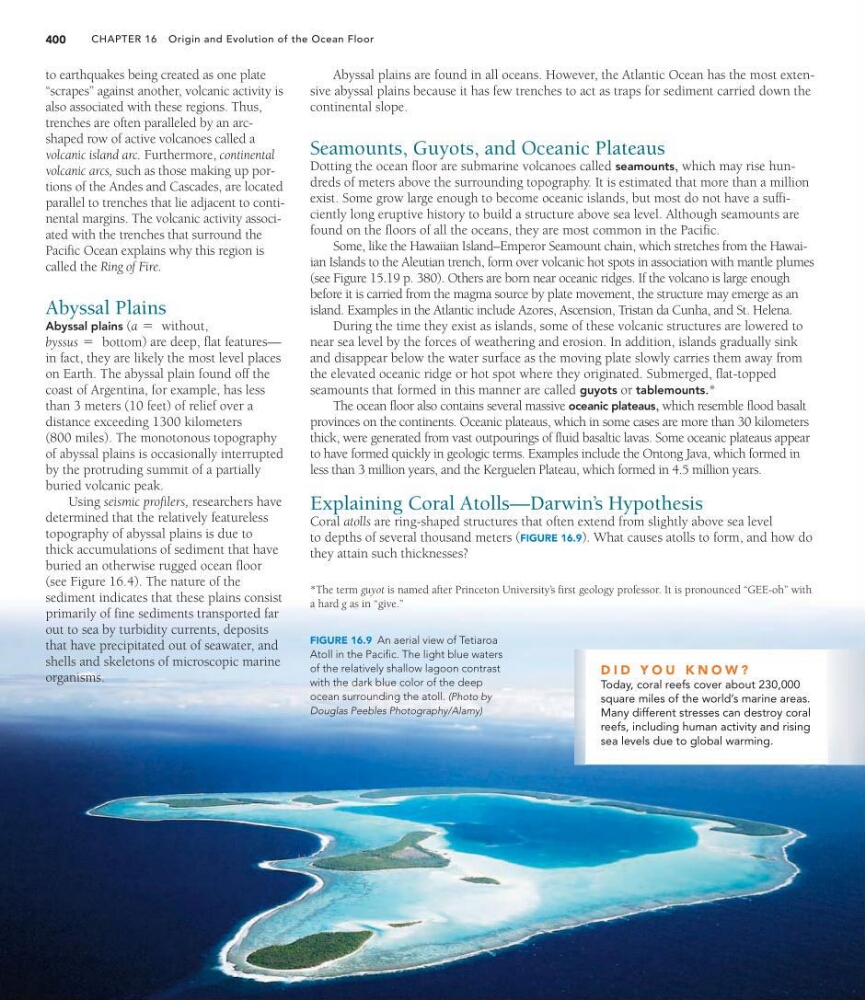
FIGURE 16.9 An aerial view of Tetiaroa
Atoll in the Pacific. The light blue waters
of the relatively shallow lagoon contrast
with the dark blue color of the deep
ocean surrounding the atoll. (Photo by
Douglas Peebles Photography/Alamy)
CHAPTER 16 Origin and Evolution of the Ocean Floor
400
to earthquakes being created as one plate
“scrapes” against another, volcanic activity is
also associated with these regions. Thus,
trenches are often paralleled by an arcshaped row of active volcanoes called a
volcanic island arc. Furthermore, continental
volcanic arcs, such as those making up portions of the Andes and Cascades, are located
parallel to trenches that lie adjacent to continental margins. The volcanic activity associated with the trenches that surround the
Pacific Ocean explains why this region is
called the Ring of Fire.
Abyssal Plains
Abyssal plains (
,
) are deep, flat features—
in fact, they are likely the most level places
on Earth. The abyssal plain found off the
coast of Argentina, for example, has less
than 3 meters (10 feet) of relief over a
distance exceeding 1300 kilometers
(800 miles). The monotonous topography
of abyssal plains is occasionally interrupted
by the protruding summit of a partially
buried volcanic peak.
Using seismic profilers, researchers have
determined that the relatively featureless
topography of abyssal plains is due to
thick accumulations of sediment that have
buried an otherwise rugged ocean floor
(see Figure 16.4). The nature of the
sediment indicates that these plains consist
primarily of fine sediments transported far
out to sea by turbidity currents, deposits
that have precipitated out of seawater, and
shells and skeletons of microscopic marine
organisms.
byssus = bottom
a = without
Abyssal plains are found in all oceans. However, the Atlantic Ocean has the most extensive abyssal plains because it has few trenches to act as traps for sediment carried down the
continental slope.
Seamounts, Guyots, and Oceanic Plateaus
Dotting the ocean floor are submarine volcanoes called seamounts, which may rise hundreds of meters above the surrounding topography. It is estimated that more than a million
exist. Some grow large enough to become oceanic islands, but most do not have a sufficiently long eruptive history to build a structure above sea level. Although seamounts are
found on the floors of all the oceans, they are most common in the Pacific.
Some, like the Hawaiian Island–Emperor Seamount chain, which stretches from the Hawaiian Islands to the Aleutian trench, form over volcanic hot spots in association with mantle plumes
(see Figure 15.19 p. 380). Others are born near oceanic ridges. If the volcano is large enough
before it is carried from the magma source by plate movement, the structure may emerge as an
island. Examples in the Atlantic include Azores, Ascension, Tristan da Cunha, and St. Helena.
During the time they exist as islands, some of these volcanic structures are lowered to
near sea level by the forces of weathering and erosion. In addition, islands gradually sink
and disappear below the water surface as the moving plate slowly carries them away from
the elevated oceanic ridge or hot spot where they originated. Submerged, flat-topped
seamounts that formed in this manner are called guyots or tablemounts.*
The ocean floor also contains several massive oceanic plateaus, which resemble flood basalt
provinces on the continents. Oceanic plateaus, which in some cases are more than 30 kilometers
thick, were generated from vast outpourings of fluid basaltic lavas. Some oceanic plateaus appear
to have formed quickly in geologic terms. Examples include the Ontong Java, which formed in
less than 3 million years, and the Kerguelen Plateau, which formed in 4.5 million years.
Explaining Coral Atolls—Darwin’ s Hypothesis
Coral atolls are ring-shaped structures that often extend from slightly above sea level
to depths of several thousand meters (FIGURE 16.9). What causes atolls to form, and how do
they attain such thicknesses?
*The term guyot is named after Princeton University’ s first geology professor. It is pronounced “GEE-oh” with
a hard g as in “give.”
D I D Y O U K N O W ?
Today, coral reefs cover about 230,000
square miles of the world’s marine areas.
Many different stresses can destroy coral
reefs, including human activity and rising
sea levels due to global warming.
Atoll in the Pacific. The light blue waters
of the relatively shallow lagoon contrast
with the dark blue color of the deep
ocean surrounding the atoll. (Photo by
Douglas Peebles Photography/Alamy)
CHAPTER 16 Origin and Evolution of the Ocean Floor
400
to earthquakes being created as one plate
“scrapes” against another, volcanic activity is
also associated with these regions. Thus,
trenches are often paralleled by an arcshaped row of active volcanoes called a
volcanic island arc. Furthermore, continental
volcanic arcs, such as those making up portions of the Andes and Cascades, are located
parallel to trenches that lie adjacent to continental margins. The volcanic activity associated with the trenches that surround the
Pacific Ocean explains why this region is
called the Ring of Fire.
Abyssal Plains
Abyssal plains (
,
) are deep, flat features—
in fact, they are likely the most level places
on Earth. The abyssal plain found off the
coast of Argentina, for example, has less
than 3 meters (10 feet) of relief over a
distance exceeding 1300 kilometers
(800 miles). The monotonous topography
of abyssal plains is occasionally interrupted
by the protruding summit of a partially
buried volcanic peak.
Using seismic profilers, researchers have
determined that the relatively featureless
topography of abyssal plains is due to
thick accumulations of sediment that have
buried an otherwise rugged ocean floor
(see Figure 16.4). The nature of the
sediment indicates that these plains consist
primarily of fine sediments transported far
out to sea by turbidity currents, deposits
that have precipitated out of seawater, and
shells and skeletons of microscopic marine
organisms.
byssus = bottom
a = without
Abyssal plains are found in all oceans. However, the Atlantic Ocean has the most extensive abyssal plains because it has few trenches to act as traps for sediment carried down the
continental slope.
Seamounts, Guyots, and Oceanic Plateaus
Dotting the ocean floor are submarine volcanoes called seamounts, which may rise hundreds of meters above the surrounding topography. It is estimated that more than a million
exist. Some grow large enough to become oceanic islands, but most do not have a sufficiently long eruptive history to build a structure above sea level. Although seamounts are
found on the floors of all the oceans, they are most common in the Pacific.
Some, like the Hawaiian Island–Emperor Seamount chain, which stretches from the Hawaiian Islands to the Aleutian trench, form over volcanic hot spots in association with mantle plumes
(see Figure 15.19 p. 380). Others are born near oceanic ridges. If the volcano is large enough
before it is carried from the magma source by plate movement, the structure may emerge as an
island. Examples in the Atlantic include Azores, Ascension, Tristan da Cunha, and St. Helena.
During the time they exist as islands, some of these volcanic structures are lowered to
near sea level by the forces of weathering and erosion. In addition, islands gradually sink
and disappear below the water surface as the moving plate slowly carries them away from
the elevated oceanic ridge or hot spot where they originated. Submerged, flat-topped
seamounts that formed in this manner are called guyots or tablemounts.*
The ocean floor also contains several massive oceanic plateaus, which resemble flood basalt
provinces on the continents. Oceanic plateaus, which in some cases are more than 30 kilometers
thick, were generated from vast outpourings of fluid basaltic lavas. Some oceanic plateaus appear
to have formed quickly in geologic terms. Examples include the Ontong Java, which formed in
less than 3 million years, and the Kerguelen Plateau, which formed in 4.5 million years.
Explaining Coral Atolls—Darwin’ s Hypothesis
Coral atolls are ring-shaped structures that often extend from slightly above sea level
to depths of several thousand meters (FIGURE 16.9). What causes atolls to form, and how do
they attain such thicknesses?
*The term guyot is named after Princeton University’ s first geology professor. It is pronounced “GEE-oh” with
a hard g as in “give.”
D I D Y O U K N O W ?
Today, coral reefs cover about 230,000
square miles of the world’s marine areas.
Many different stresses can destroy coral
reefs, including human activity and rising
sea levels due to global warming.