

387
What Drives Plate Motions?
ridge that causes mantle upwelling, not the
other way around. Thus, modern models
have plates being an integral part of mantle
convection and perhaps even its most
active component.
Although convection in the mantle is
still poorly understood, researchers generally agree on the following:
1. Convective flow in the rocky 2900kilometer-thick mantle—in which
warm, buoyant rock rises and cooler,
denser material sinks—is the underlying driving force for plate movement.
2. Mantle convection and plate tectonics
are part of the same system. Subducting oceanic plates drive the cold
downward-moving portion of convective flow while shallow upwelling of
hot rock along the oceanic ridge and
buoyant mantle plumes are the
upward-flowing arms of the convective
mechanism.
3. Convective flow in the mantle is the
primary mechanism for transporting
heat away from Earth’ s interior to the
surface where it is eventually radiated
into space.
What is not known with any high degree of
certainty is the exact structure of this convective flow. First, we will look at some of
the forces that contribute to plate motion,
and then we will examine two models
that have been proposed to describe
plate–mantle convection.
Forces That Drive Plate
Motion
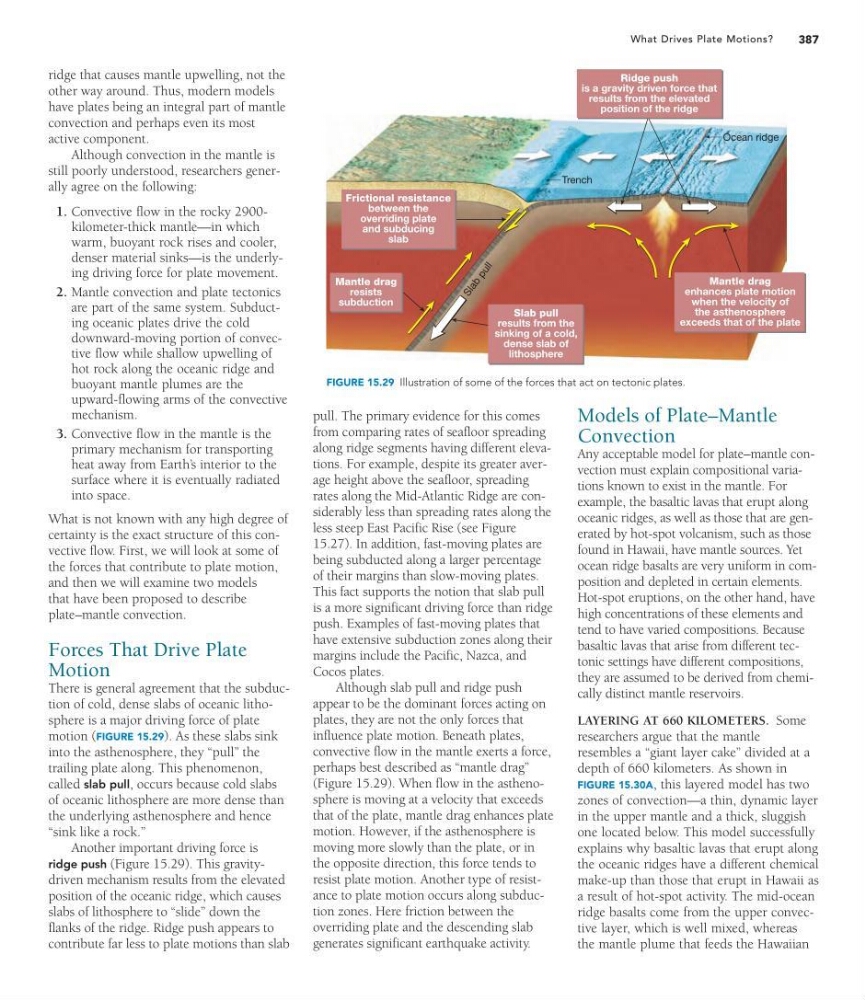
There is general agreement that the subduction of cold, dense slabs of oceanic lithosphere is a major driving force of plate
motion (FIGURE 15.29). As these slabs sink
into the asthenosphere, they “pull” the
trailing plate along. This phenomenon,
called slab pull, occurs because cold slabs
of oceanic lithosphere are more dense than
the underlying asthenosphere and hence
“sink like a rock.”
Another important driving force is
ridge push (Figure 15.29). This gravitydriven mechanism results from the elevated
position of the oceanic ridge, which causes
slabs of lithosphere to “slide” down the
flanks of the ridge. Ridge push appears to
contribute far less to plate motions than slab
pull. The primary evidence for this comes
from comparing rates of seafloor spreading
along ridge segments having different elevations. For example, despite its greater average height above the seafloor, spreading
rates along the Mid-Atlantic Ridge are considerably less than spreading rates along the
less steep East Pacific Rise (see Figure
15.27). In addition, fast-moving plates are
being subducted along a larger percentage
of their margins than slow-moving plates.
This fact supports the notion that slab pull
is a more significant driving force than ridge
push. Examples of fast-moving plates that
have extensive subduction zones along their
margins include the Pacific, Nazca, and
Cocos plates.
Although slab pull and ridge push
appear to be the dominant forces acting on
plates, they are not the only forces that
influence plate motion. Beneath plates,
convective flow in the mantle exerts a force,
perhaps best described as “mantle drag”
(Figure 15.29). When flow in the asthenosphere is moving at a velocity that exceeds
that of the plate, mantle drag enhances plate
motion. However, if the asthenosphere is
moving more slowly than the plate, or in
the opposite direction, this force tends to
resist plate motion. Another type of resistance to plate motion occurs along subduction zones. Here friction between the
overriding plate and the descending slab
generates significant earthquake activity.
Models of Plate–Mantle
Convection
Any acceptable model for plate–mantle convection must explain compositional variations known to exist in the mantle. For
example, the basaltic lavas that erupt along
oceanic ridges, as well as those that are generated by hot-spot volcanism, such as those
found in Hawaii, have mantle sources. Yet
ocean ridge basalts are very uniform in composition and depleted in certain elements.
Hot-spot eruptions, on the other hand, have
high concentrations of these elements and
tend to have varied compositions. Because
basaltic lavas that arise from different tectonic settings have different compositions,
they are assumed to be derived from chemically distinct mantle reservoirs.
LAYERING AT 660 KILOMETERS. Some
researchers argue that the mantle
resembles a “giant layer cake” divided at a
depth of 660 kilometers. As shown in
FIGURE 15.30A, this layered model has two
zones of convection—a thin, dynamic layer
in the upper mantle and a thick, sluggish
one located below. This model successfully
explains why basaltic lavas that erupt along
the oceanic ridges have a different chemical
make-up than those that erupt in Hawaii as
a result of hot-spot activity. The mid-ocean
ridge basalts come from the upper convective layer, which is well mixed, whereas
the mantle plume that feeds the Hawaiian
Trench
Ocean ridge
S l a b
p u l l
Ridge push
is a gravity driven force that
results from the elevated
position of the ridge
Mantle drag
enhances plate motion
when the velocity of
the asthenosphere
exceeds that of the plate
Mantle drag
resists
subduction
Slab pull
results from the
sinking of a cold,
dense slab of
lithosphere
Frictional resistance
between the
overriding plate
and subducing
slab
FIGURE 15.29 Illustration of some of the forces that act on tectonic plates.
What Drives Plate Motions?
ridge that causes mantle upwelling, not the
other way around. Thus, modern models
have plates being an integral part of mantle
convection and perhaps even its most
active component.
Although convection in the mantle is
still poorly understood, researchers generally agree on the following:
1. Convective flow in the rocky 2900kilometer-thick mantle—in which
warm, buoyant rock rises and cooler,
denser material sinks—is the underlying driving force for plate movement.
2. Mantle convection and plate tectonics
are part of the same system. Subducting oceanic plates drive the cold
downward-moving portion of convective flow while shallow upwelling of
hot rock along the oceanic ridge and
buoyant mantle plumes are the
upward-flowing arms of the convective
mechanism.
3. Convective flow in the mantle is the
primary mechanism for transporting
heat away from Earth’ s interior to the
surface where it is eventually radiated
into space.
What is not known with any high degree of
certainty is the exact structure of this convective flow. First, we will look at some of
the forces that contribute to plate motion,
and then we will examine two models
that have been proposed to describe
plate–mantle convection.
Forces That Drive Plate
Motion
There is general agreement that the subduction of cold, dense slabs of oceanic lithosphere is a major driving force of plate
motion (FIGURE 15.29). As these slabs sink
into the asthenosphere, they “pull” the
trailing plate along. This phenomenon,
called slab pull, occurs because cold slabs
of oceanic lithosphere are more dense than
the underlying asthenosphere and hence
“sink like a rock.”
Another important driving force is
ridge push (Figure 15.29). This gravitydriven mechanism results from the elevated
position of the oceanic ridge, which causes
slabs of lithosphere to “slide” down the
flanks of the ridge. Ridge push appears to
contribute far less to plate motions than slab
pull. The primary evidence for this comes
from comparing rates of seafloor spreading
along ridge segments having different elevations. For example, despite its greater average height above the seafloor, spreading
rates along the Mid-Atlantic Ridge are considerably less than spreading rates along the
less steep East Pacific Rise (see Figure
15.27). In addition, fast-moving plates are
being subducted along a larger percentage
of their margins than slow-moving plates.
This fact supports the notion that slab pull
is a more significant driving force than ridge
push. Examples of fast-moving plates that
have extensive subduction zones along their
margins include the Pacific, Nazca, and
Cocos plates.
Although slab pull and ridge push
appear to be the dominant forces acting on
plates, they are not the only forces that
influence plate motion. Beneath plates,
convective flow in the mantle exerts a force,
perhaps best described as “mantle drag”
(Figure 15.29). When flow in the asthenosphere is moving at a velocity that exceeds
that of the plate, mantle drag enhances plate
motion. However, if the asthenosphere is
moving more slowly than the plate, or in
the opposite direction, this force tends to
resist plate motion. Another type of resistance to plate motion occurs along subduction zones. Here friction between the
overriding plate and the descending slab
generates significant earthquake activity.
Models of Plate–Mantle
Convection
Any acceptable model for plate–mantle convection must explain compositional variations known to exist in the mantle. For
example, the basaltic lavas that erupt along
oceanic ridges, as well as those that are generated by hot-spot volcanism, such as those
found in Hawaii, have mantle sources. Yet
ocean ridge basalts are very uniform in composition and depleted in certain elements.
Hot-spot eruptions, on the other hand, have
high concentrations of these elements and
tend to have varied compositions. Because
basaltic lavas that arise from different tectonic settings have different compositions,
they are assumed to be derived from chemically distinct mantle reservoirs.
LAYERING AT 660 KILOMETERS. Some
researchers argue that the mantle
resembles a “giant layer cake” divided at a
depth of 660 kilometers. As shown in
FIGURE 15.30A, this layered model has two
zones of convection—a thin, dynamic layer
in the upper mantle and a thick, sluggish
one located below. This model successfully
explains why basaltic lavas that erupt along
the oceanic ridges have a different chemical
make-up than those that erupt in Hawaii as
a result of hot-spot activity. The mid-ocean
ridge basalts come from the upper convective layer, which is well mixed, whereas
the mantle plume that feeds the Hawaiian
Trench
Ocean ridge
S l a b
p u l l
Ridge push
is a gravity driven force that
results from the elevated
position of the ridge
Mantle drag
enhances plate motion
when the velocity of
the asthenosphere
exceeds that of the plate
Mantle drag
resists
subduction
Slab pull
results from the
sinking of a cold,
dense slab of
lithosphere
Frictional resistance
between the
overriding plate
and subducing
slab
FIGURE 15.29 Illustration of some of the forces that act on tectonic plates.