

CHAPTER 15 Plate Tectonics: A Scientific Revolution Unfolds
388
A. Layering at 660 kilometers
B. Whole mantle convection
Oceanic
lithosphere
Ridge push
Lower mantle
Core
Slab-pull
at trench
Upper mantle
Hot
spot
Hot
rising
mantle
plume
Oceanic ridge
Core
Upper mantle
Cool descending
oceanic plate
Cool
descending
oceanic
plate
Hot
rising
mega-plume
66 0 km
volcanoes taps a deeper, more primitive magma source that resides in the
lower convective layer.
However, data gathered from the study of earthquake waves have shown
that at least some subducting oceanic slabs penetrate the 660-kilometer
boundary and descend deep into the mantle. The subducting lithosphere should serve to mix the upper and lower layers together,
thereby destroying the layered structure proposed in this model.
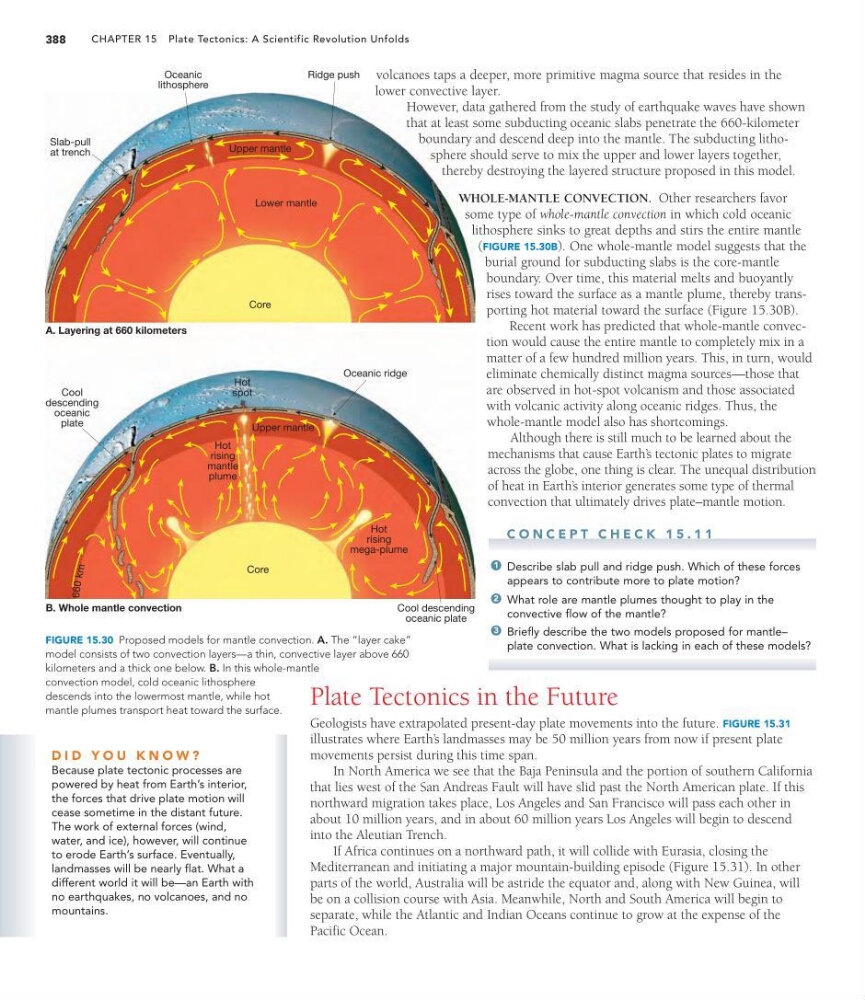
WHOLE-MANTLE CONVECTION. Other researchers favor
some type of whole-mantle convection in which cold oceanic
lithosphere sinks to great depths and stirs the entire mantle
(FIGURE 15.30B). One whole-mantle model suggests that the
burial ground for subducting slabs is the core-mantle
boundary. Over time, this material melts and buoyantly
rises toward the surface as a mantle plume, thereby transporting hot material toward the surface (Figure 15.30B).
Recent work has predicted that whole-mantle convection would cause the entire mantle to completely mix in a
matter of a few hundred million years. This, in turn, would
eliminate chemically distinct magma sources—those that
are observed in hot-spot volcanism and those associated
with volcanic activity along oceanic ridges. Thus, the
whole-mantle model also has shortcomings.
Although there is still much to be learned about the
mechanisms that cause Earth’ s tectonic plates to migrate
across the globe, one thing is clear. The unequal distribution
of heat in Earth’ s interior generates some type of thermal
convection that ultimately drives plate–mantle motion.
D I D Y O U K N O W ?
Because plate tectonic processes are
powered by heat from Earth’s interior,
the forces that drive plate motion will
cease sometime in the distant future.
The work of external forces (wind,
water, and ice), however, will continue
to erode Earth’s surface. Eventually,
landmasses will be nearly flat. What a
different world it will be—an Earth with
no earthquakes, no volcanoes, and no
mountains.
FIGURE 15.30 Proposed models for mantle convection. A. The “layer cake”
model consists of two convection layers—a thin, convective layer above 660
kilometers and a thick one below. B. In this whole-mantle
convection model, cold oceanic lithosphere
descends into the lowermost mantle, while hot
mantle plumes transport heat toward the surface.
Plate Tectonics in the Future
Geologists have extrapolated present-day plate movements into the future. FIGURE 15.31
illustrates where Earth’ s landmasses may be 50 million years from now if present plate
movements persist during this time span.
In North America we see that the Baja Peninsula and the portion of southern California
that lies west of the San Andreas Fault will have slid past the North American plate. If this
northward migration takes place, Los Angeles and San Francisco will pass each other in
about 10 million years, and in about 60 million years Los Angeles will begin to descend
into the Aleutian Trench.
If Africa continues on a northward path, it will collide with Eurasia, closing the
Mediterranean and initiating a major mountain-building episode (Figure 15.31). In other
parts of the world, Australia will be astride the equator and, along with New Guinea, will
be on a collision course with Asia. Meanwhile, North and South America will begin to
separate, while the Atlantic and Indian Oceans continue to grow at the expense of the
Pacific Ocean.
C O N C E P T C H E C K 1 5 . 1 1
Describe slab pull and ridge push. Which of these forces
appears to contribute more to plate motion?
What role are mantle plumes thought to play in the
convective flow of the mantle?
Briefly describe the two models proposed for mantle–
plate convection. What is lacking in each of these models?
3
2
1
388
A. Layering at 660 kilometers
B. Whole mantle convection
Oceanic
lithosphere
Ridge push
Lower mantle
Core
Slab-pull
at trench
Upper mantle
Hot
spot
Hot
rising
mantle
plume
Oceanic ridge
Core
Upper mantle
Cool descending
oceanic plate
Cool
descending
oceanic
plate
Hot
rising
mega-plume
66 0 km
volcanoes taps a deeper, more primitive magma source that resides in the
lower convective layer.
However, data gathered from the study of earthquake waves have shown
that at least some subducting oceanic slabs penetrate the 660-kilometer
boundary and descend deep into the mantle. The subducting lithosphere should serve to mix the upper and lower layers together,
thereby destroying the layered structure proposed in this model.
WHOLE-MANTLE CONVECTION. Other researchers favor
some type of whole-mantle convection in which cold oceanic
lithosphere sinks to great depths and stirs the entire mantle
(FIGURE 15.30B). One whole-mantle model suggests that the
burial ground for subducting slabs is the core-mantle
boundary. Over time, this material melts and buoyantly
rises toward the surface as a mantle plume, thereby transporting hot material toward the surface (Figure 15.30B).
Recent work has predicted that whole-mantle convection would cause the entire mantle to completely mix in a
matter of a few hundred million years. This, in turn, would
eliminate chemically distinct magma sources—those that
are observed in hot-spot volcanism and those associated
with volcanic activity along oceanic ridges. Thus, the
whole-mantle model also has shortcomings.
Although there is still much to be learned about the
mechanisms that cause Earth’ s tectonic plates to migrate
across the globe, one thing is clear. The unequal distribution
of heat in Earth’ s interior generates some type of thermal
convection that ultimately drives plate–mantle motion.
D I D Y O U K N O W ?
Because plate tectonic processes are
powered by heat from Earth’s interior,
the forces that drive plate motion will
cease sometime in the distant future.
The work of external forces (wind,
water, and ice), however, will continue
to erode Earth’s surface. Eventually,
landmasses will be nearly flat. What a
different world it will be—an Earth with
no earthquakes, no volcanoes, and no
mountains.
FIGURE 15.30 Proposed models for mantle convection. A. The “layer cake”
model consists of two convection layers—a thin, convective layer above 660
kilometers and a thick one below. B. In this whole-mantle
convection model, cold oceanic lithosphere
descends into the lowermost mantle, while hot
mantle plumes transport heat toward the surface.
Plate Tectonics in the Future
Geologists have extrapolated present-day plate movements into the future. FIGURE 15.31
illustrates where Earth’ s landmasses may be 50 million years from now if present plate
movements persist during this time span.
In North America we see that the Baja Peninsula and the portion of southern California
that lies west of the San Andreas Fault will have slid past the North American plate. If this
northward migration takes place, Los Angeles and San Francisco will pass each other in
about 10 million years, and in about 60 million years Los Angeles will begin to descend
into the Aleutian Trench.
If Africa continues on a northward path, it will collide with Eurasia, closing the
Mediterranean and initiating a major mountain-building episode (Figure 15.31). In other
parts of the world, Australia will be astride the equator and, along with New Guinea, will
be on a collision course with Asia. Meanwhile, North and South America will begin to
separate, while the Atlantic and Indian Oceans continue to grow at the expense of the
Pacific Ocean.
C O N C E P T C H E C K 1 5 . 1 1
Describe slab pull and ridge push. Which of these forces
appears to contribute more to plate motion?
What role are mantle plumes thought to play in the
convective flow of the mantle?
Briefly describe the two models proposed for mantle–
plate convection. What is lacking in each of these models?
3
2
1