

C O N C E P T C H E C K 1 5 . 8
What is the age of the oldest sediments
recovered by deep-ocean drilling? How do
the ages of these sediments compare to
the ages of the oldest continental rocks?
Assuming hot spots remain fixed, in what
direction was the Pacific plate moving
while the Hawaiian Islands were forming?
When Suiko Seamount was forming?
Describe how Fred Vine and D. H.
Matthews related the seafloor-spreading
hypothesis to magnetic reversals.
The Breakup
of Pangaea
Wegener used evidence from fossils, rock
types, and ancient climates to create a
jigsaw-puzzle fit of the continents—thereby
creating his supercontinent of Pangaea. In a
similar manner, but employing modern
tools not available to Wegener, geologists
have recreated the steps in the break-up of
this supercontinent, an event that began
3
2
1
CHAPTER 15 Plate Tectonics: A Scientific Revolution Unfolds
384
nearly 200 million years ago. From this work, the dates
when individual crustal fragments separated from one
another and their relative motions have become well
established (FIGURE 15.26).
An important consequence of the break-up of Pangaea
was the creation of a “new” ocean basin: the Atlantic. As
you can see in FIGURE 15.26B, splitting of the supercontinent did not occur simultaneously along the margins of
the Atlantic. The first split developed between North
America and Africa.
Here, the continental crust was highly fractured, providing pathways for huge quantities of fluid lavas to reach
the surface. Remnants of these lavas are found along the
Eastern Seaboard of the United States—primarily buried
beneath younger sedimentary rocks that form the continental shelf. Radiometric dating of these solidified lavas
indicates that rifting began in various stages between
180 million and 165 million years ago. This time span can
be used as the “birth date” for this section of the North
Atlantic.
About 130 million years ago, the South Atlantic began
to open near the tip of what is now South Africa. As this
zone of rifting migrated northward, it gradually opened
the South Atlantic (compare Figure 15.26, parts B and C).
Continued break-up in the Southern Hemisphere led to
the separation of Africa and Antarctica and sent India on a
northward journey. By the early Cenozoic, about 50 million years ago, Australia had separated from Antarctica,
and the South Atlantic had emerged as a full-fledged ocean
(FIGURE 15.26D).
A modern map (FIGURE 15.26F) shows that India eventually collided with Asia, an event
that began about 50 million years ago and created the Himalayas as well as the Tibetan
Highlands. About the same time, the separation of Greenland from Eurasia completed the
break-up of the northern landmass. During the last 20 million years or so of Earth history,
Arabia rifted from Africa to form the Red Sea, and Baja California separated from Mexico to
form the Gulf of California (FIGURE 15.26E). Meanwhile, a sliver of land (now known as
Central America) was trapped between North America and South America to produce our
globe’ s familiar, modern appearance.
C O N C E P T C H E C K 1 5 . 9
When did the supercontinent of Pangaea begin to break apart?
What two continents were the first to separate?
During the break-up of Pangaea, which continent was actually growing in size through the
accretion of other landmasses?
How Is Plate Motion Measured?
PLATE TECTONICS
Formation and Break-up of Pangaea
A number of methods have been employed to establish the direction and rate of plate
motion. Paleomagnetism stored in the rocks of the ocean floor is one method used to determine the speeds at which plates move away from the ridge axes where they were generated.
In addition, hot spot tracks, such as the Hawaiian Island–Emperor Seamount chain, trace
GEODe
ESSENTIALS
OF GEOLOGY
3
2
1
A. Normal polarity
C. Normal polarity
B. Reverse polarity
Magma
T
I
M
E
Magma
Magma
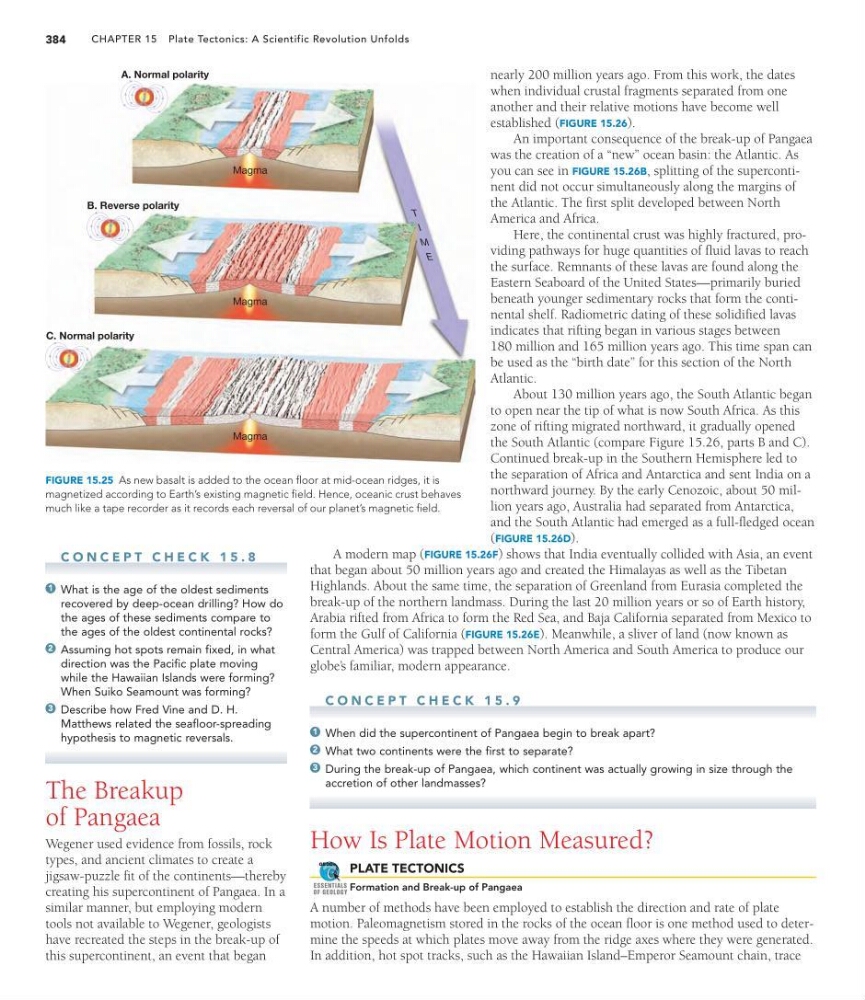
FIGURE 15.25 As new basalt is added to the ocean floor at mid-ocean ridges, it is
magnetized according to Earth’s existing magnetic field. Hence, oceanic crust behaves
much like a tape recorder as it records each reversal of our planet’s magnetic field.
What is the age of the oldest sediments
recovered by deep-ocean drilling? How do
the ages of these sediments compare to
the ages of the oldest continental rocks?
Assuming hot spots remain fixed, in what
direction was the Pacific plate moving
while the Hawaiian Islands were forming?
When Suiko Seamount was forming?
Describe how Fred Vine and D. H.
Matthews related the seafloor-spreading
hypothesis to magnetic reversals.
The Breakup
of Pangaea
Wegener used evidence from fossils, rock
types, and ancient climates to create a
jigsaw-puzzle fit of the continents—thereby
creating his supercontinent of Pangaea. In a
similar manner, but employing modern
tools not available to Wegener, geologists
have recreated the steps in the break-up of
this supercontinent, an event that began
3
2
1
CHAPTER 15 Plate Tectonics: A Scientific Revolution Unfolds
384
nearly 200 million years ago. From this work, the dates
when individual crustal fragments separated from one
another and their relative motions have become well
established (FIGURE 15.26).
An important consequence of the break-up of Pangaea
was the creation of a “new” ocean basin: the Atlantic. As
you can see in FIGURE 15.26B, splitting of the supercontinent did not occur simultaneously along the margins of
the Atlantic. The first split developed between North
America and Africa.
Here, the continental crust was highly fractured, providing pathways for huge quantities of fluid lavas to reach
the surface. Remnants of these lavas are found along the
Eastern Seaboard of the United States—primarily buried
beneath younger sedimentary rocks that form the continental shelf. Radiometric dating of these solidified lavas
indicates that rifting began in various stages between
180 million and 165 million years ago. This time span can
be used as the “birth date” for this section of the North
Atlantic.
About 130 million years ago, the South Atlantic began
to open near the tip of what is now South Africa. As this
zone of rifting migrated northward, it gradually opened
the South Atlantic (compare Figure 15.26, parts B and C).
Continued break-up in the Southern Hemisphere led to
the separation of Africa and Antarctica and sent India on a
northward journey. By the early Cenozoic, about 50 million years ago, Australia had separated from Antarctica,
and the South Atlantic had emerged as a full-fledged ocean
(FIGURE 15.26D).
A modern map (FIGURE 15.26F) shows that India eventually collided with Asia, an event
that began about 50 million years ago and created the Himalayas as well as the Tibetan
Highlands. About the same time, the separation of Greenland from Eurasia completed the
break-up of the northern landmass. During the last 20 million years or so of Earth history,
Arabia rifted from Africa to form the Red Sea, and Baja California separated from Mexico to
form the Gulf of California (FIGURE 15.26E). Meanwhile, a sliver of land (now known as
Central America) was trapped between North America and South America to produce our
globe’ s familiar, modern appearance.
C O N C E P T C H E C K 1 5 . 9
When did the supercontinent of Pangaea begin to break apart?
What two continents were the first to separate?
During the break-up of Pangaea, which continent was actually growing in size through the
accretion of other landmasses?
How Is Plate Motion Measured?
PLATE TECTONICS
Formation and Break-up of Pangaea
A number of methods have been employed to establish the direction and rate of plate
motion. Paleomagnetism stored in the rocks of the ocean floor is one method used to determine the speeds at which plates move away from the ridge axes where they were generated.
In addition, hot spot tracks, such as the Hawaiian Island–Emperor Seamount chain, trace
GEODe
ESSENTIALS
OF GEOLOGY
3
2
1
A. Normal polarity
C. Normal polarity
B. Reverse polarity
Magma
T
I
M
E
Magma
Magma
FIGURE 15.25 As new basalt is added to the ocean floor at mid-ocean ridges, it is
magnetized according to Earth’s existing magnetic field. Hence, oceanic crust behaves
much like a tape recorder as it records each reversal of our planet’s magnetic field.