

hot-spot volcanism
379
Testing the Plate Tectonics Model
Evidence: Ocean Drilling
Some of the most convincing evidence for
seafloor spreading came from the Deep Sea
Drilling Project, which operated from 1968
until 1983. One of the early goals was to
gather samples of the ocean floor in order
to establish its age. To accomplish this, the
Glomar Challenger, a drilling ship capable of
working in water thousands of meters
deep, was built. Hundreds of holes were
drilled through the layers of sediments that
blanket the ocean crust, as well as into the
basaltic rocks below. Rather than radiometrically dating the crustal rocks, researchers
used the fossil remains of microorganisms
found in the sediments resting directly on
the crust to date the seafloor at each site.*
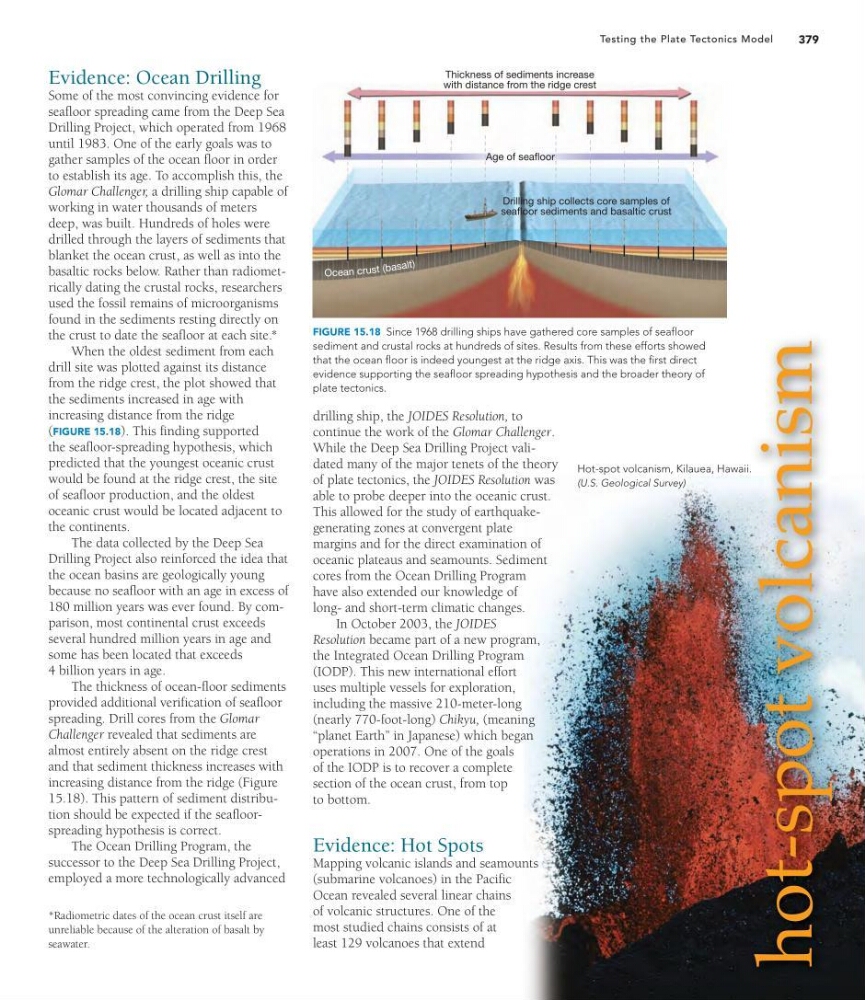
When the oldest sediment from each
drill site was plotted against its distance
from the ridge crest, the plot showed that
the sediments increased in age with
increasing distance from the ridge
(FIGURE 15.18). This finding supported
the seafloor-spreading hypothesis, which
predicted that the youngest oceanic crust
would be found at the ridge crest, the site
of seafloor production, and the oldest
oceanic crust would be located adjacent to
the continents.
The data collected by the Deep Sea
Drilling Project also reinforced the idea that
the ocean basins are geologically young
because no seafloor with an age in excess of
180 million years was ever found. By comparison, most continental crust exceeds
several hundred million years in age and
some has been located that exceeds
4 billion years in age.
The thickness of ocean-floor sediments
provided additional verification of seafloor
spreading. Drill cores from the Glomar
Challenger revealed that sediments are
almost entirely absent on the ridge crest
and that sediment thickness increases with
increasing distance from the ridge (Figure
15.18). This pattern of sediment distribution should be expected if the seafloorspreading hypothesis is correct.
The Ocean Drilling Program, the
successor to the Deep Sea Drilling Project,
employed a more technologically advanced
Thickness of sediments increase
with distance from the ridge crest
Drilling ship collects core samples of
seafloor sediments and basaltic crust
Age of seafloor
Ocean cru st (ba sa lt)
FIGURE 15.18 Since 1968 drilling ships have gathered core samples of seafloor
sediment and crustal rocks at hundreds of sites. Results from these efforts showed
that the ocean floor is indeed youngest at the ridge axis. This was the first direct
evidence supporting the seafloor spreading hypothesis and the broader theory of
plate tectonics.
drilling ship, the JOIDES Resolution, to
continue the work of the Glomar Challenger.
While the Deep Sea Drilling Project validated many of the major tenets of the theory
of plate tectonics, the JOIDES Resolution was
able to probe deeper into the oceanic crust.
This allowed for the study of earthquakegenerating zones at convergent plate
margins and for the direct examination of
oceanic plateaus and seamounts. Sediment
cores from the Ocean Drilling Program
have also extended our knowledge of
long- and short-term climatic changes.
In October 2003, the JOIDES
Resolution became part of a new program,
the Integrated Ocean Drilling Program
(IODP). This new international effort
uses multiple vessels for exploration,
including the massive 210-meter-long
(nearly 770-foot-long) Chikyu, (meaning
“planet Earth” in Japanese) which began
operations in 2007. One of the goals
of the IODP is to recover a complete
section of the ocean crust, from top
to bottom.
Evidence: Hot Spots
Mapping volcanic islands and seamounts
(submarine volcanoes) in the Pacific
Ocean revealed several linear chains
of volcanic structures. One of the
most studied chains consists of at
least 129 volcanoes that extend
Hot-spot volcanism, Kilauea, Hawaii.
(U.S. Geological Survey)
*Radiometric dates of the ocean crust itself are
unreliable because of the alteration of basalt by
seawater.
379
Testing the Plate Tectonics Model
Evidence: Ocean Drilling
Some of the most convincing evidence for
seafloor spreading came from the Deep Sea
Drilling Project, which operated from 1968
until 1983. One of the early goals was to
gather samples of the ocean floor in order
to establish its age. To accomplish this, the
Glomar Challenger, a drilling ship capable of
working in water thousands of meters
deep, was built. Hundreds of holes were
drilled through the layers of sediments that
blanket the ocean crust, as well as into the
basaltic rocks below. Rather than radiometrically dating the crustal rocks, researchers
used the fossil remains of microorganisms
found in the sediments resting directly on
the crust to date the seafloor at each site.*
When the oldest sediment from each
drill site was plotted against its distance
from the ridge crest, the plot showed that
the sediments increased in age with
increasing distance from the ridge
(FIGURE 15.18). This finding supported
the seafloor-spreading hypothesis, which
predicted that the youngest oceanic crust
would be found at the ridge crest, the site
of seafloor production, and the oldest
oceanic crust would be located adjacent to
the continents.
The data collected by the Deep Sea
Drilling Project also reinforced the idea that
the ocean basins are geologically young
because no seafloor with an age in excess of
180 million years was ever found. By comparison, most continental crust exceeds
several hundred million years in age and
some has been located that exceeds
4 billion years in age.
The thickness of ocean-floor sediments
provided additional verification of seafloor
spreading. Drill cores from the Glomar
Challenger revealed that sediments are
almost entirely absent on the ridge crest
and that sediment thickness increases with
increasing distance from the ridge (Figure
15.18). This pattern of sediment distribution should be expected if the seafloorspreading hypothesis is correct.
The Ocean Drilling Program, the
successor to the Deep Sea Drilling Project,
employed a more technologically advanced
Thickness of sediments increase
with distance from the ridge crest
Drilling ship collects core samples of
seafloor sediments and basaltic crust
Age of seafloor
Ocean cru st (ba sa lt)
FIGURE 15.18 Since 1968 drilling ships have gathered core samples of seafloor
sediment and crustal rocks at hundreds of sites. Results from these efforts showed
that the ocean floor is indeed youngest at the ridge axis. This was the first direct
evidence supporting the seafloor spreading hypothesis and the broader theory of
plate tectonics.
drilling ship, the JOIDES Resolution, to
continue the work of the Glomar Challenger.
While the Deep Sea Drilling Project validated many of the major tenets of the theory
of plate tectonics, the JOIDES Resolution was
able to probe deeper into the oceanic crust.
This allowed for the study of earthquakegenerating zones at convergent plate
margins and for the direct examination of
oceanic plateaus and seamounts. Sediment
cores from the Ocean Drilling Program
have also extended our knowledge of
long- and short-term climatic changes.
In October 2003, the JOIDES
Resolution became part of a new program,
the Integrated Ocean Drilling Program
(IODP). This new international effort
uses multiple vessels for exploration,
including the massive 210-meter-long
(nearly 770-foot-long) Chikyu, (meaning
“planet Earth” in Japanese) which began
operations in 2007. One of the goals
of the IODP is to recover a complete
section of the ocean crust, from top
to bottom.
Evidence: Hot Spots
Mapping volcanic islands and seamounts
(submarine volcanoes) in the Pacific
Ocean revealed several linear chains
of volcanic structures. One of the
most studied chains consists of at
least 129 volcanoes that extend
Hot-spot volcanism, Kilauea, Hawaii.
(U.S. Geological Survey)
*Radiometric dates of the ocean crust itself are
unreliable because of the alteration of basalt by
seawater.