

CHAPTER 15 Plate Tectonics: A Scientific Revolution Unfolds
380
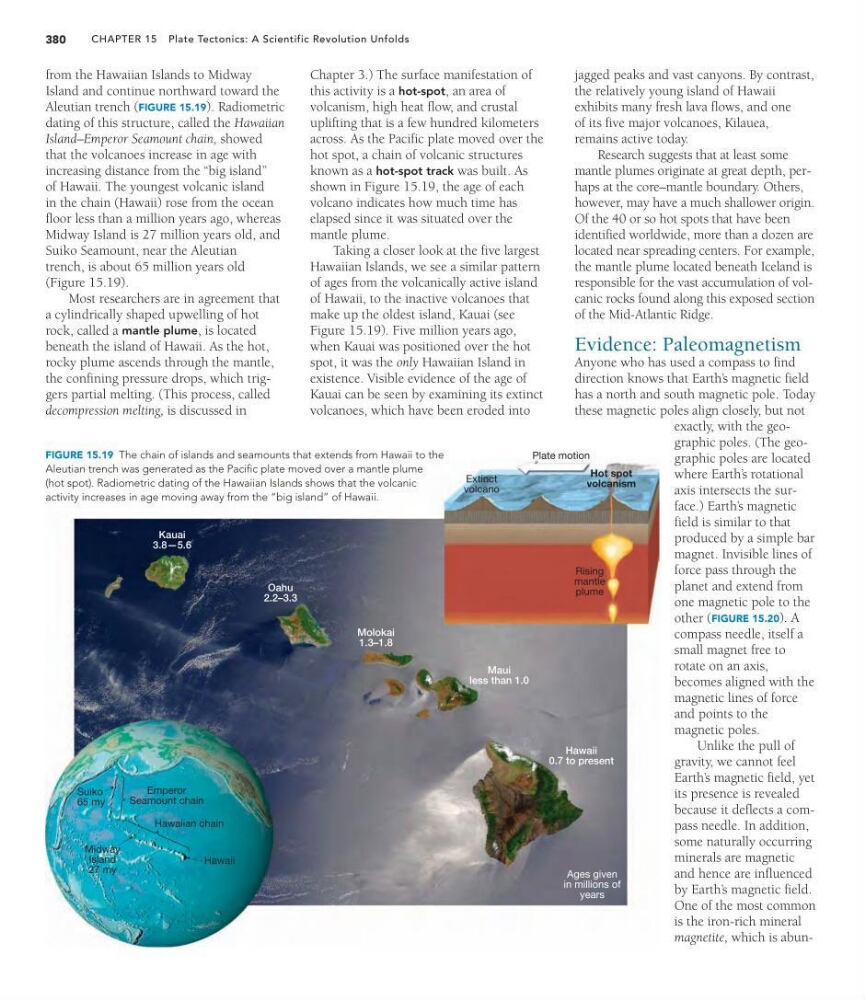
from the Hawaiian Islands to Midway
Island and continue northward toward the
Aleutian trench (FIGURE 15.19). Radiometric
dating of this structure, called the Hawaiian
Island–Emperor Seamount chain, showed
that the volcanoes increase in age with
increasing distance from the “big island”
of Hawaii. The youngest volcanic island
in the chain (Hawaii) rose from the ocean
floor less than a million years ago, whereas
Midway Island is 27 million years old, and
Suiko Seamount, near the Aleutian
trench, is about 65 million years old
(Figure 15.19).
Most researchers are in agreement that
a cylindrically shaped upwelling of hot
rock, called a mantle plume, is located
beneath the island of Hawaii. As the hot,
rocky plume ascends through the mantle,
the confining pressure drops, which triggers partial melting. (This process, called
decompression melting, is discussed in
Chapter 3.) The surface manifestation of
this activity is a hot-spot, an area of
volcanism, high heat flow, and crustal
uplifting that is a few hundred kilometers
across. As the Pacific plate moved over the
hot spot, a chain of volcanic structures
known as a hot-spot track was built. As
shown in Figure 15.19, the age of each
volcano indicates how much time has
elapsed since it was situated over the
mantle plume.
Taking a closer look at the five largest
Hawaiian Islands, we see a similar pattern
of ages from the volcanically active island
of Hawaii, to the inactive volcanoes that
make up the oldest island, Kauai (see
Figure 15.19). Five million years ago,
when Kauai was positioned over the hot
spot, it was the only Hawaiian Island in
existence. Visible evidence of the age of
Kauai can be seen by examining its extinct
volcanoes, which have been eroded into
jagged peaks and vast canyons. By contrast,
the relatively young island of Hawaii
exhibits many fresh lava flows, and one
of its five major volcanoes, Kilauea,
remains active today.
Research suggests that at least some
mantle plumes originate at great depth, perhaps at the core–mantle boundary. Others,
however, may have a much shallower origin.
Of the 40 or so hot spots that have been
identified worldwide, more than a dozen are
located near spreading centers. For example,
the mantle plume located beneath Iceland is
responsible for the vast accumulation of volcanic rocks found along this exposed section
of the Mid-Atlantic Ridge.
Evidence: Paleomagnetism
Anyone who has used a compass to find
direction knows that Earth’ s magnetic field
has a north and south magnetic pole. Today
these magnetic poles align closely, but not
exactly, with the geographic poles. (The geographic poles are located
where Earth’ s rotational
axis intersects the surface.) Earth’ s magnetic
field is similar to that
produced by a simple bar
magnet. Invisible lines of
force pass through the
planet and extend from
one magnetic pole to the
other (FIGURE 15.20). A
compass needle, itself a
small magnet free to
rotate on an axis,
becomes aligned with the
magnetic lines of force
and points to the
magnetic poles.
Unlike the pull of
gravity, we cannot feel
Earth’ s magnetic field, yet
its presence is revealed
because it deflects a compass needle. In addition,
some naturally occurring
minerals are magnetic
and hence are influenced
by Earth’ s magnetic field.
One of the most common
is the iron-rich mineral
magnetite, which is abunEmperor
Seamount chain
Suiko
65 my
Hawaiian chain
Plate motion
Hawaii
Kauai
3.8—5.6
Ages given
in millions of
years
Oahu
2.2–3.3
Molokai
1.3–1.8
Maui
less than 1.0
Hawaii
0.7 to present
Hot spot
volcanism
Extinct
volcano
Midway
Island
27 my
Rising
mantle
plume
FIGURE 15.19 The chain of islands and seamounts that extends from Hawaii to the
Aleutian trench was generated as the Pacific plate moved over a mantle plume
(hot spot). Radiometric dating of the Hawaiian Islands shows that the volcanic
activity increases in age moving away from the “big island” of Hawaii.
380
from the Hawaiian Islands to Midway
Island and continue northward toward the
Aleutian trench (FIGURE 15.19). Radiometric
dating of this structure, called the Hawaiian
Island–Emperor Seamount chain, showed
that the volcanoes increase in age with
increasing distance from the “big island”
of Hawaii. The youngest volcanic island
in the chain (Hawaii) rose from the ocean
floor less than a million years ago, whereas
Midway Island is 27 million years old, and
Suiko Seamount, near the Aleutian
trench, is about 65 million years old
(Figure 15.19).
Most researchers are in agreement that
a cylindrically shaped upwelling of hot
rock, called a mantle plume, is located
beneath the island of Hawaii. As the hot,
rocky plume ascends through the mantle,
the confining pressure drops, which triggers partial melting. (This process, called
decompression melting, is discussed in
Chapter 3.) The surface manifestation of
this activity is a hot-spot, an area of
volcanism, high heat flow, and crustal
uplifting that is a few hundred kilometers
across. As the Pacific plate moved over the
hot spot, a chain of volcanic structures
known as a hot-spot track was built. As
shown in Figure 15.19, the age of each
volcano indicates how much time has
elapsed since it was situated over the
mantle plume.
Taking a closer look at the five largest
Hawaiian Islands, we see a similar pattern
of ages from the volcanically active island
of Hawaii, to the inactive volcanoes that
make up the oldest island, Kauai (see
Figure 15.19). Five million years ago,
when Kauai was positioned over the hot
spot, it was the only Hawaiian Island in
existence. Visible evidence of the age of
Kauai can be seen by examining its extinct
volcanoes, which have been eroded into
jagged peaks and vast canyons. By contrast,
the relatively young island of Hawaii
exhibits many fresh lava flows, and one
of its five major volcanoes, Kilauea,
remains active today.
Research suggests that at least some
mantle plumes originate at great depth, perhaps at the core–mantle boundary. Others,
however, may have a much shallower origin.
Of the 40 or so hot spots that have been
identified worldwide, more than a dozen are
located near spreading centers. For example,
the mantle plume located beneath Iceland is
responsible for the vast accumulation of volcanic rocks found along this exposed section
of the Mid-Atlantic Ridge.
Evidence: Paleomagnetism
Anyone who has used a compass to find
direction knows that Earth’ s magnetic field
has a north and south magnetic pole. Today
these magnetic poles align closely, but not
exactly, with the geographic poles. (The geographic poles are located
where Earth’ s rotational
axis intersects the surface.) Earth’ s magnetic
field is similar to that
produced by a simple bar
magnet. Invisible lines of
force pass through the
planet and extend from
one magnetic pole to the
other (FIGURE 15.20). A
compass needle, itself a
small magnet free to
rotate on an axis,
becomes aligned with the
magnetic lines of force
and points to the
magnetic poles.
Unlike the pull of
gravity, we cannot feel
Earth’ s magnetic field, yet
its presence is revealed
because it deflects a compass needle. In addition,
some naturally occurring
minerals are magnetic
and hence are influenced
by Earth’ s magnetic field.
One of the most common
is the iron-rich mineral
magnetite, which is abunEmperor
Seamount chain
Suiko
65 my
Hawaiian chain
Plate motion
Hawaii
Kauai
3.8—5.6
Ages given
in millions of
years
Oahu
2.2–3.3
Molokai
1.3–1.8
Maui
less than 1.0
Hawaii
0.7 to present
Hot spot
volcanism
Extinct
volcano
Midway
Island
27 my
Rising
mantle
plume
FIGURE 15.19 The chain of islands and seamounts that extends from Hawaii to the
Aleutian trench was generated as the Pacific plate moved over a mantle plume
(hot spot). Radiometric dating of the Hawaiian Islands shows that the volcanic
activity increases in age moving away from the “big island” of Hawaii.