

377
Transform Fault Boundaries
tures are preserved as linear topographic
depressions. The trend of these fracture
zones roughly parallels the direction of
plate motion at the time of their formation.
Thus, these structures are useful in
mapping the direction of plate motion
in the geologic past.
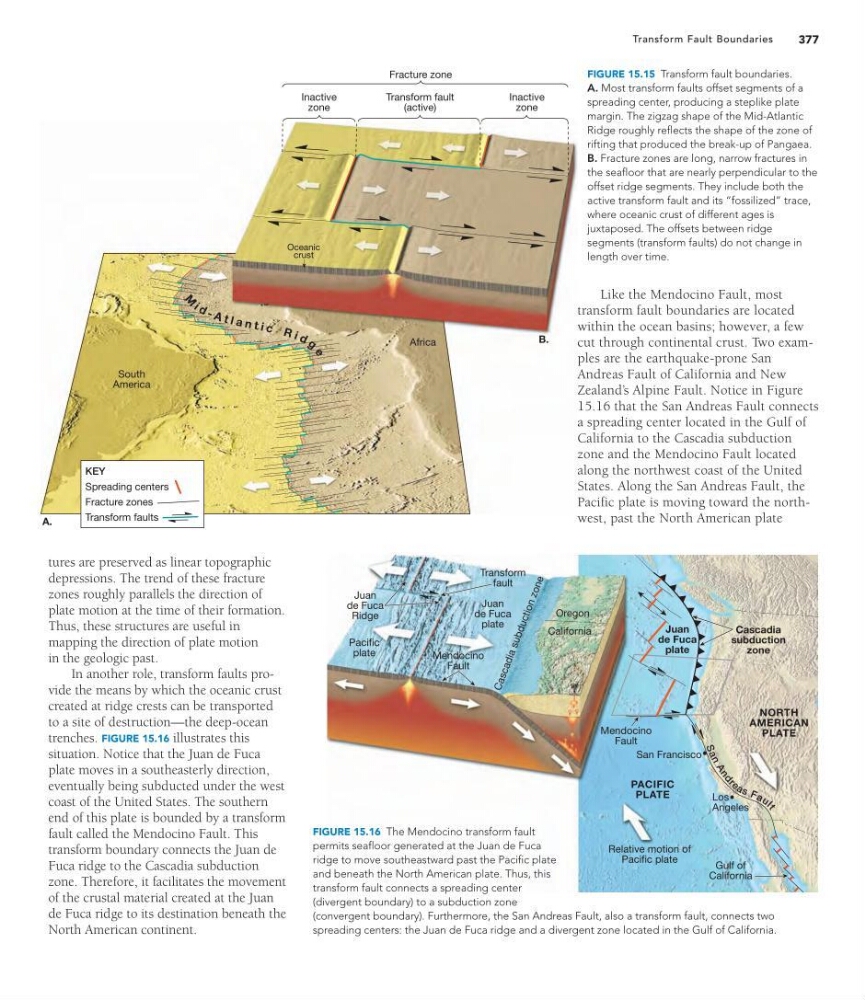
In another role, transform faults provide the means by which the oceanic crust
created at ridge crests can be transported
to a site of destruction—the deep-ocean
trenches. FIGURE 15.16 illustrates this
situation. Notice that the Juan de Fuca
plate moves in a southeasterly direction,
eventually being subducted under the west
coast of the United States. The southern
end of this plate is bounded by a transform
fault called the Mendocino Fault. This
transform boundary connects the Juan de
Fuca ridge to the Cascadia subduction
zone. Therefore, it facilitates the movement
of the crustal material created at the Juan
de Fuca ridge to its destination beneath the
North American continent.
Fracture zone
Transform fault
(active)
Inactive
zone
Inactive
zone
South
America
Africa
A.
B.
Oceanic
crust
KEY
Spreading centers
Fracture zones
Transform faults
M
i d - A t l a n t i c R i d g
e
FIGURE 15.15 Transform fault boundaries.
A. Most transform faults offset segments of a
spreading center, producing a steplike plate
margin. The zigzag shape of the Mid-Atlantic
Ridge roughly reflects the shape of the zone of
rifting that produced the break-up of Pangaea.
B. Fracture zones are long, narrow fractures in
the seafloor that are nearly perpendicular to the
offset ridge segments. They include both the
active transform fault and its “fossilized” trace,
where oceanic crust of different ages is
juxtaposed. The offsets between ridge
segments (transform faults) do not change in
length over time.
Mendocino
Fault
PACIFIC
PLATE
NORTH
AMERICAN
PLATE
Cascadia
subduction
zone
S
a
n
A
n
d
r
e a s F a u l
t
Gulf of
California
Juan
de Fuca
plate
Juan
de Fuca
plate
Transform
fault
Oregon
Pacific
plate
California
Juan
de Fuca
Ridge
Mendocino
Fault
San Francisco
Los
Angeles
Relative motion of
Pacific plate
C a s c a d ia s u b d u c ti o n z o n e
FIGURE 15.16 The Mendocino transform fault
permits seafloor generated at the Juan de Fuca
ridge to move southeastward past the Pacific plate
and beneath the North American plate. Thus, this
transform fault connects a spreading center
(divergent boundary) to a subduction zone
(convergent boundary). Furthermore, the San Andreas Fault, also a transform fault, connects two
spreading centers: the Juan de Fuca ridge and a divergent zone located in the Gulf of California.
Like the Mendocino Fault, most
transform fault boundaries are located
within the ocean basins; however, a few
cut through continental crust. Two examples are the earthquake-prone San
Andreas Fault of California and New
Zealand’ s Alpine Fault. Notice in Figure
15.16 that the San Andreas Fault connects
a spreading center located in the Gulf of
California to the Cascadia subduction
zone and the Mendocino Fault located
along the northwest coast of the United
States. Along the San Andreas Fault, the
Pacific plate is moving toward the northwest, past the North American plate
Transform Fault Boundaries
tures are preserved as linear topographic
depressions. The trend of these fracture
zones roughly parallels the direction of
plate motion at the time of their formation.
Thus, these structures are useful in
mapping the direction of plate motion
in the geologic past.
In another role, transform faults provide the means by which the oceanic crust
created at ridge crests can be transported
to a site of destruction—the deep-ocean
trenches. FIGURE 15.16 illustrates this
situation. Notice that the Juan de Fuca
plate moves in a southeasterly direction,
eventually being subducted under the west
coast of the United States. The southern
end of this plate is bounded by a transform
fault called the Mendocino Fault. This
transform boundary connects the Juan de
Fuca ridge to the Cascadia subduction
zone. Therefore, it facilitates the movement
of the crustal material created at the Juan
de Fuca ridge to its destination beneath the
North American continent.
Fracture zone
Transform fault
(active)
Inactive
zone
Inactive
zone
South
America
Africa
A.
B.
Oceanic
crust
KEY
Spreading centers
Fracture zones
Transform faults
M
i d - A t l a n t i c R i d g
e
FIGURE 15.15 Transform fault boundaries.
A. Most transform faults offset segments of a
spreading center, producing a steplike plate
margin. The zigzag shape of the Mid-Atlantic
Ridge roughly reflects the shape of the zone of
rifting that produced the break-up of Pangaea.
B. Fracture zones are long, narrow fractures in
the seafloor that are nearly perpendicular to the
offset ridge segments. They include both the
active transform fault and its “fossilized” trace,
where oceanic crust of different ages is
juxtaposed. The offsets between ridge
segments (transform faults) do not change in
length over time.
Mendocino
Fault
PACIFIC
PLATE
NORTH
AMERICAN
PLATE
Cascadia
subduction
zone
S
a
n
A
n
d
r
e a s F a u l
t
Gulf of
California
Juan
de Fuca
plate
Juan
de Fuca
plate
Transform
fault
Oregon
Pacific
plate
California
Juan
de Fuca
Ridge
Mendocino
Fault
San Francisco
Los
Angeles
Relative motion of
Pacific plate
C a s c a d ia s u b d u c ti o n z o n e
FIGURE 15.16 The Mendocino transform fault
permits seafloor generated at the Juan de Fuca
ridge to move southeastward past the Pacific plate
and beneath the North American plate. Thus, this
transform fault connects a spreading center
(divergent boundary) to a subduction zone
(convergent boundary). Furthermore, the San Andreas Fault, also a transform fault, connects two
spreading centers: the Juan de Fuca ridge and a divergent zone located in the Gulf of California.
Like the Mendocino Fault, most
transform fault boundaries are located
within the ocean basins; however, a few
cut through continental crust. Two examples are the earthquake-prone San
Andreas Fault of California and New
Zealand’ s Alpine Fault. Notice in Figure
15.16 that the San Andreas Fault connects
a spreading center located in the Gulf of
California to the Cascadia subduction
zone and the Mendocino Fault located
along the northwest coast of the United
States. Along the San Andreas Fault, the
Pacific plate is moving toward the northwest, past the North American plate