

CHAPTER 15 Plate Tectonics: A Scientific Revolution Unfolds
376
spectacular mountain range on Earth
(Figure 15.14C). During this collision, the
continental crust buckled and fractured and
was generally shortened and thickened. In
addition to the Himalayas, several other
major mountain systems, including the
Alps, Appalachians, and Urals, formed as
continental fragments collided. (This topic
will be considered further in Chapter 17.)
C O N C E P T C H E C K 1 5 . 6
Why does the rate of lithosphere production roughly balance with the rate at which
it is destroyed?
Compare a continental volcanic arc and a
volcanic island arc.
Why does oceanic lithosphere subduct
while continental lithosphere does not?
Briefly describe how mountain systems
such as the Himalayas form.
4
3
2
1
Transform Fault
Boundaries
PLATE TECTONICS
Transform Fault Boundaries
Along a transform fault boundary,
plates slide horizontally past one another
without the production or destruction of
lithosphere (conservative plate margins). The
nature of transform faults was discovered
in 1965 by Canadian geologist J. Tuzo
Wilson, who proposed that these large
faults connected two spreading centers
(divergent boundaries) or less commonly
two trenches (convergent boundaries).
Most transform faults are found on the
ocean floor (FIGURE 15.15A). Here they
offset segments of the oceanic ridge system,
producing a steplike plate margin. Notice
that the zigzag shape of the Mid-Atlantic
Ridge in Figure 15.9 roughly reflects the
GEODe
ESSENTIALS
OF GEOLOGY
shape of the original rifting that caused the
break-up of the supercontinent of Pangaea.
(Compare the shapes of the continental
margins of the landmasses on both sides
of the Atlantic with the shape of the MidAtlantic Ridge.)
Typically, transform faults are part of
prominent linear breaks in the seafloor
known as fracture zones, which include
both the active transform faults as well as
their inactive extensions into the plate
interior (FIGURE 15.15B). Active transform
faults lie only between the two offset ridge
segments and are generally defined by
weak, shallow earthquakes. Here seafloor
produced at one ridge axis moves in the
opposite direction of seafloor produced at
an opposing ridge segment. Thus, between
the ridge segments these adjacent slabs of
oceanic crust are grinding past each other
along a transform fault. Beyond the ridge
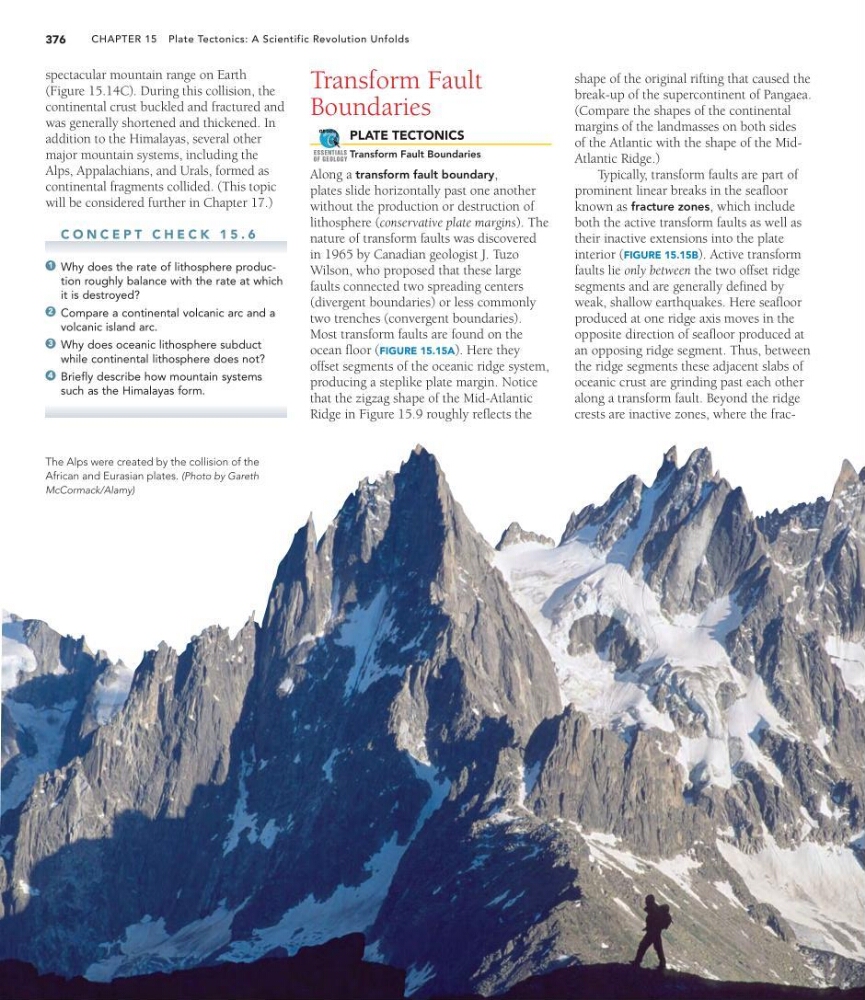
crests are inactive zones, where the fracThe Alps were created by the collision of the
African and Eurasian plates. (Photo by Gareth
McCormack/Alamy)
376
spectacular mountain range on Earth
(Figure 15.14C). During this collision, the
continental crust buckled and fractured and
was generally shortened and thickened. In
addition to the Himalayas, several other
major mountain systems, including the
Alps, Appalachians, and Urals, formed as
continental fragments collided. (This topic
will be considered further in Chapter 17.)
C O N C E P T C H E C K 1 5 . 6
Why does the rate of lithosphere production roughly balance with the rate at which
it is destroyed?
Compare a continental volcanic arc and a
volcanic island arc.
Why does oceanic lithosphere subduct
while continental lithosphere does not?
Briefly describe how mountain systems
such as the Himalayas form.
4
3
2
1
Transform Fault
Boundaries
PLATE TECTONICS
Transform Fault Boundaries
Along a transform fault boundary,
plates slide horizontally past one another
without the production or destruction of
lithosphere (conservative plate margins). The
nature of transform faults was discovered
in 1965 by Canadian geologist J. Tuzo
Wilson, who proposed that these large
faults connected two spreading centers
(divergent boundaries) or less commonly
two trenches (convergent boundaries).
Most transform faults are found on the
ocean floor (FIGURE 15.15A). Here they
offset segments of the oceanic ridge system,
producing a steplike plate margin. Notice
that the zigzag shape of the Mid-Atlantic
Ridge in Figure 15.9 roughly reflects the
GEODe
ESSENTIALS
OF GEOLOGY
shape of the original rifting that caused the
break-up of the supercontinent of Pangaea.
(Compare the shapes of the continental
margins of the landmasses on both sides
of the Atlantic with the shape of the MidAtlantic Ridge.)
Typically, transform faults are part of
prominent linear breaks in the seafloor
known as fracture zones, which include
both the active transform faults as well as
their inactive extensions into the plate
interior (FIGURE 15.15B). Active transform
faults lie only between the two offset ridge
segments and are generally defined by
weak, shallow earthquakes. Here seafloor
produced at one ridge axis moves in the
opposite direction of seafloor produced at
an opposing ridge segment. Thus, between
the ridge segments these adjacent slabs of
oceanic crust are grinding past each other
along a transform fault. Beyond the ridge
crests are inactive zones, where the fracThe Alps were created by the collision of the
African and Eurasian plates. (Photo by Gareth
McCormack/Alamy)