

375
Convergent Boundaries
Cleveland
Volcano
Cleveland
Volcano
ALASKA
Pacific
Ocean
Oceanic
crust
Trench
Continental
crust
Melting
Asthenosphere
A.
B.
Oceanic lithosphere
Volcanic island arc
100 km
200 km
S u b d u c t i n g o c e a n ic
li t h o s p h e r e
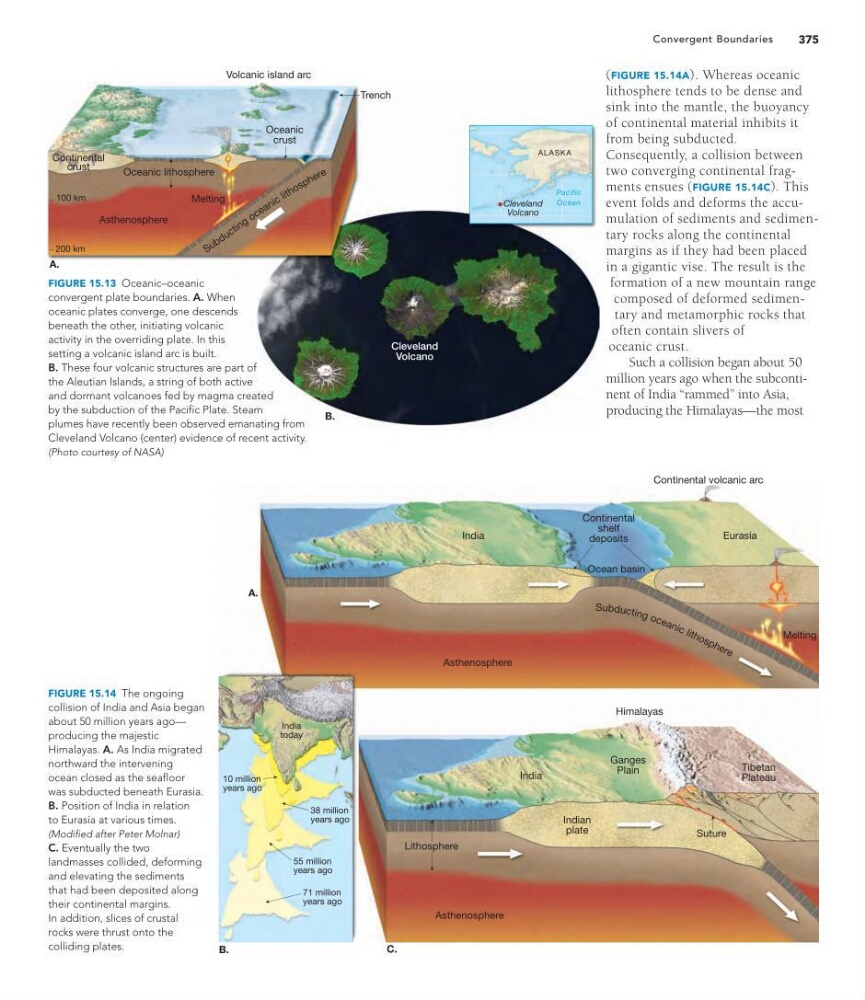
FIGURE 15.13 Oceanic–oceanic
convergent plate boundaries. A. When
oceanic plates converge, one descends
beneath the other, initiating volcanic
activity in the overriding plate. In this
setting a volcanic island arc is built.
B. These four volcanic structures are part of
the Aleutian Islands, a string of both active
and dormant volcanoes fed by magma created
by the subduction of the Pacific Plate. Steam
plumes have recently been observed emanating from
Cleveland Volcano (center) evidence of recent activity.
(Photo courtesy of NASA)
(FIGURE 15.14A). Whereas oceanic
lithosphere tends to be dense and
sink into the mantle, the buoyancy
of continental material inhibits it
from being subducted.
Consequently, a collision between
two converging continental fragments ensues (FIGURE 15.14C). This
event folds and deforms the accumulation of sediments and sedimentary rocks along the continental
margins as if they had been placed
in a gigantic vise. The result is the
formation of a new mountain range
composed of deformed sedimentary and metamorphic rocks that
often contain slivers of
oceanic crust.
Such a collision began about 50
million years ago when the subcontinent of India “rammed” into Asia,
producing the Himalayas—the most
A.
India
Continental
shelf
deposits
Indian
plate
Ocean basin
Continental volcanic arc
Eurasia
Melting
Asthenosphere
B.
C.
Himalayas
India
Tibetan
Plateau
Suture
Asthenosphere
Lithosphere
India
today
10 million
years ago
38 million
years ago
55 million
years ago
71 million
years ago
Ganges
Plain
Sub du ct in g o c e a n ic li t h o s p h e r e
FIGURE 15.14 The ongoing
collision of India and Asia began
about 50 million years ago—
producing the majestic
Himalayas. A. As India migrated
northward the intervening
ocean closed as the seafloor
was subducted beneath Eurasia.
B. Position of India in relation
to Eurasia at various times.
(Modified after Peter Molnar)
C. Eventually the two
landmasses collided, deforming
and elevating the sediments
that had been deposited along
their continental margins.
In addition, slices of crustal
rocks were thrust onto the
colliding plates.
Convergent Boundaries
Cleveland
Volcano
Cleveland
Volcano
ALASKA
Pacific
Ocean
Oceanic
crust
Trench
Continental
crust
Melting
Asthenosphere
A.
B.
Oceanic lithosphere
Volcanic island arc
100 km
200 km
S u b d u c t i n g o c e a n ic
li t h o s p h e r e
FIGURE 15.13 Oceanic–oceanic
convergent plate boundaries. A. When
oceanic plates converge, one descends
beneath the other, initiating volcanic
activity in the overriding plate. In this
setting a volcanic island arc is built.
B. These four volcanic structures are part of
the Aleutian Islands, a string of both active
and dormant volcanoes fed by magma created
by the subduction of the Pacific Plate. Steam
plumes have recently been observed emanating from
Cleveland Volcano (center) evidence of recent activity.
(Photo courtesy of NASA)
(FIGURE 15.14A). Whereas oceanic
lithosphere tends to be dense and
sink into the mantle, the buoyancy
of continental material inhibits it
from being subducted.
Consequently, a collision between
two converging continental fragments ensues (FIGURE 15.14C). This
event folds and deforms the accumulation of sediments and sedimentary rocks along the continental
margins as if they had been placed
in a gigantic vise. The result is the
formation of a new mountain range
composed of deformed sedimentary and metamorphic rocks that
often contain slivers of
oceanic crust.
Such a collision began about 50
million years ago when the subcontinent of India “rammed” into Asia,
producing the Himalayas—the most
A.
India
Continental
shelf
deposits
Indian
plate
Ocean basin
Continental volcanic arc
Eurasia
Melting
Asthenosphere
B.
C.
Himalayas
India
Tibetan
Plateau
Suture
Asthenosphere
Lithosphere
India
today
10 million
years ago
38 million
years ago
55 million
years ago
71 million
years ago
Ganges
Plain
Sub du ct in g o c e a n ic li t h o s p h e r e
FIGURE 15.14 The ongoing
collision of India and Asia began
about 50 million years ago—
producing the majestic
Himalayas. A. As India migrated
northward the intervening
ocean closed as the seafloor
was subducted beneath Eurasia.
B. Position of India in relation
to Eurasia at various times.
(Modified after Peter Molnar)
C. Eventually the two
landmasses collided, deforming
and elevating the sediments
that had been deposited along
their continental margins.
In addition, slices of crustal
rocks were thrust onto the
colliding plates.