

Oceanic crust
Trench
A.
B.
Continental
volcanic arc
Continental
crust
Osorno
Volcano
Asthenosphere
Continental
lithosphere
Melting
SOUTH
AMERICA
Atlantic
Ocean
Pacific
Ocean
C H IL E
100 km
200 km
Subducting o c e a n ic li t h o s p h e r e
eventually build a chain of volcanic
structures large enough to emerge
as islands. The volcanic islands tend
to be spaced at intervals of about 80
kilometers (50 miles). This newly
formed land consisting of an arcshaped chain of volcanic islands is
called a volcanic island arc, or simply an island arc (FIGURE 15.13B).
The Aleutian, Mariana, and
Tonga islands are examples of relatively young volcanic island arcs.
Island arcs are generally located 100
to 300 kilometers (60 to 200 miles)
from a deep-ocean trench. Located
adjacent to the island arcs just mentioned are the Aleutian trench, the
Mariana trench, and the Tonga trench.
Most volcanic island arcs are located in
the western Pacific. Only two are located in
the Atlantic—the Lesser Antilles arc, on the
eastern margin of the Caribbean Sea and
the Sandwich Islands located off the tip of
South America. The Lesser Antilles are a
product of the subduction of the Atlantic
seafloor beneath the Caribbean plate.
Located within this volcanic arc are the
United States and British Virgin Islands as
well as the island of Martinique, where
Mount Pelée erupted in 1902, destroying
the town of St. Pierre and killing an estimated 28,000 people. This chain of islands
also includes Montserrat, where there has
been recent volcanic activity.*
Relatively young island arcs are fairly
simple structures made of numerous volcanic
cones that are underlain by oceanic crust
that is generally less than 20 kilometers
(12 miles) thick. By contrast, older island
arcs are more complex and are underlain by
highly deformed crust that may reach
35 kilometers in thickness. Examples include
the islands that make up the countries of
Japan, Indonesia, and the Philippines. These
island arcs are built upon material generated
by earlier episodes of subduction or on small
slivers of continental crust.
Continental–Continental
Convergence
The third type of convergent boundary
results when one landmass moves toward
the margin of another because of subduction of the intervening seafloor
CHAPTER 15 Plate Tectonics: A Scientific Revolution Unfolds
374
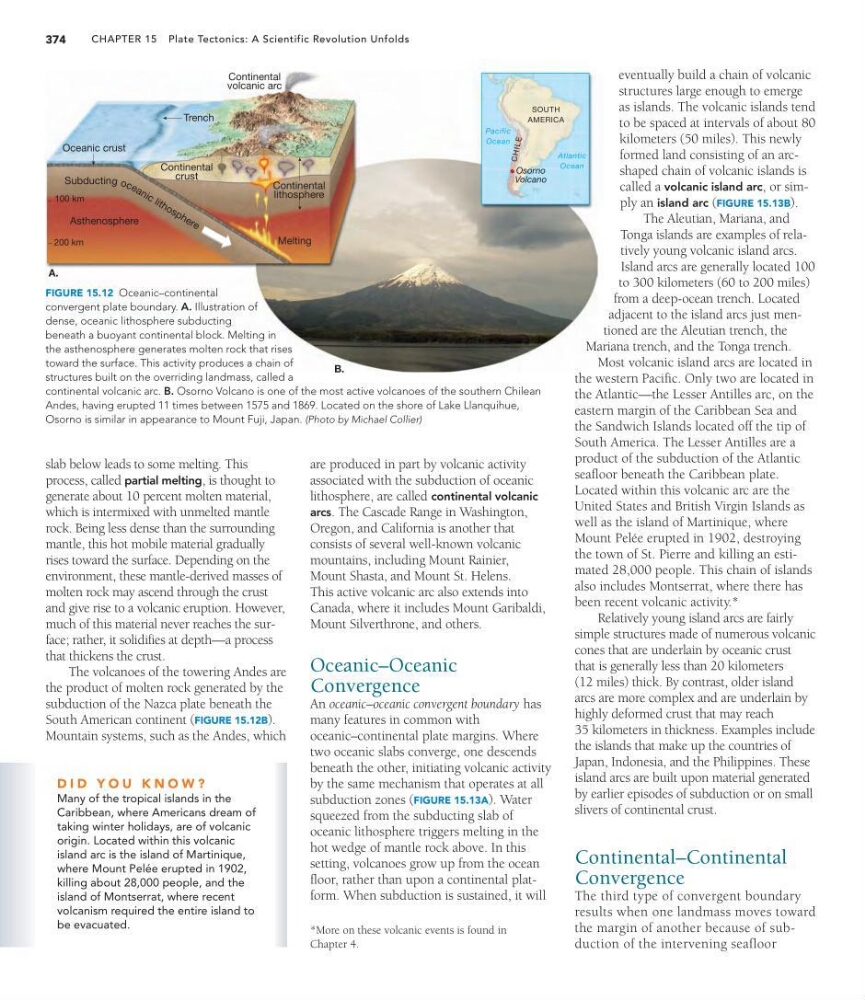
slab below leads to some melting. This
process, called partial melting, is thought to
generate about 10 percent molten material,
which is intermixed with unmelted mantle
rock. Being less dense than the surrounding
mantle, this hot mobile material gradually
rises toward the surface. Depending on the
environment, these mantle-derived masses of
molten rock may ascend through the crust
and give rise to a volcanic eruption. However,
much of this material never reaches the surface; rather, it solidifies at depth—a process
that thickens the crust.
The volcanoes of the towering Andes are
the product of molten rock generated by the
subduction of the Nazca plate beneath the
South American continent (FIGURE 15.12B).
Mountain systems, such as the Andes, which
are produced in part by volcanic activity
associated with the subduction of oceanic
lithosphere, are called continental volcanic
arcs. The Cascade Range in Washington,
Oregon, and California is another that
consists of several well-known volcanic
mountains, including Mount Rainier,
Mount Shasta, and Mount St. Helens.
This active volcanic arc also extends into
Canada, where it includes Mount Garibaldi,
Mount Silverthrone, and others.
Oceanic–Oceanic
Convergence
An oceanic–oceanic convergent boundary has
many features in common with
oceanic–continental plate margins. Where
two oceanic slabs converge, one descends
beneath the other, initiating volcanic activity
by the same mechanism that operates at all
subduction zones (FIGURE 15.13A). Water
squeezed from the subducting slab of
oceanic lithosphere triggers melting in the
hot wedge of mantle rock above. In this
setting, volcanoes grow up from the ocean
floor, rather than upon a continental platform. When subduction is sustained, it will
D I D Y O U K N O W ?
Many of the tropical islands in the
Caribbean, where Americans dream of
taking winter holidays, are of volcanic
origin. Located within this volcanic
island arc is the island of Martinique,
where Mount Pelée erupted in 1902,
killing about 28,000 people, and the
island of Montserrat, where recent
volcanism required the entire island to
be evacuated.
*More on these volcanic events is found in
Chapter 4.
FIGURE 15.12 Oceanic–continental
convergent plate boundary. A. Illustration of
dense, oceanic lithosphere subducting
beneath a buoyant continental block. Melting in
the asthenosphere generates molten rock that rises
toward the surface. This activity produces a chain of
structures built on the overriding landmass, called a
continental volcanic arc. B. Osorno Volcano is one of the most active volcanoes of the southern Chilean
Andes, having erupted 11 times between 1575 and 1869. Located on the shore of Lake Llanquihue,
Osorno is similar in appearance to Mount Fuji, Japan. (Photo by Michael Collier)
Trench
A.
B.
Continental
volcanic arc
Continental
crust
Osorno
Volcano
Asthenosphere
Continental
lithosphere
Melting
SOUTH
AMERICA
Atlantic
Ocean
Pacific
Ocean
C H IL E
100 km
200 km
Subducting o c e a n ic li t h o s p h e r e
eventually build a chain of volcanic
structures large enough to emerge
as islands. The volcanic islands tend
to be spaced at intervals of about 80
kilometers (50 miles). This newly
formed land consisting of an arcshaped chain of volcanic islands is
called a volcanic island arc, or simply an island arc (FIGURE 15.13B).
The Aleutian, Mariana, and
Tonga islands are examples of relatively young volcanic island arcs.
Island arcs are generally located 100
to 300 kilometers (60 to 200 miles)
from a deep-ocean trench. Located
adjacent to the island arcs just mentioned are the Aleutian trench, the
Mariana trench, and the Tonga trench.
Most volcanic island arcs are located in
the western Pacific. Only two are located in
the Atlantic—the Lesser Antilles arc, on the
eastern margin of the Caribbean Sea and
the Sandwich Islands located off the tip of
South America. The Lesser Antilles are a
product of the subduction of the Atlantic
seafloor beneath the Caribbean plate.
Located within this volcanic arc are the
United States and British Virgin Islands as
well as the island of Martinique, where
Mount Pelée erupted in 1902, destroying
the town of St. Pierre and killing an estimated 28,000 people. This chain of islands
also includes Montserrat, where there has
been recent volcanic activity.*
Relatively young island arcs are fairly
simple structures made of numerous volcanic
cones that are underlain by oceanic crust
that is generally less than 20 kilometers
(12 miles) thick. By contrast, older island
arcs are more complex and are underlain by
highly deformed crust that may reach
35 kilometers in thickness. Examples include
the islands that make up the countries of
Japan, Indonesia, and the Philippines. These
island arcs are built upon material generated
by earlier episodes of subduction or on small
slivers of continental crust.
Continental–Continental
Convergence
The third type of convergent boundary
results when one landmass moves toward
the margin of another because of subduction of the intervening seafloor
CHAPTER 15 Plate Tectonics: A Scientific Revolution Unfolds
374
slab below leads to some melting. This
process, called partial melting, is thought to
generate about 10 percent molten material,
which is intermixed with unmelted mantle
rock. Being less dense than the surrounding
mantle, this hot mobile material gradually
rises toward the surface. Depending on the
environment, these mantle-derived masses of
molten rock may ascend through the crust
and give rise to a volcanic eruption. However,
much of this material never reaches the surface; rather, it solidifies at depth—a process
that thickens the crust.
The volcanoes of the towering Andes are
the product of molten rock generated by the
subduction of the Nazca plate beneath the
South American continent (FIGURE 15.12B).
Mountain systems, such as the Andes, which
are produced in part by volcanic activity
associated with the subduction of oceanic
lithosphere, are called continental volcanic
arcs. The Cascade Range in Washington,
Oregon, and California is another that
consists of several well-known volcanic
mountains, including Mount Rainier,
Mount Shasta, and Mount St. Helens.
This active volcanic arc also extends into
Canada, where it includes Mount Garibaldi,
Mount Silverthrone, and others.
Oceanic–Oceanic
Convergence
An oceanic–oceanic convergent boundary has
many features in common with
oceanic–continental plate margins. Where
two oceanic slabs converge, one descends
beneath the other, initiating volcanic activity
by the same mechanism that operates at all
subduction zones (FIGURE 15.13A). Water
squeezed from the subducting slab of
oceanic lithosphere triggers melting in the
hot wedge of mantle rock above. In this
setting, volcanoes grow up from the ocean
floor, rather than upon a continental platform. When subduction is sustained, it will
D I D Y O U K N O W ?
Many of the tropical islands in the
Caribbean, where Americans dream of
taking winter holidays, are of volcanic
origin. Located within this volcanic
island arc is the island of Martinique,
where Mount Pelée erupted in 1902,
killing about 28,000 people, and the
island of Montserrat, where recent
volcanism required the entire island to
be evacuated.
*More on these volcanic events is found in
Chapter 4.
FIGURE 15.12 Oceanic–continental
convergent plate boundary. A. Illustration of
dense, oceanic lithosphere subducting
beneath a buoyant continental block. Melting in
the asthenosphere generates molten rock that rises
toward the surface. This activity produces a chain of
structures built on the overriding landmass, called a
continental volcanic arc. B. Osorno Volcano is one of the most active volcanoes of the southern Chilean
Andes, having erupted 11 times between 1575 and 1869. Located on the shore of Lake Llanquihue,
Osorno is similar in appearance to Mount Fuji, Japan. (Photo by Michael Collier)