

Alfred Wegener
A.
B.
Continental rift
Rift valley
Mid-ocean ridge
Oceanic crust
Continental
crust
C.
Linear sea
Upwelling
Upwelling
Upwelling
Upwelling
Con tin en ta l cr us t
Up warping
T
I
M
E
melting is triggered within the wedge of hot asthenosphere that lies
above it. But how does the subduction of a cool slab of oceanic
lithosphere cause mantle rock to melt? The answer lies in the fact
that water contained in the descending plates acts like salt does to
melt ice. That is, “wet” rock in a high-pressure environment
melts at substantially lower temperatures than does “dry” rock of
the same composition.
Sediments and oceanic crust contain a large amount of water,
which is carried to great depths by a subducting plate. As the plate
plunges downward, heat and pressure drive water from the voids in
the rock. At a depth of roughly 100 kilometers, the wedge of mantle
rock is sufficiently hot that the introduction of water from the
373
Convergent Boundaries
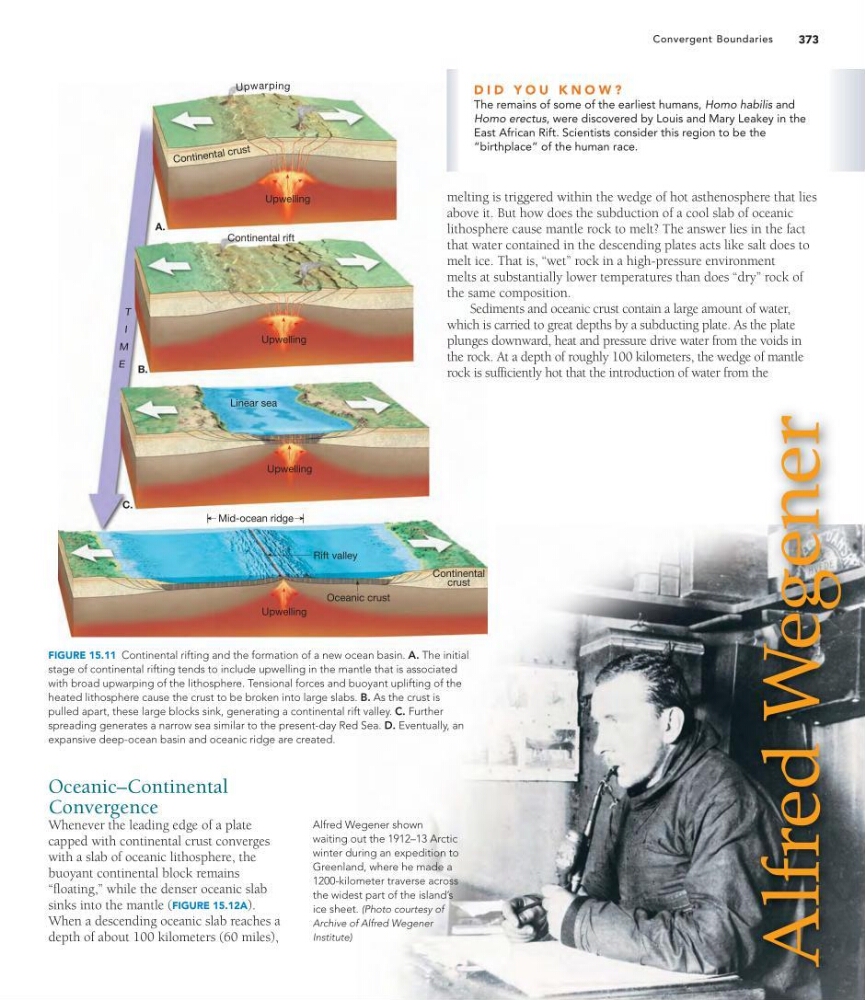
FIGURE 15.11 Continental rifting and the formation of a new ocean basin. A. The initial
stage of continental rifting tends to include upwelling in the mantle that is associated
with broad upwarping of the lithosphere. Tensional forces and buoyant uplifting of the
heated lithosphere cause the crust to be broken into large slabs. B. As the crust is
pulled apart, these large blocks sink, generating a continental rift valley. C. Further
spreading generates a narrow sea similar to the present-day Red Sea. D. Eventually, an
expansive deep-ocean basin and oceanic ridge are created.
Oceanic–Continental
Convergence
Whenever the leading edge of a plate
capped with continental crust converges
with a slab of oceanic lithosphere, the
buoyant continental block remains
“floating,” while the denser oceanic slab
sinks into the mantle (FIGURE 15.12A).
When a descending oceanic slab reaches a
depth of about 100 kilometers (60 miles),
D I D Y O U K N O W ?
The remains of some of the earliest humans, Homo habilis and
Homo erectus, were discovered by Louis and Mary Leakey in the
East African Rift. Scientists consider this region to be the
“birthplace” of the human race.
Alfred Wegener shown
waiting out the 1912–13 Arctic
winter during an expedition to
Greenland, where he made a
1200-kilometer traverse across
the widest part of the island’s
ice sheet. (Photo courtesy of
Archive of Alfred Wegener
Institute)
A.
B.
Continental rift
Rift valley
Mid-ocean ridge
Oceanic crust
Continental
crust
C.
Linear sea
Upwelling
Upwelling
Upwelling
Upwelling
Con tin en ta l cr us t
Up warping
T
I
M
E
melting is triggered within the wedge of hot asthenosphere that lies
above it. But how does the subduction of a cool slab of oceanic
lithosphere cause mantle rock to melt? The answer lies in the fact
that water contained in the descending plates acts like salt does to
melt ice. That is, “wet” rock in a high-pressure environment
melts at substantially lower temperatures than does “dry” rock of
the same composition.
Sediments and oceanic crust contain a large amount of water,
which is carried to great depths by a subducting plate. As the plate
plunges downward, heat and pressure drive water from the voids in
the rock. At a depth of roughly 100 kilometers, the wedge of mantle
rock is sufficiently hot that the introduction of water from the
373
Convergent Boundaries
FIGURE 15.11 Continental rifting and the formation of a new ocean basin. A. The initial
stage of continental rifting tends to include upwelling in the mantle that is associated
with broad upwarping of the lithosphere. Tensional forces and buoyant uplifting of the
heated lithosphere cause the crust to be broken into large slabs. B. As the crust is
pulled apart, these large blocks sink, generating a continental rift valley. C. Further
spreading generates a narrow sea similar to the present-day Red Sea. D. Eventually, an
expansive deep-ocean basin and oceanic ridge are created.
Oceanic–Continental
Convergence
Whenever the leading edge of a plate
capped with continental crust converges
with a slab of oceanic lithosphere, the
buoyant continental block remains
“floating,” while the denser oceanic slab
sinks into the mantle (FIGURE 15.12A).
When a descending oceanic slab reaches a
depth of about 100 kilometers (60 miles),
D I D Y O U K N O W ?
The remains of some of the earliest humans, Homo habilis and
Homo erectus, were discovered by Louis and Mary Leakey in the
East African Rift. Scientists consider this region to be the
“birthplace” of the human race.
Alfred Wegener shown
waiting out the 1912–13 Arctic
winter during an expedition to
Greenland, where he made a
1200-kilometer traverse across
the widest part of the island’s
ice sheet. (Photo courtesy of
Archive of Alfred Wegener
Institute)