

North
America
Africa
Europe
Partial
melting
L it h o s p h e re
A s th e n o s p h e re
Rift
valley
Spreading
center
Oceanic crust
Asthenosphere
M id - A t la n t i c
R
i d g e
Upwelling
CHAPTER 15 Plate Tectonics: A Scientific Revolution Unfolds
372
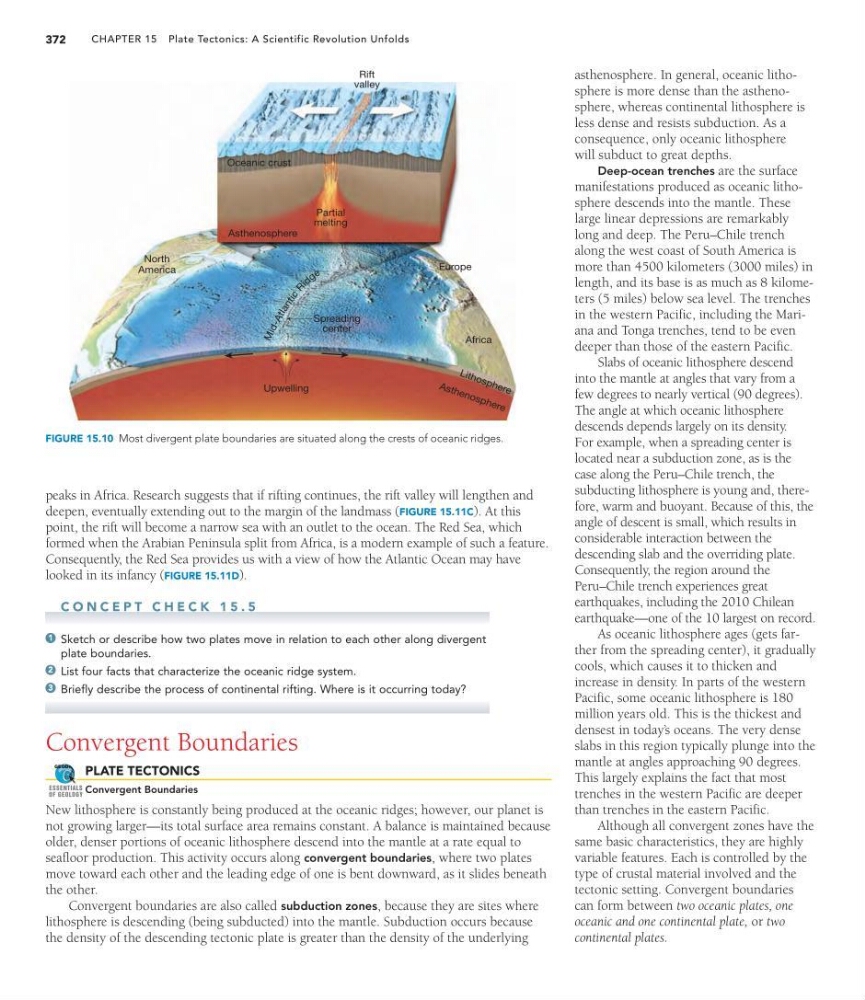
FIGURE 15.10 Most divergent plate boundaries are situated along the crests of oceanic ridges.
peaks in Africa. Research suggests that if rifting continues, the rift valley will lengthen and
deepen, eventually extending out to the margin of the landmass (FIGURE 15.11C). At this
point, the rift will become a narrow sea with an outlet to the ocean. The Red Sea, which
formed when the Arabian Peninsula split from Africa, is a modern example of such a feature.
Consequently, the Red Sea provides us with a view of how the Atlantic Ocean may have
looked in its infancy (FIGURE 15.11D).
C O N C E P T C H E C K 1 5 . 5
Sketch or describe how two plates move in relation to each other along divergent
plate boundaries.
List four facts that characterize the oceanic ridge system.
Briefly describe the process of continental rifting. Where is it occurring today?
Convergent Boundaries
PLATE TECTONICS
Convergent Boundaries
New lithosphere is constantly being produced at the oceanic ridges; however, our planet is
not growing larger—its total surface area remains constant. A balance is maintained because
older, denser portions of oceanic lithosphere descend into the mantle at a rate equal to
seafloor production. This activity occurs along convergent boundaries, where two plates
move toward each other and the leading edge of one is bent downward, as it slides beneath
the other.
Convergent boundaries are also called subduction zones, because they are sites where
lithosphere is descending (being subducted) into the mantle. Subduction occurs because
the density of the descending tectonic plate is greater than the density of the underlying
GEODe
ESSENTIALS
OF GEOLOGY
3
2
1
asthenosphere. In general, oceanic lithosphere is more dense than the asthenosphere, whereas continental lithosphere is
less dense and resists subduction. As a
consequence, only oceanic lithosphere
will subduct to great depths.
Deep-ocean trenches are the surface
manifestations produced as oceanic lithosphere descends into the mantle. These
large linear depressions are remarkably
long and deep. The Peru–Chile trench
along the west coast of South America is
more than 4500 kilometers (3000 miles) in
length, and its base is as much as 8 kilometers (5 miles) below sea level. The trenches
in the western Pacific, including the Mariana and Tonga trenches, tend to be even
deeper than those of the eastern Pacific.
Slabs of oceanic lithosphere descend
into the mantle at angles that vary from a
few degrees to nearly vertical (90 degrees).
The angle at which oceanic lithosphere
descends depends largely on its density.
For example, when a spreading center is
located near a subduction zone, as is the
case along the Peru–Chile trench, the
subducting lithosphere is young and, therefore, warm and buoyant. Because of this, the
angle of descent is small, which results in
considerable interaction between the
descending slab and the overriding plate.
Consequently, the region around the
Peru–Chile trench experiences great
earthquakes, including the 2010 Chilean
earthquake—one of the 10 largest on record.
As oceanic lithosphere ages (gets farther from the spreading center), it gradually
cools, which causes it to thicken and
increase in density. In parts of the western
Pacific, some oceanic lithosphere is 180
million years old. This is the thickest and
densest in today’ s oceans. The very dense
slabs in this region typically plunge into the
mantle at angles approaching 90 degrees.
This largely explains the fact that most
trenches in the western Pacific are deeper
than trenches in the eastern Pacific.
Although all convergent zones have the
same basic characteristics, they are highly
variable features. Each is controlled by the
type of crustal material involved and the
tectonic setting. Convergent boundaries
can form between two oceanic plates, one
oceanic and one continental plate, or two
continental plates.
America
Africa
Europe
Partial
melting
L it h o s p h e re
A s th e n o s p h e re
Rift
valley
Spreading
center
Oceanic crust
Asthenosphere
M id - A t la n t i c
R
i d g e
Upwelling
CHAPTER 15 Plate Tectonics: A Scientific Revolution Unfolds
372
FIGURE 15.10 Most divergent plate boundaries are situated along the crests of oceanic ridges.
peaks in Africa. Research suggests that if rifting continues, the rift valley will lengthen and
deepen, eventually extending out to the margin of the landmass (FIGURE 15.11C). At this
point, the rift will become a narrow sea with an outlet to the ocean. The Red Sea, which
formed when the Arabian Peninsula split from Africa, is a modern example of such a feature.
Consequently, the Red Sea provides us with a view of how the Atlantic Ocean may have
looked in its infancy (FIGURE 15.11D).
C O N C E P T C H E C K 1 5 . 5
Sketch or describe how two plates move in relation to each other along divergent
plate boundaries.
List four facts that characterize the oceanic ridge system.
Briefly describe the process of continental rifting. Where is it occurring today?
Convergent Boundaries
PLATE TECTONICS
Convergent Boundaries
New lithosphere is constantly being produced at the oceanic ridges; however, our planet is
not growing larger—its total surface area remains constant. A balance is maintained because
older, denser portions of oceanic lithosphere descend into the mantle at a rate equal to
seafloor production. This activity occurs along convergent boundaries, where two plates
move toward each other and the leading edge of one is bent downward, as it slides beneath
the other.
Convergent boundaries are also called subduction zones, because they are sites where
lithosphere is descending (being subducted) into the mantle. Subduction occurs because
the density of the descending tectonic plate is greater than the density of the underlying
GEODe
ESSENTIALS
OF GEOLOGY
3
2
1
asthenosphere. In general, oceanic lithosphere is more dense than the asthenosphere, whereas continental lithosphere is
less dense and resists subduction. As a
consequence, only oceanic lithosphere
will subduct to great depths.
Deep-ocean trenches are the surface
manifestations produced as oceanic lithosphere descends into the mantle. These
large linear depressions are remarkably
long and deep. The Peru–Chile trench
along the west coast of South America is
more than 4500 kilometers (3000 miles) in
length, and its base is as much as 8 kilometers (5 miles) below sea level. The trenches
in the western Pacific, including the Mariana and Tonga trenches, tend to be even
deeper than those of the eastern Pacific.
Slabs of oceanic lithosphere descend
into the mantle at angles that vary from a
few degrees to nearly vertical (90 degrees).
The angle at which oceanic lithosphere
descends depends largely on its density.
For example, when a spreading center is
located near a subduction zone, as is the
case along the Peru–Chile trench, the
subducting lithosphere is young and, therefore, warm and buoyant. Because of this, the
angle of descent is small, which results in
considerable interaction between the
descending slab and the overriding plate.
Consequently, the region around the
Peru–Chile trench experiences great
earthquakes, including the 2010 Chilean
earthquake—one of the 10 largest on record.
As oceanic lithosphere ages (gets farther from the spreading center), it gradually
cools, which causes it to thicken and
increase in density. In parts of the western
Pacific, some oceanic lithosphere is 180
million years old. This is the thickest and
densest in today’ s oceans. The very dense
slabs in this region typically plunge into the
mantle at angles approaching 90 degrees.
This largely explains the fact that most
trenches in the western Pacific are deeper
than trenches in the eastern Pacific.
Although all convergent zones have the
same basic characteristics, they are highly
variable features. Each is controlled by the
type of crustal material involved and the
tectonic setting. Convergent boundaries
can form between two oceanic plates, one
oceanic and one continental plate, or two
continental plates.