

367
The Great Debate
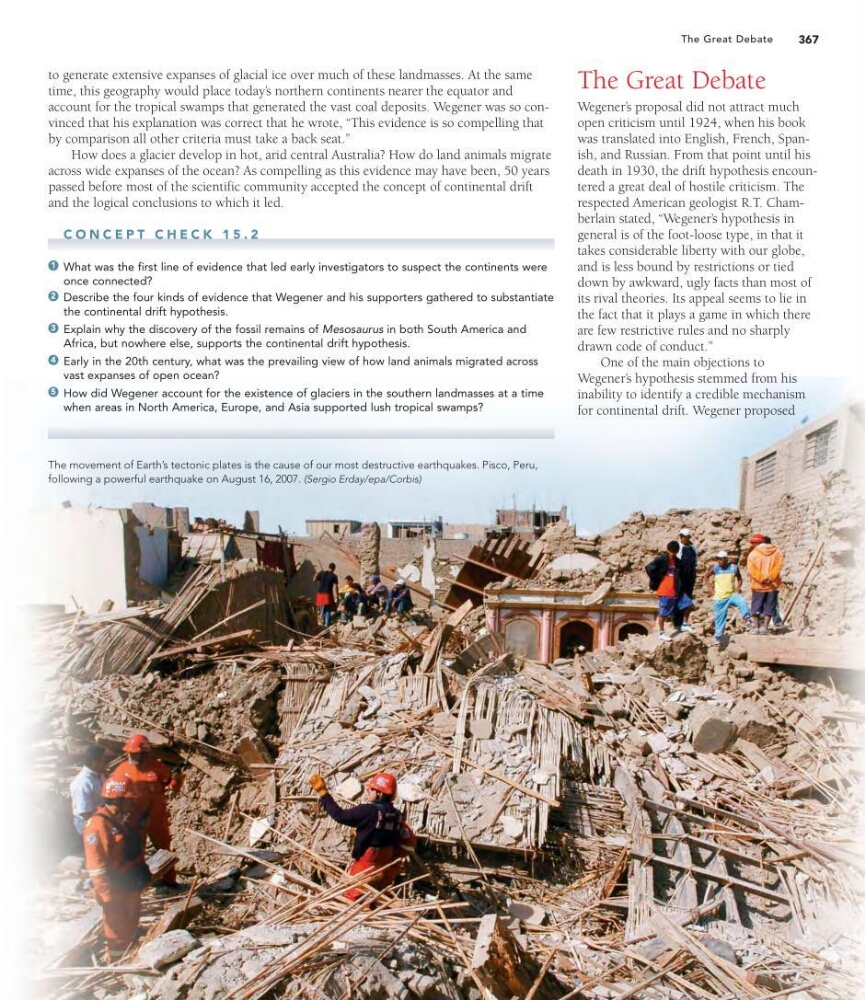
The movement of Earth’s tectonic plates is the cause of our most destructive earthquakes. Pisco, Peru,
following a powerful earthquake on August 16, 2007. (Sergio Erday/epa/Corbis)
to generate extensive expanses of glacial ice over much of these landmasses. At the same
time, this geography would place today’ s northern continents nearer the equator and
account for the tropical swamps that generated the vast coal deposits. Wegener was so convinced that his explanation was correct that he wrote, “This evidence is so compelling that
by comparison all other criteria must take a back seat.”
How does a glacier develop in hot, arid central Australia? How do land animals migrate
across wide expanses of the ocean? As compelling as this evidence may have been, 50 years
passed before most of the scientific community accepted the concept of continental drift
and the logical conclusions to which it led.
C O N C E P T C H E C K 1 5 . 2
What was the first line of evidence that led early investigators to suspect the continents were
once connected?
Describe the four kinds of evidence that Wegener and his supporters gathered to substantiate
the continental drift hypothesis.
Explain why the discovery of the fossil remains of Mesosaurus in both South America and
Africa, but nowhere else, supports the continental drift hypothesis.
Early in the 20th century, what was the prevailing view of how land animals migrated across
vast expanses of open ocean?
How did Wegener account for the existence of glaciers in the southern landmasses at a time
when areas in North America, Europe, and Asia supported lush tropical swamps?
5
4
3
2
1
The Great Debate
Wegener’ s proposal did not attract much
open criticism until 1924, when his book
was translated into English, French, Spanish, and Russian. From that point until his
death in 1930, the drift hypothesis encountered a great deal of hostile criticism. The
respected American geologist R.T. Chamberlain stated, “Wegener’ s hypothesis in
general is of the foot-loose type, in that it
takes considerable liberty with our globe,
and is less bound by restrictions or tied
down by awkward, ugly facts than most of
its rival theories. Its appeal seems to lie in
the fact that it plays a game in which there
are few restrictive rules and no sharply
drawn code of conduct.”
One of the main objections to
Wegener’ s hypothesis stemmed from his
inability to identify a credible mechanism
for continental drift. Wegener proposed
The Great Debate
The movement of Earth’s tectonic plates is the cause of our most destructive earthquakes. Pisco, Peru,
following a powerful earthquake on August 16, 2007. (Sergio Erday/epa/Corbis)
to generate extensive expanses of glacial ice over much of these landmasses. At the same
time, this geography would place today’ s northern continents nearer the equator and
account for the tropical swamps that generated the vast coal deposits. Wegener was so convinced that his explanation was correct that he wrote, “This evidence is so compelling that
by comparison all other criteria must take a back seat.”
How does a glacier develop in hot, arid central Australia? How do land animals migrate
across wide expanses of the ocean? As compelling as this evidence may have been, 50 years
passed before most of the scientific community accepted the concept of continental drift
and the logical conclusions to which it led.
C O N C E P T C H E C K 1 5 . 2
What was the first line of evidence that led early investigators to suspect the continents were
once connected?
Describe the four kinds of evidence that Wegener and his supporters gathered to substantiate
the continental drift hypothesis.
Explain why the discovery of the fossil remains of Mesosaurus in both South America and
Africa, but nowhere else, supports the continental drift hypothesis.
Early in the 20th century, what was the prevailing view of how land animals migrated across
vast expanses of open ocean?
How did Wegener account for the existence of glaciers in the southern landmasses at a time
when areas in North America, Europe, and Asia supported lush tropical swamps?
5
4
3
2
1
The Great Debate
Wegener’ s proposal did not attract much
open criticism until 1924, when his book
was translated into English, French, Spanish, and Russian. From that point until his
death in 1930, the drift hypothesis encountered a great deal of hostile criticism. The
respected American geologist R.T. Chamberlain stated, “Wegener’ s hypothesis in
general is of the foot-loose type, in that it
takes considerable liberty with our globe,
and is less bound by restrictions or tied
down by awkward, ugly facts than most of
its rival theories. Its appeal seems to lie in
the fact that it plays a game in which there
are few restrictive rules and no sharply
drawn code of conduct.”
One of the main objections to
Wegener’ s hypothesis stemmed from his
inability to identify a credible mechanism
for continental drift. Wegener proposed