

North
American
plate
South
American
plate
African
plate
Eurasian
plate
Eurasian
plate
Australian-Indian
plate
Pacific
plate
Philippine
plate
Antarctic plate
North
American plate
Nazca
plate
Antarctic
plate
Arabian
plate
Cocos
plate
Caribbean
plate
Scotia plate
CHAPTER 15 Plate Tectonics: A Scientific Revolution Unfolds
368
that gravitational forces of the
Moon and Sun that produce
Earth’ s tides were also capable of
gradually moving the continents
across the globe. However, the prominent physicist Harold Jeffreys correctly
countered that tidal forces of the
magnitude needed to displace the
continents would bring Earth’ s rotation
to a halt in a matter of a few years.
Wegener also incorrectly suggested that the larger and sturdier continents broke
through thinner oceanic crust, much like ice breakers cut through ice. However, no
evidence existed to suggest that the ocean floor was weak enough to permit passage of
the continents without the continents being appreciably deformed in the process.
In 1930 Wegener made his fourth and final trip to the Greenland ice sheet. Although
the primary focus of this expedition was to study the harsh winter polar climate on the
ice-covered island, Wegener continued to test his continental drift hypothesis. As in earlier
expeditions, he used astronomical methods in an attempt to verify that Greenland had
drifted westward with respect to Europe. While returning from Eismitte (an experimental
station located in the center of Greenland), Wegener perished along with a companion.
His intriguing idea, however, did not die.
What went wrong? Why was Wegener unable to overturn the established scientific
views of his day? Foremost was the fact that, although the central theme of Wegener’ s drift
hypothesis was correct, it contained some incorrect details. For example, continents do not
break through the ocean floor, and tidal energy is much too weak to cause continents to be
displaced. Moreover, in order for any comprehensive scientific theory to gain wide acceptance, it must stand up to critical testing from all areas of science. Wegener’ s great contribution to our understanding of Earth notwithstanding, not all of the evidence supported the
continental drift hypothesis as he had formulated it.
Although many of Wegener’ s contemporaries opposed his views, even to the point of
open ridicule, some considered his ideas plausible. For those geologists who continued the
search, the exciting concept of continents adrift held their interest. Others viewed continental drift as a solution to previously unexplainable observations. Nevertheless, most of the
scientific community, particularly in North America, either categorically rejected continental drift or at least treated it with considerable skepticism.
C O N C E P T C H E C K 1 5 . 3
To which two aspects of Wegener’s continental drift hypothesis did most Earth
scientists object?
Plate Tectonics
PLATE TECTONICS
Introduction
Following World War II, oceanographers
equipped with new marine tools and ample
funding from the U.S. Office of Naval
Research embarked on an unprecedented
period of oceanographic exploration. Over
the next two decades a much better picture
of large expanses of the seafloor slowly and
painstakingly began to emerge. From this
work came the discovery of a global
oceanic ridge system that winds through
all of the major oceans in a manner similar
to the seams on a baseball.
In other parts of the ocean, new
discoveries were also being made. Earthquake studies conducted in the western
Pacific demonstrated that tectonic
activity was occurring at great depths
beneath deep-ocean trenches. Of equal
importance was the fact that dredging of
the seafloor did not bring up any oceanic
crust that was older than 180 million years.
Further, sediment accumulations in the
deep-ocean basins were found to be thin,
not the thousands of meters that were
predicted.
By 1968, these developments, among
others, led to the unfolding of a far more
encompassing theory than continental
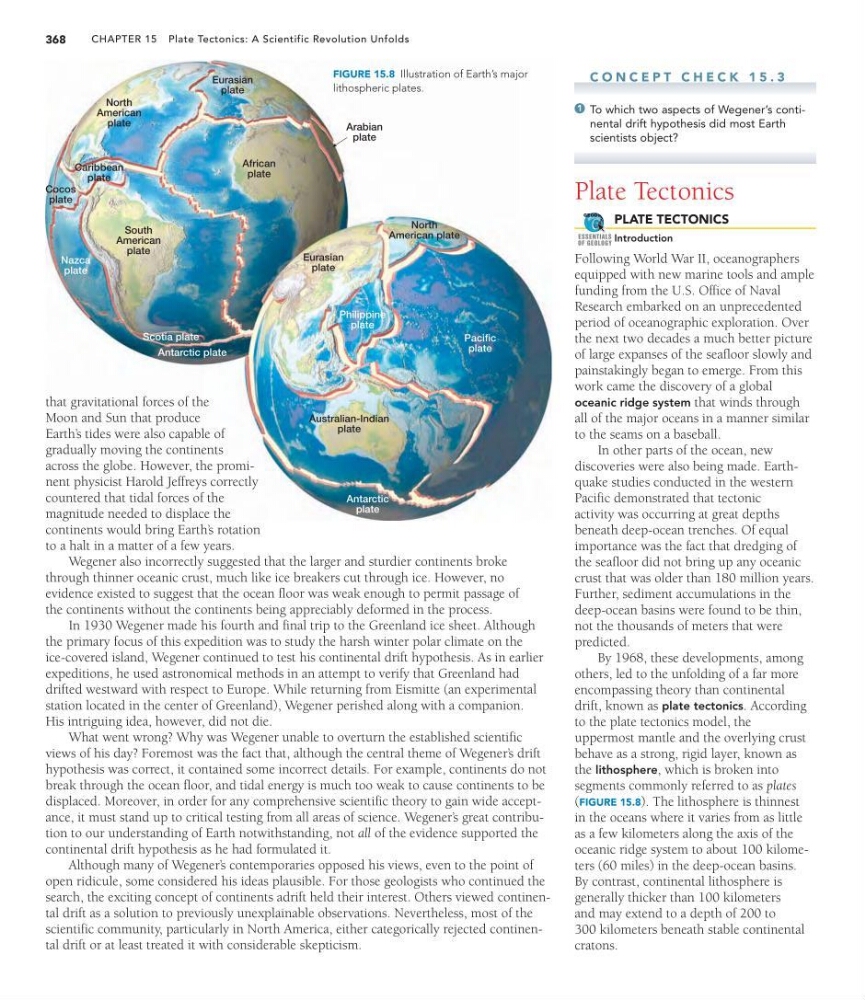
drift, known as plate tectonics. According
to the plate tectonics model, the
uppermost mantle and the overlying crust
behave as a strong, rigid layer, known as
the lithosphere, which is broken into
segments commonly referred to as plates
(FIGURE 15.8). The lithosphere is thinnest
in the oceans where it varies from as little
as a few kilometers along the axis of the
oceanic ridge system to about 100 kilometers (60 miles) in the deep-ocean basins.
By contrast, continental lithosphere is
generally thicker than 100 kilometers
and may extend to a depth of 200 to
300 kilometers beneath stable continental
cratons.
GEODe
ESSENTIALS
OF GEOLOGY
1
FIGURE 15.8 Illustration of Earth’s major
lithospheric plates.
American
plate
South
American
plate
African
plate
Eurasian
plate
Eurasian
plate
Australian-Indian
plate
Pacific
plate
Philippine
plate
Antarctic plate
North
American plate
Nazca
plate
Antarctic
plate
Arabian
plate
Cocos
plate
Caribbean
plate
Scotia plate
CHAPTER 15 Plate Tectonics: A Scientific Revolution Unfolds
368
that gravitational forces of the
Moon and Sun that produce
Earth’ s tides were also capable of
gradually moving the continents
across the globe. However, the prominent physicist Harold Jeffreys correctly
countered that tidal forces of the
magnitude needed to displace the
continents would bring Earth’ s rotation
to a halt in a matter of a few years.
Wegener also incorrectly suggested that the larger and sturdier continents broke
through thinner oceanic crust, much like ice breakers cut through ice. However, no
evidence existed to suggest that the ocean floor was weak enough to permit passage of
the continents without the continents being appreciably deformed in the process.
In 1930 Wegener made his fourth and final trip to the Greenland ice sheet. Although
the primary focus of this expedition was to study the harsh winter polar climate on the
ice-covered island, Wegener continued to test his continental drift hypothesis. As in earlier
expeditions, he used astronomical methods in an attempt to verify that Greenland had
drifted westward with respect to Europe. While returning from Eismitte (an experimental
station located in the center of Greenland), Wegener perished along with a companion.
His intriguing idea, however, did not die.
What went wrong? Why was Wegener unable to overturn the established scientific
views of his day? Foremost was the fact that, although the central theme of Wegener’ s drift
hypothesis was correct, it contained some incorrect details. For example, continents do not
break through the ocean floor, and tidal energy is much too weak to cause continents to be
displaced. Moreover, in order for any comprehensive scientific theory to gain wide acceptance, it must stand up to critical testing from all areas of science. Wegener’ s great contribution to our understanding of Earth notwithstanding, not all of the evidence supported the
continental drift hypothesis as he had formulated it.
Although many of Wegener’ s contemporaries opposed his views, even to the point of
open ridicule, some considered his ideas plausible. For those geologists who continued the
search, the exciting concept of continents adrift held their interest. Others viewed continental drift as a solution to previously unexplainable observations. Nevertheless, most of the
scientific community, particularly in North America, either categorically rejected continental drift or at least treated it with considerable skepticism.
C O N C E P T C H E C K 1 5 . 3
To which two aspects of Wegener’s continental drift hypothesis did most Earth
scientists object?
Plate Tectonics
PLATE TECTONICS
Introduction
Following World War II, oceanographers
equipped with new marine tools and ample
funding from the U.S. Office of Naval
Research embarked on an unprecedented
period of oceanographic exploration. Over
the next two decades a much better picture
of large expanses of the seafloor slowly and
painstakingly began to emerge. From this
work came the discovery of a global
oceanic ridge system that winds through
all of the major oceans in a manner similar
to the seams on a baseball.
In other parts of the ocean, new
discoveries were also being made. Earthquake studies conducted in the western
Pacific demonstrated that tectonic
activity was occurring at great depths
beneath deep-ocean trenches. Of equal
importance was the fact that dredging of
the seafloor did not bring up any oceanic
crust that was older than 180 million years.
Further, sediment accumulations in the
deep-ocean basins were found to be thin,
not the thousands of meters that were
predicted.
By 1968, these developments, among
others, led to the unfolding of a far more
encompassing theory than continental
drift, known as plate tectonics. According
to the plate tectonics model, the
uppermost mantle and the overlying crust
behave as a strong, rigid layer, known as
the lithosphere, which is broken into
segments commonly referred to as plates
(FIGURE 15.8). The lithosphere is thinnest
in the oceans where it varies from as little
as a few kilometers along the axis of the
oceanic ridge system to about 100 kilometers (60 miles) in the deep-ocean basins.
By contrast, continental lithosphere is
generally thicker than 100 kilometers
and may extend to a depth of 200 to
300 kilometers beneath stable continental
cratons.
GEODe
ESSENTIALS
OF GEOLOGY
1
FIGURE 15.8 Illustration of Earth’s major
lithospheric plates.