

Europe
Greenland
A.
B.
North
America
South
America
Appalachian
Mountains
Africa
Scandinavia
Caledonian
Mountains
British
Isles
North
America
Africa
South
America
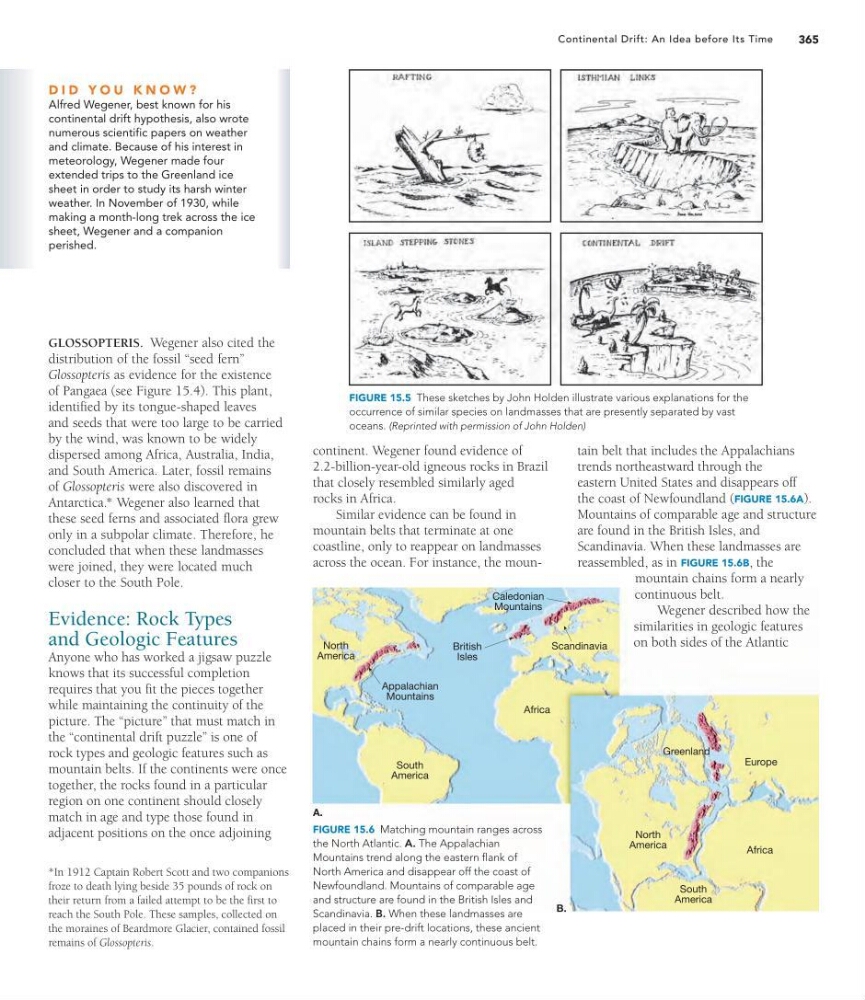
tain belt that includes the Appalachians
trends northeastward through the
eastern United States and disappears off
the coast of Newfoundland (FIGURE 15.6A).
Mountains of comparable age and structure
are found in the British Isles, and
Scandinavia. When these landmasses are
reassembled, as in FIGURE 15.6B, the
mountain chains form a nearly
continuous belt.
Wegener described how the
similarities in geologic features
on both sides of the Atlantic
365
Continental Drift: An Idea before Its Time
FIGURE 15.5 These sketches by John Holden illustrate various explanations for the
occurrence of similar species on landmasses that are presently separated by vast
oceans. (Reprinted with permission of John Holden)
D I D Y O U K N O W ?
Alfred Wegener, best known for his
continental drift hypothesis, also wrote
numerous scientific papers on weather
and climate. Because of his interest in
meteorology, Wegener made four
extended trips to the Greenland ice
sheet in order to study its harsh winter
weather. In November of 1930, while
making a month-long trek across the ice
sheet, Wegener and a companion
perished.
GLOSSOPTERIS. Wegener also cited the
distribution of the fossil “seed fern”
Glossopteris as evidence for the existence
of Pangaea (see Figure 15.4). This plant,
identified by its tongue-shaped leaves
and seeds that were too large to be carried
by the wind, was known to be widely
dispersed among Africa, Australia, India,
and South America. Later, fossil remains
of Glossopteris were also discovered in
Antarctica.* Wegener also learned that
these seed ferns and associated flora grew
only in a subpolar climate. Therefore, he
concluded that when these landmasses
were joined, they were located much
closer to the South Pole.
Evidence: Rock Types
and Geologic Features
Anyone who has worked a jigsaw puzzle
knows that its successful completion
requires that you fit the pieces together
while maintaining the continuity of the
picture. The “picture” that must match in
the “continental drift puzzle” is one of
rock types and geologic features such as
mountain belts. If the continents were once
together, the rocks found in a particular
region on one continent should closely
match in age and type those found in
adjacent positions on the once adjoining
continent. Wegener found evidence of
2.2-billion-year-old igneous rocks in Brazil
that closely resembled similarly aged
rocks in Africa.
Similar evidence can be found in
mountain belts that terminate at one
coastline, only to reappear on landmasses
across the ocean. For instance, the moun*In 1912 Captain Robert Scott and two companions
froze to death lying beside 35 pounds of rock on
their return from a failed attempt to be the first to
reach the South Pole. These samples, collected on
the moraines of Beardmore Glacier, contained fossil
remains of Glossopteris.
FIGURE 15.6 Matching mountain ranges across
the North Atlantic. A. The Appalachian
Mountains trend along the eastern flank of
North America and disappear off the coast of
Newfoundland. Mountains of comparable age
and structure are found in the British Isles and
Scandinavia. B. When these landmasses are
placed in their pre-drift locations, these ancient
mountain chains form a nearly continuous belt.
Greenland
A.
B.
North
America
South
America
Appalachian
Mountains
Africa
Scandinavia
Caledonian
Mountains
British
Isles
North
America
Africa
South
America
tain belt that includes the Appalachians
trends northeastward through the
eastern United States and disappears off
the coast of Newfoundland (FIGURE 15.6A).
Mountains of comparable age and structure
are found in the British Isles, and
Scandinavia. When these landmasses are
reassembled, as in FIGURE 15.6B, the
mountain chains form a nearly
continuous belt.
Wegener described how the
similarities in geologic features
on both sides of the Atlantic
365
Continental Drift: An Idea before Its Time
FIGURE 15.5 These sketches by John Holden illustrate various explanations for the
occurrence of similar species on landmasses that are presently separated by vast
oceans. (Reprinted with permission of John Holden)
D I D Y O U K N O W ?
Alfred Wegener, best known for his
continental drift hypothesis, also wrote
numerous scientific papers on weather
and climate. Because of his interest in
meteorology, Wegener made four
extended trips to the Greenland ice
sheet in order to study its harsh winter
weather. In November of 1930, while
making a month-long trek across the ice
sheet, Wegener and a companion
perished.
GLOSSOPTERIS. Wegener also cited the
distribution of the fossil “seed fern”
Glossopteris as evidence for the existence
of Pangaea (see Figure 15.4). This plant,
identified by its tongue-shaped leaves
and seeds that were too large to be carried
by the wind, was known to be widely
dispersed among Africa, Australia, India,
and South America. Later, fossil remains
of Glossopteris were also discovered in
Antarctica.* Wegener also learned that
these seed ferns and associated flora grew
only in a subpolar climate. Therefore, he
concluded that when these landmasses
were joined, they were located much
closer to the South Pole.
Evidence: Rock Types
and Geologic Features
Anyone who has worked a jigsaw puzzle
knows that its successful completion
requires that you fit the pieces together
while maintaining the continuity of the
picture. The “picture” that must match in
the “continental drift puzzle” is one of
rock types and geologic features such as
mountain belts. If the continents were once
together, the rocks found in a particular
region on one continent should closely
match in age and type those found in
adjacent positions on the once adjoining
continent. Wegener found evidence of
2.2-billion-year-old igneous rocks in Brazil
that closely resembled similarly aged
rocks in Africa.
Similar evidence can be found in
mountain belts that terminate at one
coastline, only to reappear on landmasses
across the ocean. For instance, the moun*In 1912 Captain Robert Scott and two companions
froze to death lying beside 35 pounds of rock on
their return from a failed attempt to be the first to
reach the South Pole. These samples, collected on
the moraines of Beardmore Glacier, contained fossil
remains of Glossopteris.
FIGURE 15.6 Matching mountain ranges across
the North Atlantic. A. The Appalachian
Mountains trend along the eastern flank of
North America and disappear off the coast of
Newfoundland. Mountains of comparable age
and structure are found in the British Isles and
Scandinavia. B. When these landmasses are
placed in their pre-drift locations, these ancient
mountain chains form a nearly continuous belt.