

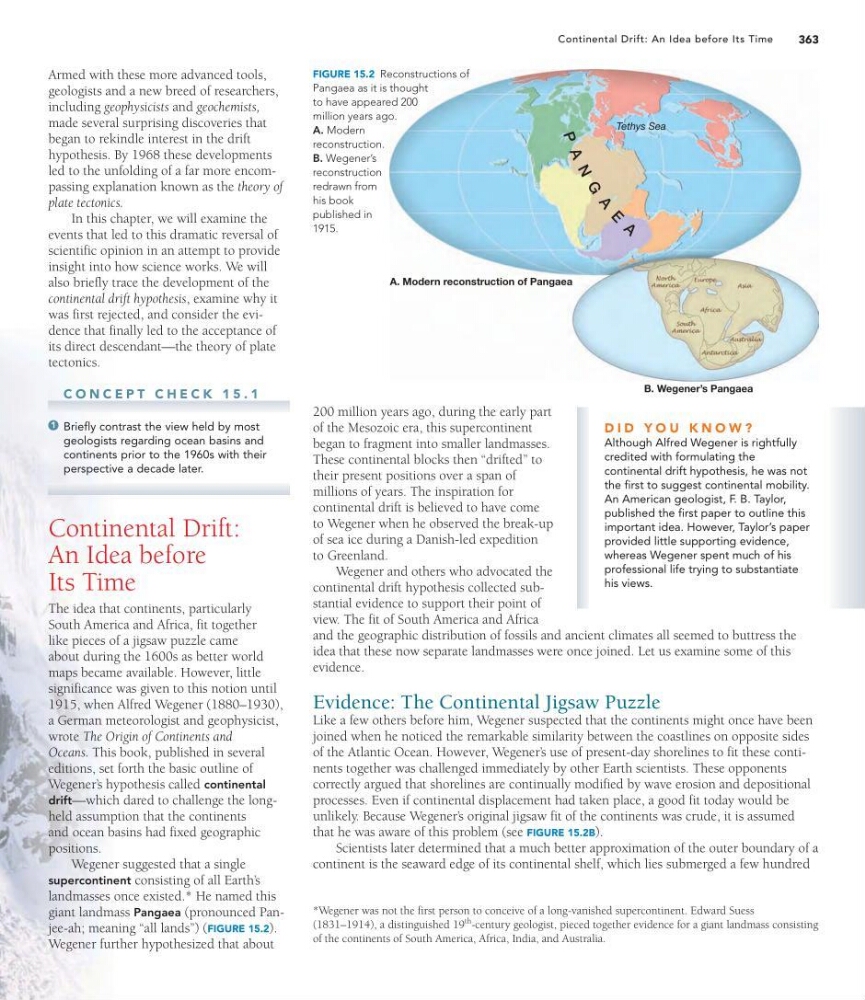
Tethys Sea
P A
N
G
A
E
A
A. Modern reconstruction of Pangaea
B. Wegener’s Pangaea
200 million years ago, during the early part
of the Mesozoic era, this supercontinent
began to fragment into smaller landmasses.
These continental blocks then “drifted” to
their present positions over a span of
millions of years. The inspiration for
continental drift is believed to have come
to Wegener when he observed the break-up
of sea ice during a Danish-led expedition
to Greenland.
Wegener and others who advocated the
continental drift hypothesis collected substantial evidence to support their point of
view. The fit of South America and Africa
and the geographic distribution of fossils and ancient climates all seemed to buttress the
idea that these now separate landmasses were once joined. Let us examine some of this
evidence.
Evidence: The Continental Jigsaw Puzzle
Like a few others before him, Wegener suspected that the continents might once have been
joined when he noticed the remarkable similarity between the coastlines on opposite sides
of the Atlantic Ocean. However, Wegener’ s use of present-day shorelines to fit these continents together was challenged immediately by other Earth scientists. These opponents
correctly argued that shorelines are continually modified by wave erosion and depositional
processes. Even if continental displacement had taken place, a good fit today would be
unlikely. Because Wegener’ s original jigsaw fit of the continents was crude, it is assumed
that he was aware of this problem (see FIGURE 15.2B).
Scientists later determined that a much better approximation of the outer boundary of a
continent is the seaward edge of its continental shelf, which lies submerged a few hundred
363
Continental Drift: An Idea before Its Time
*Wegener was not the first person to conceive of a long-vanished supercontinent. Edward Suess
(1831–1914), a distinguished 19
th -century geologist, pieced together evidence for a giant landmass consisting
of the continents of South America, Africa, India, and Australia.
Armed with these more advanced tools,
geologists and a new breed of researchers,
including geophysicists and geochemists,
made several surprising discoveries that
began to rekindle interest in the drift
hypothesis. By 1968 these developments
led to the unfolding of a far more encompassing explanation known as the theory of
plate tectonics.
In this chapter, we will examine the
events that led to this dramatic reversal of
scientific opinion in an attempt to provide
insight into how science works. We will
also briefly trace the development of the
continental drift hypothesis, examine why it
was first rejected, and consider the evidence that finally led to the acceptance of
its direct descendant—the theory of plate
tectonics.
C O N C E P T C H E C K 1 5 . 1
Briefly contrast the view held by most
geologists regarding ocean basins and
continents prior to the 1960s with their
perspective a decade later.
Continental Drift:
An Idea before
Its Time
The idea that continents, particularly
South America and Africa, fit together
like pieces of a jigsaw puzzle came
about during the 1600s as better world
maps became available. However, little
significance was given to this notion until
1915, when Alfred Wegener (1880–1930),
a German meteorologist and geophysicist,
wrote The Origin of Continents and
Oceans. This book, published in several
editions, set forth the basic outline of
Wegener’ s hypothesis called continental
drift—which dared to challenge the longheld assumption that the continents
and ocean basins had fixed geographic
positions.
Wegener suggested that a single
supercontinent consisting of all Earth’ s
landmasses once existed.* He named this
giant landmass Pangaea (pronounced Panjee-ah; meaning “all lands”) (FIGURE 15.2).
Wegener further hypothesized that about
1
FIGURE 15.2 Reconstructions of
Pangaea as it is thought
to have appeared 200
million years ago.
A. Modern
reconstruction.
B. Wegener’s
reconstruction
redrawn from
his book
published in
1915.
D I D Y O U K N O W ?
Although Alfred Wegener is rightfully
credited with formulating the
continental drift hypothesis, he was not
the first to suggest continental mobility.
An American geologist, F. B. Taylor,
published the first paper to outline this
important idea. However, Taylor’s paper
provided little supporting evidence,
whereas Wegener spent much of his
professional life trying to substantiate
his views.
P A
N
G
A
E
A
A. Modern reconstruction of Pangaea
B. Wegener’s Pangaea
200 million years ago, during the early part
of the Mesozoic era, this supercontinent
began to fragment into smaller landmasses.
These continental blocks then “drifted” to
their present positions over a span of
millions of years. The inspiration for
continental drift is believed to have come
to Wegener when he observed the break-up
of sea ice during a Danish-led expedition
to Greenland.
Wegener and others who advocated the
continental drift hypothesis collected substantial evidence to support their point of
view. The fit of South America and Africa
and the geographic distribution of fossils and ancient climates all seemed to buttress the
idea that these now separate landmasses were once joined. Let us examine some of this
evidence.
Evidence: The Continental Jigsaw Puzzle
Like a few others before him, Wegener suspected that the continents might once have been
joined when he noticed the remarkable similarity between the coastlines on opposite sides
of the Atlantic Ocean. However, Wegener’ s use of present-day shorelines to fit these continents together was challenged immediately by other Earth scientists. These opponents
correctly argued that shorelines are continually modified by wave erosion and depositional
processes. Even if continental displacement had taken place, a good fit today would be
unlikely. Because Wegener’ s original jigsaw fit of the continents was crude, it is assumed
that he was aware of this problem (see FIGURE 15.2B).
Scientists later determined that a much better approximation of the outer boundary of a
continent is the seaward edge of its continental shelf, which lies submerged a few hundred
363
Continental Drift: An Idea before Its Time
*Wegener was not the first person to conceive of a long-vanished supercontinent. Edward Suess
(1831–1914), a distinguished 19
th -century geologist, pieced together evidence for a giant landmass consisting
of the continents of South America, Africa, India, and Australia.
Armed with these more advanced tools,
geologists and a new breed of researchers,
including geophysicists and geochemists,
made several surprising discoveries that
began to rekindle interest in the drift
hypothesis. By 1968 these developments
led to the unfolding of a far more encompassing explanation known as the theory of
plate tectonics.
In this chapter, we will examine the
events that led to this dramatic reversal of
scientific opinion in an attempt to provide
insight into how science works. We will
also briefly trace the development of the
continental drift hypothesis, examine why it
was first rejected, and consider the evidence that finally led to the acceptance of
its direct descendant—the theory of plate
tectonics.
C O N C E P T C H E C K 1 5 . 1
Briefly contrast the view held by most
geologists regarding ocean basins and
continents prior to the 1960s with their
perspective a decade later.
Continental Drift:
An Idea before
Its Time
The idea that continents, particularly
South America and Africa, fit together
like pieces of a jigsaw puzzle came
about during the 1600s as better world
maps became available. However, little
significance was given to this notion until
1915, when Alfred Wegener (1880–1930),
a German meteorologist and geophysicist,
wrote The Origin of Continents and
Oceans. This book, published in several
editions, set forth the basic outline of
Wegener’ s hypothesis called continental
drift—which dared to challenge the longheld assumption that the continents
and ocean basins had fixed geographic
positions.
Wegener suggested that a single
supercontinent consisting of all Earth’ s
landmasses once existed.* He named this
giant landmass Pangaea (pronounced Panjee-ah; meaning “all lands”) (FIGURE 15.2).
Wegener further hypothesized that about
1
FIGURE 15.2 Reconstructions of
Pangaea as it is thought
to have appeared 200
million years ago.
A. Modern
reconstruction.
B. Wegener’s
reconstruction
redrawn from
his book
published in
1915.
D I D Y O U K N O W ?
Although Alfred Wegener is rightfully
credited with formulating the
continental drift hypothesis, he was not
the first to suggest continental mobility.
An American geologist, F. B. Taylor,
published the first paper to outline this
important idea. However, Taylor’s paper
provided little supporting evidence,
whereas Wegener spent much of his
professional life trying to substantiate
his views.