

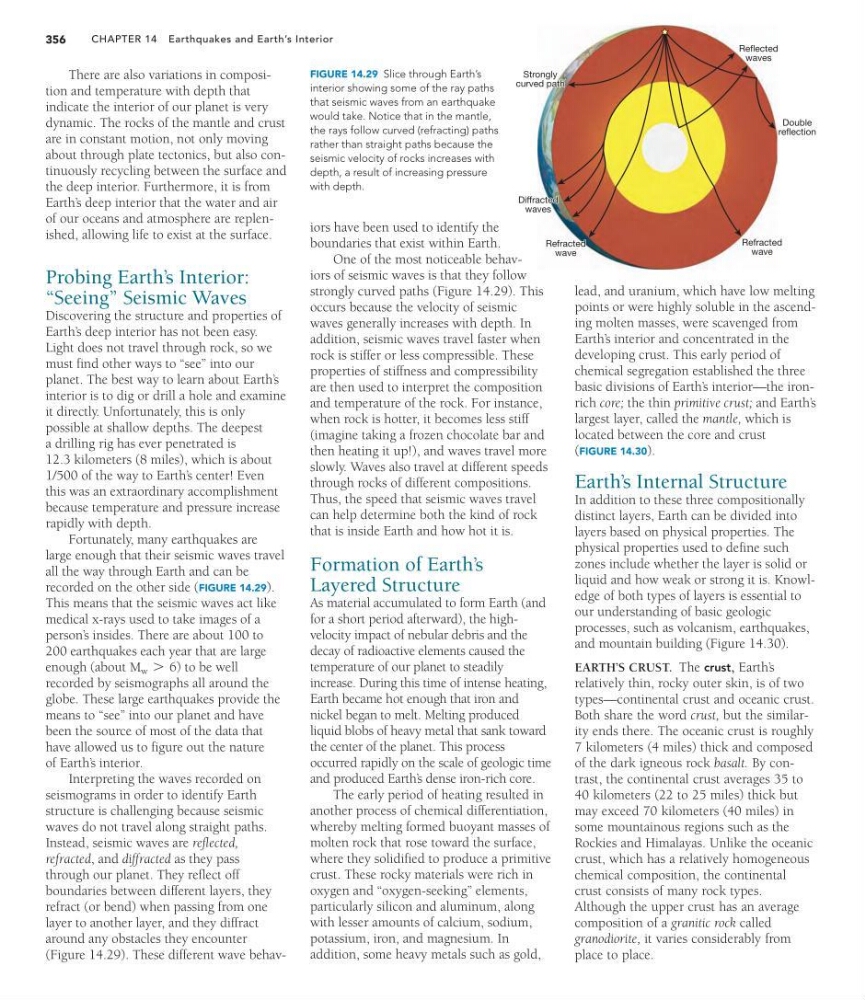
FIGURE 14.29 Slice through Earth’s
interior showing some of the ray paths
that seismic waves from an earthquake
would take. Notice that in the mantle,
the rays follow curved (refracting) paths
rather than straight paths because the
seismic velocity of rocks increases with
depth, a result of increasing pressure
with depth.
CHAPTER 14 Earthquakes and Earth’s Interior
356
There are also variations in composition and temperature with depth that
indicate the interior of our planet is very
dynamic. The rocks of the mantle and crust
are in constant motion, not only moving
about through plate tectonics, but also continuously recycling between the surface and
the deep interior. Furthermore, it is from
Earth’ s deep interior that the water and air
of our oceans and atmosphere are replenished, allowing life to exist at the surface.
Probing Earth’ s Interior:
“Seeing” Seismic Waves
Discovering the structure and properties of
Earth’ s deep interior has not been easy.
Light does not travel through rock, so we
must find other ways to “see” into our
planet. The best way to learn about Earth’ s
interior is to dig or drill a hole and examine
it directly. Unfortunately, this is only
possible at shallow depths. The deepest
a drilling rig has ever penetrated is
12.3 kilometers (8 miles), which is about
1/500 of the way to Earth’ s center! Even
this was an extraordinary accomplishment
because temperature and pressure increase
rapidly with depth.
Fortunately, many earthquakes are
large enough that their seismic waves travel
all the way through Earth and can be
recorded on the other side (FIGURE 14.29).
This means that the seismic waves act like
medical x-rays used to take images of a
person’ s insides. There are about 100 to
200 earthquakes each year that are large
enough (about
) to be well
recorded by seismographs all around the
globe. These large earthquakes provide the
means to “see” into our planet and have
been the source of most of the data that
have allowed us to figure out the nature
of Earth’ s interior.
Interpreting the waves recorded on
seismograms in order to identify Earth
structure is challenging because seismic
waves do not travel along straight paths.
Instead, seismic waves are reflected,
refracted, and diffracted as they pass
through our planet. They reflect off
boundaries between different layers, they
refract (or bend) when passing from one
layer to another layer, and they diffract
around any obstacles they encounter
(Figure 14.29). These different wave behavM w 7 6
iors have been used to identify the
boundaries that exist within Earth.
One of the most noticeable behaviors of seismic waves is that they follow
strongly curved paths (Figure 14.29). This
occurs because the velocity of seismic
waves generally increases with depth. In
addition, seismic waves travel faster when
rock is stiffer or less compressible. These
properties of stiffness and compressibility
are then used to interpret the composition
and temperature of the rock. For instance,
when rock is hotter, it becomes less stiff
(imagine taking a frozen chocolate bar and
then heating it up!), and waves travel more
slowly. Waves also travel at different speeds
through rocks of different compositions.
Thus, the speed that seismic waves travel
can help determine both the kind of rock
that is inside Earth and how hot it is.
Formation of Earth’ s
Layered Structure
As material accumulated to form Earth (and
for a short period afterward), the highvelocity impact of nebular debris and the
decay of radioactive elements caused the
temperature of our planet to steadily
increase. During this time of intense heating,
Earth became hot enough that iron and
nickel began to melt. Melting produced
liquid blobs of heavy metal that sank toward
the center of the planet. This process
occurred rapidly on the scale of geologic time
and produced Earth’ s dense iron-rich core.
The early period of heating resulted in
another process of chemical differentiation,
whereby melting formed buoyant masses of
molten rock that rose toward the surface,
where they solidified to produce a primitive
crust. These rocky materials were rich in
oxygen and “oxygen-seeking” elements,
particularly silicon and aluminum, along
with lesser amounts of calcium, sodium,
potassium, iron, and magnesium. In
addition, some heavy metals such as gold,
Reflected
waves
Refracted
wave
Refracted Refracted
wave wave
Diffracted Diffracted
waves waves
Strongly Strongly
curved path
curved path
Refracted
wave
Diffracted
waves
Strongly
curved path
Double
reflection
lead, and uranium, which have low melting
points or were highly soluble in the ascending molten masses, were scavenged from
Earth’ s interior and concentrated in the
developing crust. This early period of
chemical segregation established the three
basic divisions of Earth’ s interior—the ironrich core; the thin primitive crust; and Earth’ s
largest layer, called the mantle, which is
located between the core and crust
(FIGURE 14.30).
Earth’ s Internal Structure
In addition to these three compositionally
distinct layers, Earth can be divided into
layers based on physical properties. The
physical properties used to define such
zones include whether the layer is solid or
liquid and how weak or strong it is. Knowledge of both types of layers is essential to
our understanding of basic geologic
processes, such as volcanism, earthquakes,
and mountain building (Figure 14.30).
EARTH’S CRUST. The crust, Earth’ s
relatively thin, rocky outer skin, is of two
types—continental crust and oceanic crust.
Both share the word crust, but the similarity ends there. The oceanic crust is roughly
7 kilometers (4 miles) thick and composed
of the dark igneous rock basalt. By contrast, the continental crust averages 35 to
40 kilometers (22 to 25 miles) thick but
may exceed 70 kilometers (40 miles) in
some mountainous regions such as the
Rockies and Himalayas. Unlike the oceanic
crust, which has a relatively homogeneous
chemical composition, the continental
crust consists of many rock types.
Although the upper crust has an average
composition of a granitic rock called
granodiorite, it varies considerably from
place to place.
interior showing some of the ray paths
that seismic waves from an earthquake
would take. Notice that in the mantle,
the rays follow curved (refracting) paths
rather than straight paths because the
seismic velocity of rocks increases with
depth, a result of increasing pressure
with depth.
CHAPTER 14 Earthquakes and Earth’s Interior
356
There are also variations in composition and temperature with depth that
indicate the interior of our planet is very
dynamic. The rocks of the mantle and crust
are in constant motion, not only moving
about through plate tectonics, but also continuously recycling between the surface and
the deep interior. Furthermore, it is from
Earth’ s deep interior that the water and air
of our oceans and atmosphere are replenished, allowing life to exist at the surface.
Probing Earth’ s Interior:
“Seeing” Seismic Waves
Discovering the structure and properties of
Earth’ s deep interior has not been easy.
Light does not travel through rock, so we
must find other ways to “see” into our
planet. The best way to learn about Earth’ s
interior is to dig or drill a hole and examine
it directly. Unfortunately, this is only
possible at shallow depths. The deepest
a drilling rig has ever penetrated is
12.3 kilometers (8 miles), which is about
1/500 of the way to Earth’ s center! Even
this was an extraordinary accomplishment
because temperature and pressure increase
rapidly with depth.
Fortunately, many earthquakes are
large enough that their seismic waves travel
all the way through Earth and can be
recorded on the other side (FIGURE 14.29).
This means that the seismic waves act like
medical x-rays used to take images of a
person’ s insides. There are about 100 to
200 earthquakes each year that are large
enough (about
) to be well
recorded by seismographs all around the
globe. These large earthquakes provide the
means to “see” into our planet and have
been the source of most of the data that
have allowed us to figure out the nature
of Earth’ s interior.
Interpreting the waves recorded on
seismograms in order to identify Earth
structure is challenging because seismic
waves do not travel along straight paths.
Instead, seismic waves are reflected,
refracted, and diffracted as they pass
through our planet. They reflect off
boundaries between different layers, they
refract (or bend) when passing from one
layer to another layer, and they diffract
around any obstacles they encounter
(Figure 14.29). These different wave behavM w 7 6
iors have been used to identify the
boundaries that exist within Earth.
One of the most noticeable behaviors of seismic waves is that they follow
strongly curved paths (Figure 14.29). This
occurs because the velocity of seismic
waves generally increases with depth. In
addition, seismic waves travel faster when
rock is stiffer or less compressible. These
properties of stiffness and compressibility
are then used to interpret the composition
and temperature of the rock. For instance,
when rock is hotter, it becomes less stiff
(imagine taking a frozen chocolate bar and
then heating it up!), and waves travel more
slowly. Waves also travel at different speeds
through rocks of different compositions.
Thus, the speed that seismic waves travel
can help determine both the kind of rock
that is inside Earth and how hot it is.
Formation of Earth’ s
Layered Structure
As material accumulated to form Earth (and
for a short period afterward), the highvelocity impact of nebular debris and the
decay of radioactive elements caused the
temperature of our planet to steadily
increase. During this time of intense heating,
Earth became hot enough that iron and
nickel began to melt. Melting produced
liquid blobs of heavy metal that sank toward
the center of the planet. This process
occurred rapidly on the scale of geologic time
and produced Earth’ s dense iron-rich core.
The early period of heating resulted in
another process of chemical differentiation,
whereby melting formed buoyant masses of
molten rock that rose toward the surface,
where they solidified to produce a primitive
crust. These rocky materials were rich in
oxygen and “oxygen-seeking” elements,
particularly silicon and aluminum, along
with lesser amounts of calcium, sodium,
potassium, iron, and magnesium. In
addition, some heavy metals such as gold,
Reflected
waves
Refracted
wave
Refracted Refracted
wave wave
Diffracted Diffracted
waves waves
Strongly Strongly
curved path
curved path
Refracted
wave
Diffracted
waves
Strongly
curved path
Double
reflection
lead, and uranium, which have low melting
points or were highly soluble in the ascending molten masses, were scavenged from
Earth’ s interior and concentrated in the
developing crust. This early period of
chemical segregation established the three
basic divisions of Earth’ s interior—the ironrich core; the thin primitive crust; and Earth’ s
largest layer, called the mantle, which is
located between the core and crust
(FIGURE 14.30).
Earth’ s Internal Structure
In addition to these three compositionally
distinct layers, Earth can be divided into
layers based on physical properties. The
physical properties used to define such
zones include whether the layer is solid or
liquid and how weak or strong it is. Knowledge of both types of layers is essential to
our understanding of basic geologic
processes, such as volcanism, earthquakes,
and mountain building (Figure 14.30).
EARTH’S CRUST. The crust, Earth’ s
relatively thin, rocky outer skin, is of two
types—continental crust and oceanic crust.
Both share the word crust, but the similarity ends there. The oceanic crust is roughly
7 kilometers (4 miles) thick and composed
of the dark igneous rock basalt. By contrast, the continental crust averages 35 to
40 kilometers (22 to 25 miles) thick but
may exceed 70 kilometers (40 miles) in
some mountainous regions such as the
Rockies and Himalayas. Unlike the oceanic
crust, which has a relatively homogeneous
chemical composition, the continental
crust consists of many rock types.
Although the upper crust has an average
composition of a granitic rock called
granodiorite, it varies considerably from
place to place.