

CHAPTER 14 Earthquakes and Earth’s Interior
352
Damaging Earthquakes East
of the Rockies
When you think “earthquake,” you probably think of California
and Japan. However, six major earthquakes have occurred in the
central and eastern United States since colonial times. Three of
these had estimated Richter magnitudes of 7.5, 7.3, and 7.8, and
they were centered near the Mississippi River valley in southeastern
Missouri. Occurring on December 16, 1811; January 23, 1812; and
February 7, 1812, these earthquakes, plus numerous smaller
tremors, destroyed the town of New Madrid, Missouri, triggered
massive landslides, and caused damage over a six-state area. The
course of the Mississippi River was altered, and Tennessee’ s
Reelfoot Lake was enlarged. The distances over which these earthquakes were felt are truly remarkable. Chimneys were reported
downed in Cincinnati, Ohio, and Richmond, Virginia, while
Boston residents, located 1770 kilometers (1100 miles) to the
northeast, felt the tremor.
Despite the history of the New Madrid earthquake, Memphis,
Tennessee, the largest population center in the area, does not have
adequate earthquake provisions in its building code. Further,
because Memphis is located on unconsolidated floodplain deposits,
buildings are more susceptible to damage than are similar structures
built on bedrock. It has been estimated that if an earthquake the
size of the 1811–1812 New Madrid event were to strike in the next
decade, it would result in casualties in the thousands and damages
in tens of billions of dollars. Damaging earthquakes that occurred in
Aurora, Illinois (1909), and Valentine, Texas (1931), remind us that
other areas in the central United States are vulnerable.
The greatest historical earthquake in the eastern states
occurred on August 31, 1886, in Charleston, South Carolina. The
event, which spanned 1 minute, caused 60 deaths, numerous
injuries, and great economic loss within a radius of 200 kilometers
(120 miles) of Charleston. Within 8 minutes, effects were felt as far
away as Chicago and St. Louis, where strong vibrations shook the
upper floors of buildings, causing people to rush outdoors. In
Charleston alone, more than 100 buildings were destroyed and
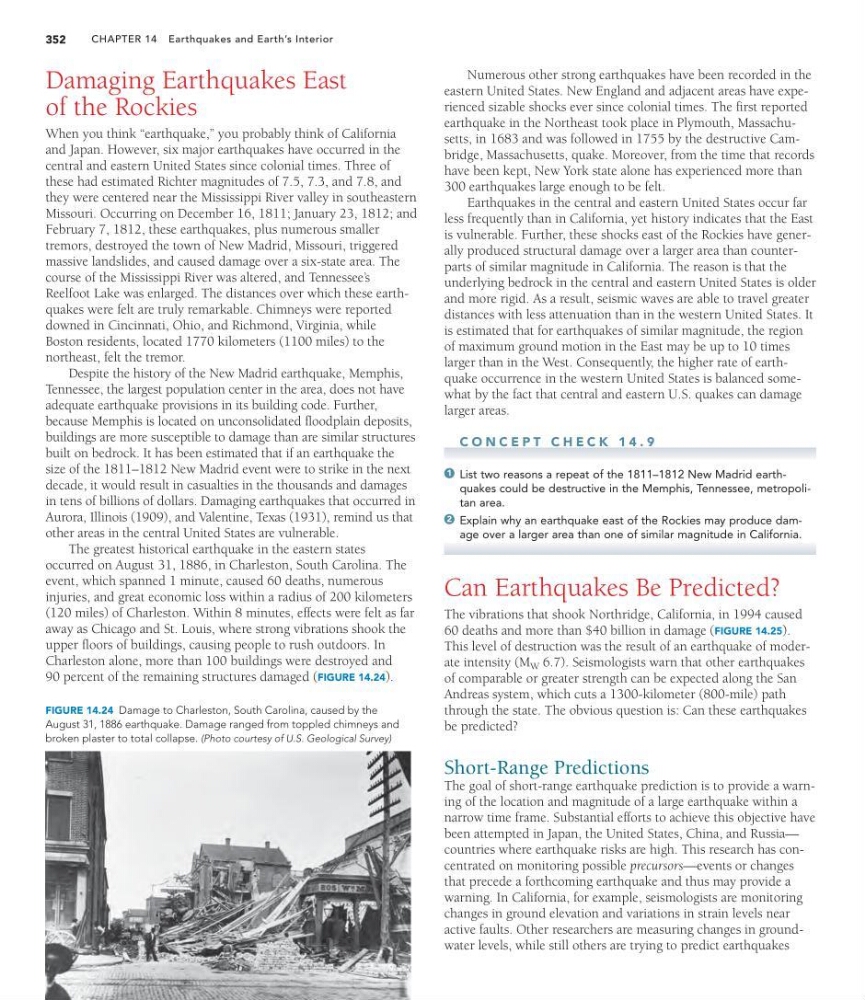
90 percent of the remaining structures damaged (FIGURE 14.24).
Numerous other strong earthquakes have been recorded in the
eastern United States. New England and adjacent areas have experienced sizable shocks ever since colonial times. The first reported
earthquake in the Northeast took place in Plymouth, Massachusetts, in 1683 and was followed in 1755 by the destructive Cambridge, Massachusetts, quake. Moreover, from the time that records
have been kept, New York state alone has experienced more than
300 earthquakes large enough to be felt.
Earthquakes in the central and eastern United States occur far
less frequently than in California, yet history indicates that the East
is vulnerable. Further, these shocks east of the Rockies have generally produced structural damage over a larger area than counterparts of similar magnitude in California. The reason is that the
underlying bedrock in the central and eastern United States is older
and more rigid. As a result, seismic waves are able to travel greater
distances with less attenuation than in the western United States. It
is estimated that for earthquakes of similar magnitude, the region
of maximum ground motion in the East may be up to 10 times
larger than in the West. Consequently, the higher rate of earthquake occurrence in the western United States is balanced somewhat by the fact that central and eastern U.S. quakes can damage
larger areas.
C O N C E P T C H E C K 1 4 . 9
List two reasons a repeat of the 1811–1812 New Madrid earthquakes could be destructive in the Memphis, Tennessee, metropolitan area.
Explain why an earthquake east of the Rockies may produce damage over a larger area than one of similar magnitude in California.
Can Earthquakes Be Predicted?
The vibrations that shook Northridge, California, in 1994 caused
60 deaths and more than $40 billion in damage (FIGURE 14.25).
This level of destruction was the result of an earthquake of moderate intensity (M W 6.7). Seismologists warn that other earthquakes
of comparable or greater strength can be expected along the San
Andreas system, which cuts a 1300-kilometer (800-mile) path
through the state. The obvious question is: Can these earthquakes
be predicted?
Short-Range Predictions
The goal of short-range earthquake prediction is to provide a warning of the location and magnitude of a large earthquake within a
narrow time frame. Substantial efforts to achieve this objective have
been attempted in Japan, the United States, China, and Russia—
countries where earthquake risks are high. This research has concentrated on monitoring possible precursors—events or changes
that precede a forthcoming earthquake and thus may provide a
warning. In California, for example, seismologists are monitoring
changes in ground elevation and variations in strain levels near
active faults. Other researchers are measuring changes in groundwater levels, while still others are trying to predict earthquakes
2
1
FIGURE 14.24 Damage to Charleston, South Carolina, caused by the
August 31, 1886 earthquake. Damage ranged from toppled chimneys and
broken plaster to total collapse. (Photo courtesy of U.S. Geological Survey)
352
Damaging Earthquakes East
of the Rockies
When you think “earthquake,” you probably think of California
and Japan. However, six major earthquakes have occurred in the
central and eastern United States since colonial times. Three of
these had estimated Richter magnitudes of 7.5, 7.3, and 7.8, and
they were centered near the Mississippi River valley in southeastern
Missouri. Occurring on December 16, 1811; January 23, 1812; and
February 7, 1812, these earthquakes, plus numerous smaller
tremors, destroyed the town of New Madrid, Missouri, triggered
massive landslides, and caused damage over a six-state area. The
course of the Mississippi River was altered, and Tennessee’ s
Reelfoot Lake was enlarged. The distances over which these earthquakes were felt are truly remarkable. Chimneys were reported
downed in Cincinnati, Ohio, and Richmond, Virginia, while
Boston residents, located 1770 kilometers (1100 miles) to the
northeast, felt the tremor.
Despite the history of the New Madrid earthquake, Memphis,
Tennessee, the largest population center in the area, does not have
adequate earthquake provisions in its building code. Further,
because Memphis is located on unconsolidated floodplain deposits,
buildings are more susceptible to damage than are similar structures
built on bedrock. It has been estimated that if an earthquake the
size of the 1811–1812 New Madrid event were to strike in the next
decade, it would result in casualties in the thousands and damages
in tens of billions of dollars. Damaging earthquakes that occurred in
Aurora, Illinois (1909), and Valentine, Texas (1931), remind us that
other areas in the central United States are vulnerable.
The greatest historical earthquake in the eastern states
occurred on August 31, 1886, in Charleston, South Carolina. The
event, which spanned 1 minute, caused 60 deaths, numerous
injuries, and great economic loss within a radius of 200 kilometers
(120 miles) of Charleston. Within 8 minutes, effects were felt as far
away as Chicago and St. Louis, where strong vibrations shook the
upper floors of buildings, causing people to rush outdoors. In
Charleston alone, more than 100 buildings were destroyed and
90 percent of the remaining structures damaged (FIGURE 14.24).
Numerous other strong earthquakes have been recorded in the
eastern United States. New England and adjacent areas have experienced sizable shocks ever since colonial times. The first reported
earthquake in the Northeast took place in Plymouth, Massachusetts, in 1683 and was followed in 1755 by the destructive Cambridge, Massachusetts, quake. Moreover, from the time that records
have been kept, New York state alone has experienced more than
300 earthquakes large enough to be felt.
Earthquakes in the central and eastern United States occur far
less frequently than in California, yet history indicates that the East
is vulnerable. Further, these shocks east of the Rockies have generally produced structural damage over a larger area than counterparts of similar magnitude in California. The reason is that the
underlying bedrock in the central and eastern United States is older
and more rigid. As a result, seismic waves are able to travel greater
distances with less attenuation than in the western United States. It
is estimated that for earthquakes of similar magnitude, the region
of maximum ground motion in the East may be up to 10 times
larger than in the West. Consequently, the higher rate of earthquake occurrence in the western United States is balanced somewhat by the fact that central and eastern U.S. quakes can damage
larger areas.
C O N C E P T C H E C K 1 4 . 9
List two reasons a repeat of the 1811–1812 New Madrid earthquakes could be destructive in the Memphis, Tennessee, metropolitan area.
Explain why an earthquake east of the Rockies may produce damage over a larger area than one of similar magnitude in California.
Can Earthquakes Be Predicted?
The vibrations that shook Northridge, California, in 1994 caused
60 deaths and more than $40 billion in damage (FIGURE 14.25).
This level of destruction was the result of an earthquake of moderate intensity (M W 6.7). Seismologists warn that other earthquakes
of comparable or greater strength can be expected along the San
Andreas system, which cuts a 1300-kilometer (800-mile) path
through the state. The obvious question is: Can these earthquakes
be predicted?
Short-Range Predictions
The goal of short-range earthquake prediction is to provide a warning of the location and magnitude of a large earthquake within a
narrow time frame. Substantial efforts to achieve this objective have
been attempted in Japan, the United States, China, and Russia—
countries where earthquake risks are high. This research has concentrated on monitoring possible precursors—events or changes
that precede a forthcoming earthquake and thus may provide a
warning. In California, for example, seismologists are monitoring
changes in ground elevation and variations in strain levels near
active faults. Other researchers are measuring changes in groundwater levels, while still others are trying to predict earthquakes
2
1
FIGURE 14.24 Damage to Charleston, South Carolina, caused by the
August 31, 1886 earthquake. Damage ranged from toppled chimneys and
broken plaster to total collapse. (Photo courtesy of U.S. Geological Survey)