

Sea level
Tsunami speed:
835 km/hr
Tsunami speed:
340 km/hr
Tsunami speed:
50 km/hr
Water depth:
5500 meters
Displacement
Water depth:
20 meters
Water depth:
900 meters
Su bd uc tin g p la te
and claimed many more lives. For example, a 1923 earthquake in Japan triggered an estimated 250 fires, which
devastated the city of Yokohama and destroyed
more than half the homes in Tokyo. More
than 100,000 deaths were attributed to
the fires, which were driven by
unusually high winds.
What Is a
Tsunami?
Large undersea earthquakes
occasionally set in motion
massive waves that scientists
call seismic sea waves. You
may be more familiar with
the Japanese term tsunami, which is frequently used to describe these destructive
phenomena. Because of Japan’ s location
CHAPTER 14 Earthquakes and Earth’s Interior
350
along the circum-Pacific belt and its expansive coastline, it is especially
vulnerable to tsunami destruction.
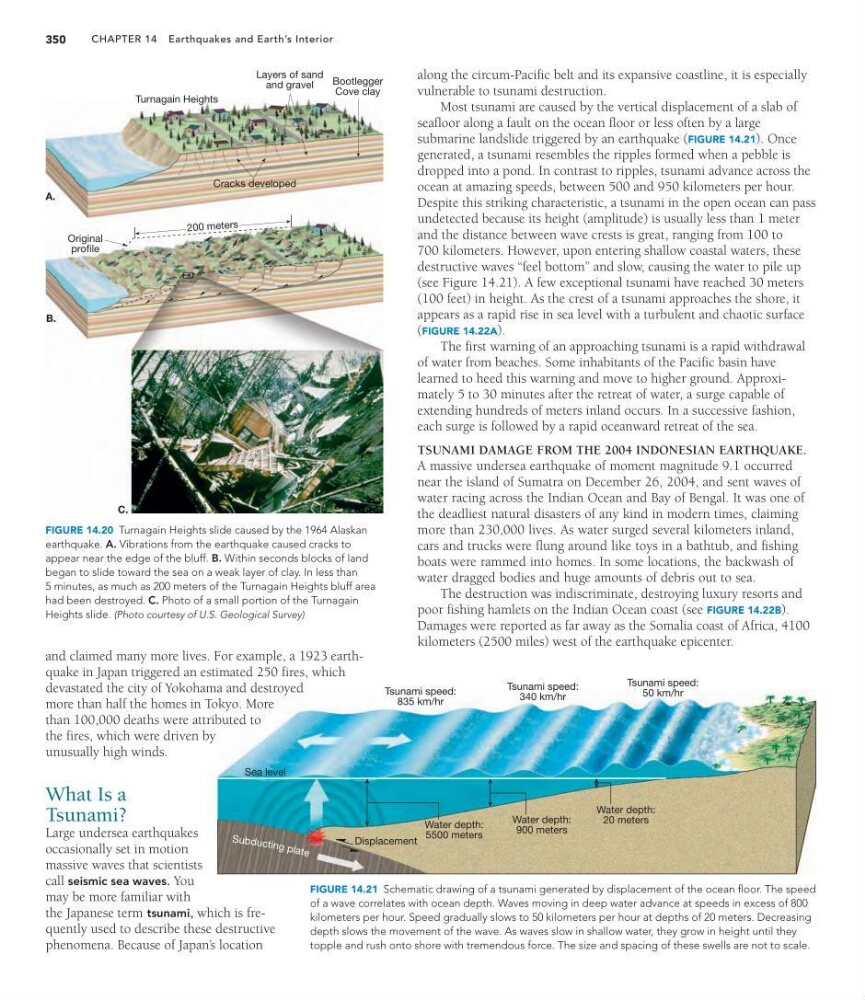
Most tsunami are caused by the vertical displacement of a slab of
seafloor along a fault on the ocean floor or less often by a large
submarine landslide triggered by an earthquake (FIGURE 14.21). Once
generated, a tsunami resembles the ripples formed when a pebble is
dropped into a pond. In contrast to ripples, tsunami advance across the
ocean at amazing speeds, between 500 and 950 kilometers per hour.
Despite this striking characteristic, a tsunami in the open ocean can pass
undetected because its height (amplitude) is usually less than 1 meter
and the distance between wave crests is great, ranging from 100 to
700 kilometers. However, upon entering shallow coastal waters, these
destructive waves “feel bottom” and slow, causing the water to pile up
(see Figure 14.21). A few exceptional tsunami have reached 30 meters
(100 feet) in height. As the crest of a tsunami approaches the shore, it
appears as a rapid rise in sea level with a turbulent and chaotic surface
(FIGURE 14.22A).
The first warning of an approaching tsunami is a rapid withdrawal
of water from beaches. Some inhabitants of the Pacific basin have
learned to heed this warning and move to higher ground. Approximately 5 to 30 minutes after the retreat of water, a surge capable of
extending hundreds of meters inland occurs. In a successive fashion,
each surge is followed by a rapid oceanward retreat of the sea.
TSUNAMI DAMAGE FROM THE 2004 INDONESIAN EARTHQUAKE.
A massive undersea earthquake of moment magnitude 9.1 occurred
near the island of Sumatra on December 26, 2004, and sent waves of
water racing across the Indian Ocean and Bay of Bengal. It was one of
the deadliest natural disasters of any kind in modern times, claiming
more than 230,000 lives. As water surged several kilometers inland,
cars and trucks were flung around like toys in a bathtub, and fishing
boats were rammed into homes. In some locations, the backwash of
water dragged bodies and huge amounts of debris out to sea.
The destruction was indiscriminate, destroying luxury resorts and
poor fishing hamlets on the Indian Ocean coast (see FIGURE 14.22B).
Damages were reported as far away as the Somalia coast of Africa, 4100
kilometers (2500 miles) west of the earthquake epicenter.
FIGURE 14.21 Schematic drawing of a tsunami generated by displacement of the ocean floor. The speed
of a wave correlates with ocean depth. Waves moving in deep water advance at speeds in excess of 800
kilometers per hour. Speed gradually slows to 50 kilometers per hour at depths of 20 meters. Decreasing
depth slows the movement of the wave. As waves slow in shallow water, they grow in height until they
topple and rush onto shore with tremendous force. The size and spacing of these swells are not to scale.
A.
Turnagain Heights
Cracks developed
Layers of sand
and gravel
Bootlegger
Cove clay
B.
C.
200 mete rs
Original
profile
FIGURE 14.20 Turnagain Heights slide caused by the 1964 Alaskan
earthquake. A. Vibrations from the earthquake caused cracks to
appear near the edge of the bluff. B. Within seconds blocks of land
began to slide toward the sea on a weak layer of clay. In less than
5 minutes, as much as 200 meters of the Turnagain Heights bluff area
had been destroyed. C. Photo of a small portion of the Turnagain
Heights slide. (Photo courtesy of U.S. Geological Survey)
Tsunami speed:
835 km/hr
Tsunami speed:
340 km/hr
Tsunami speed:
50 km/hr
Water depth:
5500 meters
Displacement
Water depth:
20 meters
Water depth:
900 meters
Su bd uc tin g p la te
and claimed many more lives. For example, a 1923 earthquake in Japan triggered an estimated 250 fires, which
devastated the city of Yokohama and destroyed
more than half the homes in Tokyo. More
than 100,000 deaths were attributed to
the fires, which were driven by
unusually high winds.
What Is a
Tsunami?
Large undersea earthquakes
occasionally set in motion
massive waves that scientists
call seismic sea waves. You
may be more familiar with
the Japanese term tsunami, which is frequently used to describe these destructive
phenomena. Because of Japan’ s location
CHAPTER 14 Earthquakes and Earth’s Interior
350
along the circum-Pacific belt and its expansive coastline, it is especially
vulnerable to tsunami destruction.
Most tsunami are caused by the vertical displacement of a slab of
seafloor along a fault on the ocean floor or less often by a large
submarine landslide triggered by an earthquake (FIGURE 14.21). Once
generated, a tsunami resembles the ripples formed when a pebble is
dropped into a pond. In contrast to ripples, tsunami advance across the
ocean at amazing speeds, between 500 and 950 kilometers per hour.
Despite this striking characteristic, a tsunami in the open ocean can pass
undetected because its height (amplitude) is usually less than 1 meter
and the distance between wave crests is great, ranging from 100 to
700 kilometers. However, upon entering shallow coastal waters, these
destructive waves “feel bottom” and slow, causing the water to pile up
(see Figure 14.21). A few exceptional tsunami have reached 30 meters
(100 feet) in height. As the crest of a tsunami approaches the shore, it
appears as a rapid rise in sea level with a turbulent and chaotic surface
(FIGURE 14.22A).
The first warning of an approaching tsunami is a rapid withdrawal
of water from beaches. Some inhabitants of the Pacific basin have
learned to heed this warning and move to higher ground. Approximately 5 to 30 minutes after the retreat of water, a surge capable of
extending hundreds of meters inland occurs. In a successive fashion,
each surge is followed by a rapid oceanward retreat of the sea.
TSUNAMI DAMAGE FROM THE 2004 INDONESIAN EARTHQUAKE.
A massive undersea earthquake of moment magnitude 9.1 occurred
near the island of Sumatra on December 26, 2004, and sent waves of
water racing across the Indian Ocean and Bay of Bengal. It was one of
the deadliest natural disasters of any kind in modern times, claiming
more than 230,000 lives. As water surged several kilometers inland,
cars and trucks were flung around like toys in a bathtub, and fishing
boats were rammed into homes. In some locations, the backwash of
water dragged bodies and huge amounts of debris out to sea.
The destruction was indiscriminate, destroying luxury resorts and
poor fishing hamlets on the Indian Ocean coast (see FIGURE 14.22B).
Damages were reported as far away as the Somalia coast of Africa, 4100
kilometers (2500 miles) west of the earthquake epicenter.
FIGURE 14.21 Schematic drawing of a tsunami generated by displacement of the ocean floor. The speed
of a wave correlates with ocean depth. Waves moving in deep water advance at speeds in excess of 800
kilometers per hour. Speed gradually slows to 50 kilometers per hour at depths of 20 meters. Decreasing
depth slows the movement of the wave. As waves slow in shallow water, they grow in height until they
topple and rush onto shore with tremendous force. The size and spacing of these swells are not to scale.
A.
Turnagain Heights
Cracks developed
Layers of sand
and gravel
Bootlegger
Cove clay
B.
C.
200 mete rs
Original
profile
FIGURE 14.20 Turnagain Heights slide caused by the 1964 Alaskan
earthquake. A. Vibrations from the earthquake caused cracks to
appear near the edge of the bluff. B. Within seconds blocks of land
began to slide toward the sea on a weak layer of clay. In less than
5 minutes, as much as 200 meters of the Turnagain Heights bluff area
had been destroyed. C. Photo of a small portion of the Turnagain
Heights slide. (Photo courtesy of U.S. Geological Survey)