

CHAPTER 14 Earthquakes and Earth’s Interior
348
D I D Y O U K N O W ?
It is a commonly held belief that
moderate earthquakes
decrease the chances of a major
earthquake in the same region,
but this is not the case. When
you compare the amount of
energy released by earthquakes
of different magnitudes, it turns
out that thousands of moderate
tremors would be needed to
release the huge amount of
energy released during one
“great” earthquake.
well as from side to side. The amount of
damage to man-made structures attributable to the vibrations depends on several
factors, including (1) the intensity and
(2) the duration of the shaking, (3) the
nature of the material upon which the
structure rests, and (4) the nature of
building materials and the construction
practices of the region.
All of the multistory structures in
Anchorage were damaged by the vibrations
in 1964. The more flexible wood-frame
residential buildings fared best. However,
many homes were destroyed when the
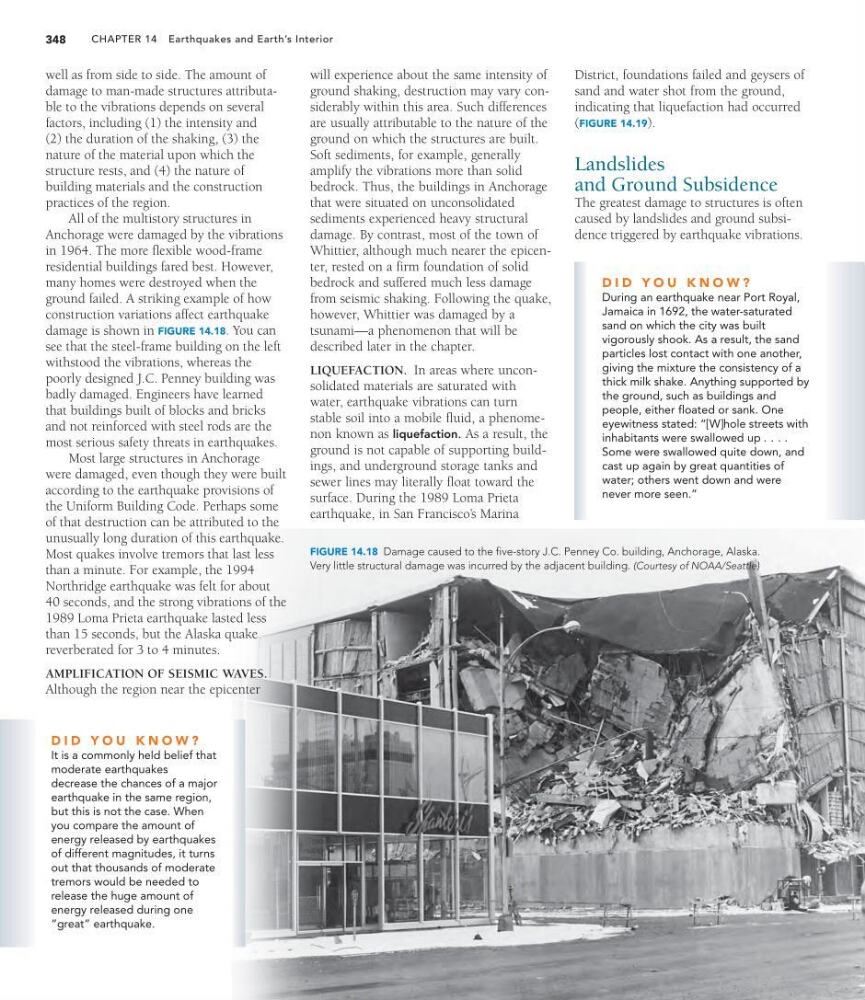
ground failed. A striking example of how
construction variations affect earthquake
damage is shown in FIGURE 14.18. You can
see that the steel-frame building on the left
withstood the vibrations, whereas the
poorly designed J.C. Penney building was
badly damaged. Engineers have learned
that buildings built of blocks and bricks
and not reinforced with steel rods are the
most serious safety threats in earthquakes.
Most large structures in Anchorage
were damaged, even though they were built
according to the earthquake provisions of
the Uniform Building Code. Perhaps some
of that destruction can be attributed to the
unusually long duration of this earthquake.
Most quakes involve tremors that last less
than a minute. For example, the 1994
Northridge earthquake was felt for about
40 seconds, and the strong vibrations of the
1989 Loma Prieta earthquake lasted less
than 15 seconds, but the Alaska quake
reverberated for 3 to 4 minutes.
AMPLIFICATION OF SEISMIC WAVES.
Although the region near the epicenter
will experience about the same intensity of
ground shaking, destruction may vary considerably within this area. Such differences
are usually attributable to the nature of the
ground on which the structures are built.
Soft sediments, for example, generally
amplify the vibrations more than solid
bedrock. Thus, the buildings in Anchorage
that were situated on unconsolidated
sediments experienced heavy structural
damage. By contrast, most of the town of
Whittier, although much nearer the epicenter, rested on a firm foundation of solid
bedrock and suffered much less damage
from seismic shaking. Following the quake,
however, Whittier was damaged by a
tsunami—a phenomenon that will be
described later in the chapter.
LIQUEFACTION. In areas where unconsolidated materials are saturated with
water, earthquake vibrations can turn
stable soil into a mobile fluid, a phenomenon known as liquefaction. As a result, the
ground is not capable of supporting buildings, and underground storage tanks and
sewer lines may literally float toward the
surface. During the 1989 Loma Prieta
earthquake, in San Francisco’ s Marina
District, foundations failed and geysers of
sand and water shot from the ground,
indicating that liquefaction had occurred
(FIGURE 14.19).
Landslides
and Ground Subsidence
The greatest damage to structures is often
caused by landslides and ground subsidence triggered by earthquake vibrations.
FIGURE 14.18 Damage caused to the five-story J.C. Penney Co. building, Anchorage, Alaska.
Very little structural damage was incurred by the adjacent building. (Courtesy of NOAA/Seattle)
D I D Y O U K N O W ?
During an earthquake near Port Royal,
Jamaica in 1692, the water-saturated
sand on which the city was built
vigorously shook. As a result, the sand
particles lost contact with one another,
giving the mixture the consistency of a
thick milk shake. Anything supported by
the ground, such as buildings and
people, either floated or sank. One
eyewitness stated: “[W]hole streets with
inhabitants were swallowed up . . . .
Some were swallowed quite down, and
cast up again by great quantities of
water; others went down and were
never more seen.”
348
D I D Y O U K N O W ?
It is a commonly held belief that
moderate earthquakes
decrease the chances of a major
earthquake in the same region,
but this is not the case. When
you compare the amount of
energy released by earthquakes
of different magnitudes, it turns
out that thousands of moderate
tremors would be needed to
release the huge amount of
energy released during one
“great” earthquake.
well as from side to side. The amount of
damage to man-made structures attributable to the vibrations depends on several
factors, including (1) the intensity and
(2) the duration of the shaking, (3) the
nature of the material upon which the
structure rests, and (4) the nature of
building materials and the construction
practices of the region.
All of the multistory structures in
Anchorage were damaged by the vibrations
in 1964. The more flexible wood-frame
residential buildings fared best. However,
many homes were destroyed when the
ground failed. A striking example of how
construction variations affect earthquake
damage is shown in FIGURE 14.18. You can
see that the steel-frame building on the left
withstood the vibrations, whereas the
poorly designed J.C. Penney building was
badly damaged. Engineers have learned
that buildings built of blocks and bricks
and not reinforced with steel rods are the
most serious safety threats in earthquakes.
Most large structures in Anchorage
were damaged, even though they were built
according to the earthquake provisions of
the Uniform Building Code. Perhaps some
of that destruction can be attributed to the
unusually long duration of this earthquake.
Most quakes involve tremors that last less
than a minute. For example, the 1994
Northridge earthquake was felt for about
40 seconds, and the strong vibrations of the
1989 Loma Prieta earthquake lasted less
than 15 seconds, but the Alaska quake
reverberated for 3 to 4 minutes.
AMPLIFICATION OF SEISMIC WAVES.
Although the region near the epicenter
will experience about the same intensity of
ground shaking, destruction may vary considerably within this area. Such differences
are usually attributable to the nature of the
ground on which the structures are built.
Soft sediments, for example, generally
amplify the vibrations more than solid
bedrock. Thus, the buildings in Anchorage
that were situated on unconsolidated
sediments experienced heavy structural
damage. By contrast, most of the town of
Whittier, although much nearer the epicenter, rested on a firm foundation of solid
bedrock and suffered much less damage
from seismic shaking. Following the quake,
however, Whittier was damaged by a
tsunami—a phenomenon that will be
described later in the chapter.
LIQUEFACTION. In areas where unconsolidated materials are saturated with
water, earthquake vibrations can turn
stable soil into a mobile fluid, a phenomenon known as liquefaction. As a result, the
ground is not capable of supporting buildings, and underground storage tanks and
sewer lines may literally float toward the
surface. During the 1989 Loma Prieta
earthquake, in San Francisco’ s Marina
District, foundations failed and geysers of
sand and water shot from the ground,
indicating that liquefaction had occurred
(FIGURE 14.19).
Landslides
and Ground Subsidence
The greatest damage to structures is often
caused by landslides and ground subsidence triggered by earthquake vibrations.
FIGURE 14.18 Damage caused to the five-story J.C. Penney Co. building, Anchorage, Alaska.
Very little structural damage was incurred by the adjacent building. (Courtesy of NOAA/Seattle)
D I D Y O U K N O W ?
During an earthquake near Port Royal,
Jamaica in 1692, the water-saturated
sand on which the city was built
vigorously shook. As a result, the sand
particles lost contact with one another,
giving the mixture the consistency of a
thick milk shake. Anything supported by
the ground, such as buildings and
people, either floated or sank. One
eyewitness stated: “[W]hole streets with
inhabitants were swallowed up . . . .
Some were swallowed quite down, and
cast up again by great quantities of
water; others went down and were
never more seen.”