

347
Earthquake Destruction
Asia
J a p a n
Australia
North
America
Alpine
Fault
Circum-Pacific
Belt
South
America
Chi le
Europe
Africa
Alpine-Himalayan Belt
S a n
A n d r e a s
F a u lt
North
Anatolian
Fault
E
ast
Pa c if ic
R is e
Mi d -A tl a n t ic Ridge
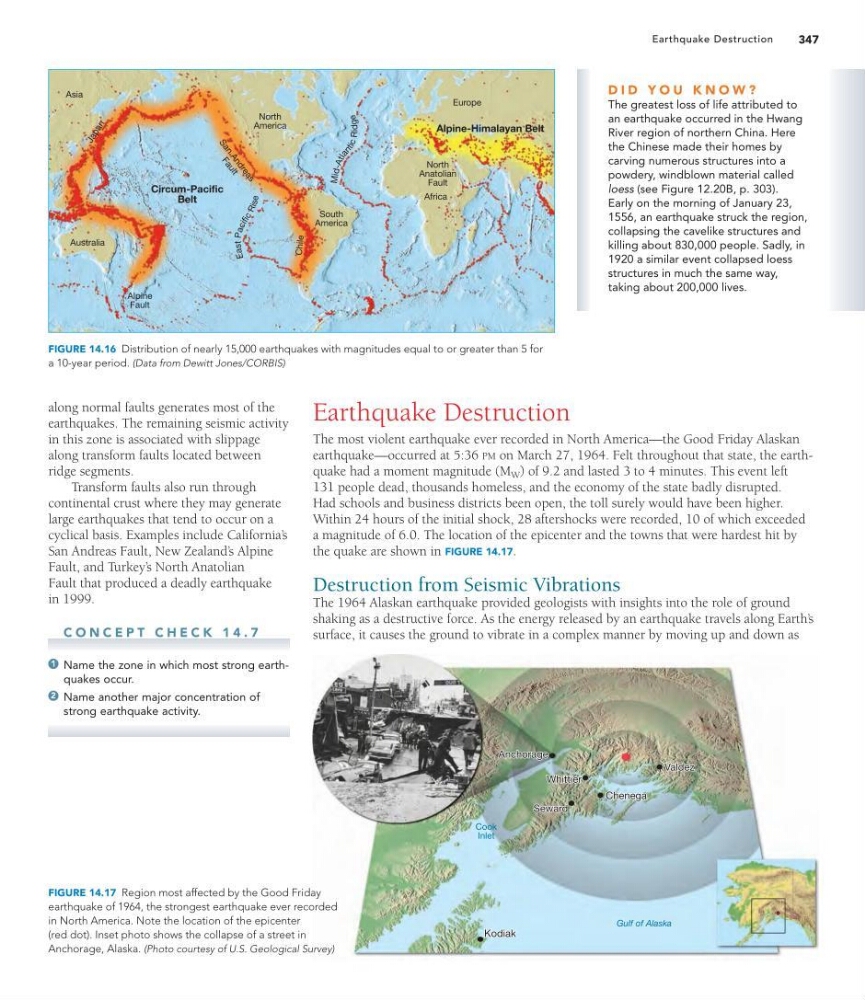
FIGURE 14.16 Distribution of nearly 15,000 earthquakes with magnitudes equal to or greater than 5 for
a 10-year period. (Data from Dewitt Jones/CORBIS)
along normal faults generates most of the
earthquakes. The remaining seismic activity
in this zone is associated with slippage
along transform faults located between
ridge segments.
Transform faults also run through
continental crust where they may generate
large earthquakes that tend to occur on a
cyclical basis. Examples include California’ s
San Andreas Fault, New Zealand’ s Alpine
Fault, and Turkey’ s North Anatolian
Fault that produced a deadly earthquake
in 1999.
C O N C E P T C H E C K 1 4 . 7
Name the zone in which most strong earthquakes occur.
Name another major concentration of
strong earthquake activity.
2
1
Earthquake Destruction
The most violent earthquake ever recorded in North America—the Good Friday Alaskan
earthquake—occurred at 5:36 PM on March 27, 1964. Felt throughout that state, the earthquake had a moment magnitude (M W ) of 9.2 and lasted 3 to 4 minutes. This event left
131 people dead, thousands homeless, and the economy of the state badly disrupted.
Had schools and business districts been open, the toll surely would have been higher.
Within 24 hours of the initial shock, 28 aftershocks were recorded, 10 of which exceeded
a magnitude of 6.0. The location of the epicenter and the towns that were hardest hit by
the quake are shown in FIGURE 14.17.
Destruction from Seismic Vibrations
The 1964 Alaskan earthquake provided geologists with insights into the role of ground
shaking as a destructive force. As the energy released by an earthquake travels along Earth’ s
surface, it causes the ground to vibrate in a complex manner by moving up and down as
Kodiak Kodiak
Anchorage Anchorage
Whittier Whittier
Valdez Valdez
Chenega Chenega
Seward Seward
Kodiak
Anchorage
Whittier
Valdez
Chenega
Seward
Cook
Inlet
Gulf of Alaska
D I D Y O U K N O W ?
The greatest loss of life attributed to
an earthquake occurred in the Hwang
River region of northern China. Here
the Chinese made their homes by
carving numerous structures into a
powdery, windblown material called
loess (see Figure 12.20B, p. 303).
Early on the morning of January 23,
1556, an earthquake struck the region,
collapsing the cavelike structures and
killing about 830,000 people. Sadly, in
1920 a similar event collapsed loess
structures in much the same way,
taking about 200,000 lives.
FIGURE 14.17 Region most affected by the Good Friday
earthquake of 1964, the strongest earthquake ever recorded
in North America. Note the location of the epicenter
(red dot). Inset photo shows the collapse of a street in
Anchorage, Alaska. (Photo courtesy of U.S. Geological Survey)
Earthquake Destruction
Asia
J a p a n
Australia
North
America
Alpine
Fault
Circum-Pacific
Belt
South
America
Chi le
Europe
Africa
Alpine-Himalayan Belt
S a n
A n d r e a s
F a u lt
North
Anatolian
Fault
E
ast
Pa c if ic
R is e
Mi d -A tl a n t ic Ridge
FIGURE 14.16 Distribution of nearly 15,000 earthquakes with magnitudes equal to or greater than 5 for
a 10-year period. (Data from Dewitt Jones/CORBIS)
along normal faults generates most of the
earthquakes. The remaining seismic activity
in this zone is associated with slippage
along transform faults located between
ridge segments.
Transform faults also run through
continental crust where they may generate
large earthquakes that tend to occur on a
cyclical basis. Examples include California’ s
San Andreas Fault, New Zealand’ s Alpine
Fault, and Turkey’ s North Anatolian
Fault that produced a deadly earthquake
in 1999.
C O N C E P T C H E C K 1 4 . 7
Name the zone in which most strong earthquakes occur.
Name another major concentration of
strong earthquake activity.
2
1
Earthquake Destruction
The most violent earthquake ever recorded in North America—the Good Friday Alaskan
earthquake—occurred at 5:36 PM on March 27, 1964. Felt throughout that state, the earthquake had a moment magnitude (M W ) of 9.2 and lasted 3 to 4 minutes. This event left
131 people dead, thousands homeless, and the economy of the state badly disrupted.
Had schools and business districts been open, the toll surely would have been higher.
Within 24 hours of the initial shock, 28 aftershocks were recorded, 10 of which exceeded
a magnitude of 6.0. The location of the epicenter and the towns that were hardest hit by
the quake are shown in FIGURE 14.17.
Destruction from Seismic Vibrations
The 1964 Alaskan earthquake provided geologists with insights into the role of ground
shaking as a destructive force. As the energy released by an earthquake travels along Earth’ s
surface, it causes the ground to vibrate in a complex manner by moving up and down as
Kodiak Kodiak
Anchorage Anchorage
Whittier Whittier
Valdez Valdez
Chenega Chenega
Seward Seward
Kodiak
Anchorage
Whittier
Valdez
Chenega
Seward
Cook
Inlet
Gulf of Alaska
D I D Y O U K N O W ?
The greatest loss of life attributed to
an earthquake occurred in the Hwang
River region of northern China. Here
the Chinese made their homes by
carving numerous structures into a
powdery, windblown material called
loess (see Figure 12.20B, p. 303).
Early on the morning of January 23,
1556, an earthquake struck the region,
collapsing the cavelike structures and
killing about 830,000 people. Sadly, in
1920 a similar event collapsed loess
structures in much the same way,
taking about 200,000 lives.
FIGURE 14.17 Region most affected by the Good Friday
earthquake of 1964, the strongest earthquake ever recorded
in North America. Note the location of the epicenter
(red dot). Inset photo shows the collapse of a street in
Anchorage, Alaska. (Photo courtesy of U.S. Geological Survey)