

13
Earth’s Spheres
2.8%
Oceans
97.2%
Hydrosphere
Groundwater
0.62%
Glaciers
2.15%
Nonocean Component
(% of total hydrosphere)
Freshwater lakes
0.009%
Saline lakes and
inland seas
0.008%
Soil moisture
0.005%
Atmosphere
0.001%
Stream channels
0.0001%
Glaciers
Groundwater (spring)
Stream channel
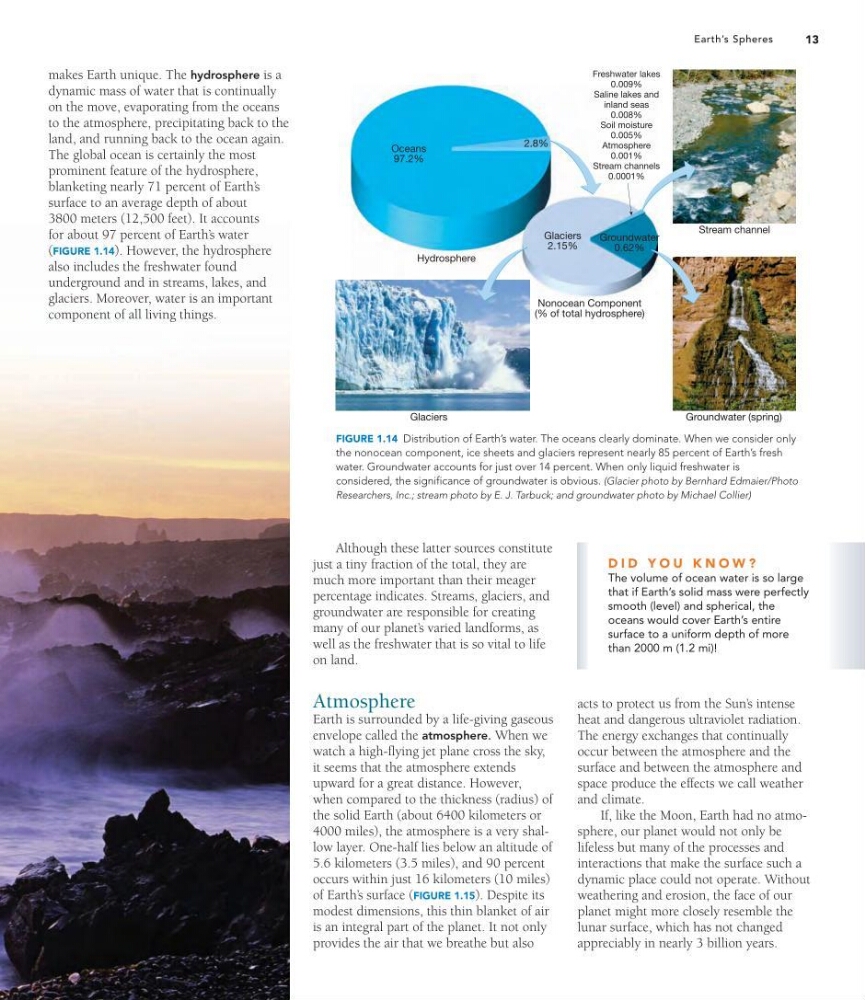
FIGURE 1.14 Distribution of Earth’s water. The oceans clearly dominate. When we consider only
the nonocean component, ice sheets and glaciers represent nearly 85 percent of Earth’s fresh
water. Groundwater accounts for just over 14 percent. When only liquid freshwater is
considered, the significance of groundwater is obvious. (Glacier photo by Bernhard Edmaier/Photo
Researchers, Inc.; stream photo by E. J. Tarbuck; and groundwater photo by Michael Collier)
D I D Y O U K N O W ?
The volume of ocean water is so large
that if Earth’s solid mass were perfectly
smooth (level) and spherical, the
oceans would cover Earth’s entire
surface to a uniform depth of more
than 2000 m (1.2 mi)!
makes Earth unique. The hydrosphere is a
dynamic mass of water that is continually
on the move, evaporating from the oceans
to the atmosphere, precipitating back to the
land, and running back to the ocean again.
The global ocean is certainly the most
prominent feature of the hydrosphere,
blanketing nearly 71 percent of Earth’ s
surface to an average depth of about
3800 meters (12,500 feet). It accounts
for about 97 percent of Earth’ s water
(FIGURE 1.14). However, the hydrosphere
also includes the freshwater found
underground and in streams, lakes, and
glaciers. Moreover, water is an important
component of all living things.
Although these latter sources constitute
just a tiny fraction of the total, they are
much more important than their meager
percentage indicates. Streams, glaciers, and
groundwater are responsible for creating
many of our planet’ s varied landforms, as
well as the freshwater that is so vital to life
on land.
Atmosphere
Earth is surrounded by a life-giving gaseous
envelope called the atmosphere. When we
watch a high-flying jet plane cross the sky,
it seems that the atmosphere extends
upward for a great distance. However,
when compared to the thickness (radius) of
the solid Earth (about 6400 kilometers or
4000 miles), the atmosphere is a very shallow layer. One-half lies below an altitude of
5.6 kilometers (3.5 miles), and 90 percent
occurs within just 16 kilometers (10 miles)
of Earth’ s surface (FIGURE 1.15). Despite its
modest dimensions, this thin blanket of air
is an integral part of the planet. It not only
provides the air that we breathe but also
acts to protect us from the Sun’ s intense
heat and dangerous ultraviolet radiation.
The energy exchanges that continually
occur between the atmosphere and the
surface and between the atmosphere and
space produce the effects we call weather
and climate.
If, like the Moon, Earth had no atmosphere, our planet would not only be
lifeless but many of the processes and
interactions that make the surface such a
dynamic place could not operate. Without
weathering and erosion, the face of our
planet might more closely resemble the
lunar surface, which has not changed
appreciably in nearly 3 billion years.
Earth’s Spheres
2.8%
Oceans
97.2%
Hydrosphere
Groundwater
0.62%
Glaciers
2.15%
Nonocean Component
(% of total hydrosphere)
Freshwater lakes
0.009%
Saline lakes and
inland seas
0.008%
Soil moisture
0.005%
Atmosphere
0.001%
Stream channels
0.0001%
Glaciers
Groundwater (spring)
Stream channel
FIGURE 1.14 Distribution of Earth’s water. The oceans clearly dominate. When we consider only
the nonocean component, ice sheets and glaciers represent nearly 85 percent of Earth’s fresh
water. Groundwater accounts for just over 14 percent. When only liquid freshwater is
considered, the significance of groundwater is obvious. (Glacier photo by Bernhard Edmaier/Photo
Researchers, Inc.; stream photo by E. J. Tarbuck; and groundwater photo by Michael Collier)
D I D Y O U K N O W ?
The volume of ocean water is so large
that if Earth’s solid mass were perfectly
smooth (level) and spherical, the
oceans would cover Earth’s entire
surface to a uniform depth of more
than 2000 m (1.2 mi)!
makes Earth unique. The hydrosphere is a
dynamic mass of water that is continually
on the move, evaporating from the oceans
to the atmosphere, precipitating back to the
land, and running back to the ocean again.
The global ocean is certainly the most
prominent feature of the hydrosphere,
blanketing nearly 71 percent of Earth’ s
surface to an average depth of about
3800 meters (12,500 feet). It accounts
for about 97 percent of Earth’ s water
(FIGURE 1.14). However, the hydrosphere
also includes the freshwater found
underground and in streams, lakes, and
glaciers. Moreover, water is an important
component of all living things.
Although these latter sources constitute
just a tiny fraction of the total, they are
much more important than their meager
percentage indicates. Streams, glaciers, and
groundwater are responsible for creating
many of our planet’ s varied landforms, as
well as the freshwater that is so vital to life
on land.
Atmosphere
Earth is surrounded by a life-giving gaseous
envelope called the atmosphere. When we
watch a high-flying jet plane cross the sky,
it seems that the atmosphere extends
upward for a great distance. However,
when compared to the thickness (radius) of
the solid Earth (about 6400 kilometers or
4000 miles), the atmosphere is a very shallow layer. One-half lies below an altitude of
5.6 kilometers (3.5 miles), and 90 percent
occurs within just 16 kilometers (10 miles)
of Earth’ s surface (FIGURE 1.15). Despite its
modest dimensions, this thin blanket of air
is an integral part of the planet. It not only
provides the air that we breathe but also
acts to protect us from the Sun’ s intense
heat and dangerous ultraviolet radiation.
The energy exchanges that continually
occur between the atmosphere and the
surface and between the atmosphere and
space produce the effects we call weather
and climate.
If, like the Moon, Earth had no atmosphere, our planet would not only be
lifeless but many of the processes and
interactions that make the surface such a
dynamic place could not operate. Without
weathering and erosion, the face of our
planet might more closely resemble the
lunar surface, which has not changed
appreciably in nearly 3 billion years.