

Despite their usefulness in providing a
tool to compare earthquake severity, intensity scales have significant drawbacks.
These scales are based on effects (largely
destruction) that depend not only on the
severity of ground shaking but also on
factors such as building design and the
nature of surface materials. For example,
the modest 7.0 magnitude 2010 Haiti
earthquake mentioned earlier was
extremely destructive, mainly because of
inferior building practices. Thus, the
destruction wrought by an earthquake is
frequently not a good measure of the
amount of energy that was unleashed.
Magnitude Scales
In order to more accurately compare earthquakes across the globe, a measure was
needed that does not rely on parameters
that vary considerably from one part of the
world to another. As a consequence, several
magnitude scales were developed.
CHAPTER 14 Earthquakes and Earth’s Interior
344
TABLE 14.1
Modified Mercalli Intensity Scale
I
Not felt except by a very few under especially favorable circumstances.
II
Felt only by a few persons at rest, especially on upper floors of buildings.
III
Felt quite noticeably indoors, especially on upper floors of buildings, but many people do not
recognize it as an earthquake.
IV
During the day felt indoors by many, outdoors by few. Sensation like heavy truck striking building.
V
Felt by nearly everyone, many awakened. Disturbances of trees, poles, and other tall objects
sometimes noticed.
VI
Felt by all; many frightened and run outdoors. Some heavy furniture moved; few instances of fallen
plaster or damaged chimneys. Damage slight.
VII
Everybody runs outdoors. Damage negligible in buildings of good design and construction;
slight to moderate in well-built ordinary structures; considerable in poorly built or badly designed
structures.
VIII Damage slight in specially designed structures; considerable in ordinary substantial buildings
with partial collapse; great in poorly built structures. (Fall of chimneys, factory stacks, columns,
monuments, walls.)
IX
Damage considerable in specially designed structures. Buildings shifted off foundations. Ground
cracked conspicuously.
X
Some well-built wooden structures destroyed. Most masonry and frame structures destroyed.
Ground badly cracked.
XI
Few, if any, (masonry) structures remain standing. Bridges destroyed. Broad fissures in ground.
XII
Damage total. Waves seen on ground surfaces. Objects thrown upward into air.
CA
OR
1
0
2 3 4 5 6 7 8 910
NV
Los Angeles
San Francisco
B. 1906 San Francisco
A. 1989 Loma Prieta
CA
OR
NV
Los Angeles
San Francisco
Modified Mercalli Intensity Scale
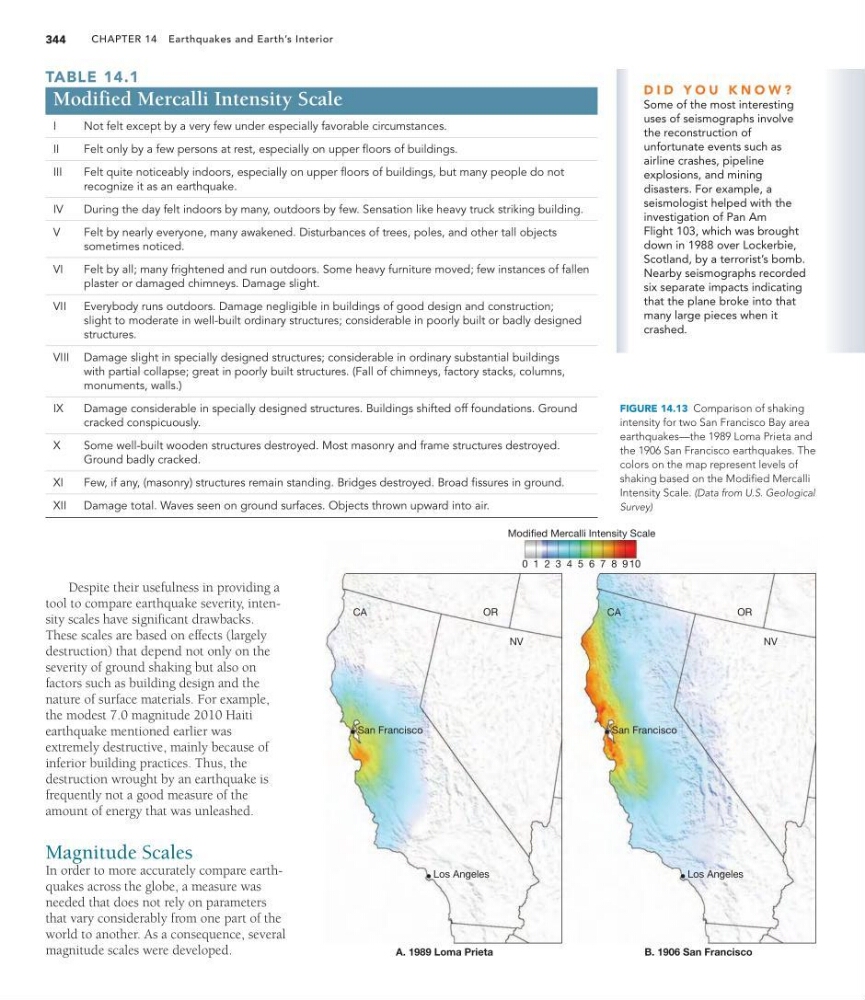
FIGURE 14.13 Comparison of shaking
intensity for two San Francisco Bay area
earthquakes—the 1989 Loma Prieta and
the 1906 San Francisco earthquakes. The
colors on the map represent levels of
shaking based on the Modified Mercalli
Intensity Scale. (Data from U.S. Geological
Survey)
D I D Y O U K N O W ?
Some of the most interesting
uses of seismographs involve
the reconstruction of
unfortunate events such as
airline crashes, pipeline
explosions, and mining
disasters. For example, a
seismologist helped with the
investigation of Pan Am
Flight 103, which was brought
down in 1988 over Lockerbie,
Scotland, by a terrorist’s bomb.
Nearby seismographs recorded
six separate impacts indicating
that the plane broke into that
many large pieces when it
crashed.
tool to compare earthquake severity, intensity scales have significant drawbacks.
These scales are based on effects (largely
destruction) that depend not only on the
severity of ground shaking but also on
factors such as building design and the
nature of surface materials. For example,
the modest 7.0 magnitude 2010 Haiti
earthquake mentioned earlier was
extremely destructive, mainly because of
inferior building practices. Thus, the
destruction wrought by an earthquake is
frequently not a good measure of the
amount of energy that was unleashed.
Magnitude Scales
In order to more accurately compare earthquakes across the globe, a measure was
needed that does not rely on parameters
that vary considerably from one part of the
world to another. As a consequence, several
magnitude scales were developed.
CHAPTER 14 Earthquakes and Earth’s Interior
344
TABLE 14.1
Modified Mercalli Intensity Scale
I
Not felt except by a very few under especially favorable circumstances.
II
Felt only by a few persons at rest, especially on upper floors of buildings.
III
Felt quite noticeably indoors, especially on upper floors of buildings, but many people do not
recognize it as an earthquake.
IV
During the day felt indoors by many, outdoors by few. Sensation like heavy truck striking building.
V
Felt by nearly everyone, many awakened. Disturbances of trees, poles, and other tall objects
sometimes noticed.
VI
Felt by all; many frightened and run outdoors. Some heavy furniture moved; few instances of fallen
plaster or damaged chimneys. Damage slight.
VII
Everybody runs outdoors. Damage negligible in buildings of good design and construction;
slight to moderate in well-built ordinary structures; considerable in poorly built or badly designed
structures.
VIII Damage slight in specially designed structures; considerable in ordinary substantial buildings
with partial collapse; great in poorly built structures. (Fall of chimneys, factory stacks, columns,
monuments, walls.)
IX
Damage considerable in specially designed structures. Buildings shifted off foundations. Ground
cracked conspicuously.
X
Some well-built wooden structures destroyed. Most masonry and frame structures destroyed.
Ground badly cracked.
XI
Few, if any, (masonry) structures remain standing. Bridges destroyed. Broad fissures in ground.
XII
Damage total. Waves seen on ground surfaces. Objects thrown upward into air.
CA
OR
1
0
2 3 4 5 6 7 8 910
NV
Los Angeles
San Francisco
B. 1906 San Francisco
A. 1989 Loma Prieta
CA
OR
NV
Los Angeles
San Francisco
Modified Mercalli Intensity Scale
FIGURE 14.13 Comparison of shaking
intensity for two San Francisco Bay area
earthquakes—the 1989 Loma Prieta and
the 1906 San Francisco earthquakes. The
colors on the map represent levels of
shaking based on the Modified Mercalli
Intensity Scale. (Data from U.S. Geological
Survey)
D I D Y O U K N O W ?
Some of the most interesting
uses of seismographs involve
the reconstruction of
unfortunate events such as
airline crashes, pipeline
explosions, and mining
disasters. For example, a
seismologist helped with the
investigation of Pan Am
Flight 103, which was brought
down in 1988 over Lockerbie,
Scotland, by a terrorist’s bomb.
Nearby seismographs recorded
six separate impacts indicating
that the plane broke into that
many large pieces when it
crashed.