

341
Seismology: The Study of Earthquake Waves
the slippage of a rock mass. Some are called
surface waves, because their motion is
restricted to near Earth’ s surface. Others
travel through Earth’ s interior and are
called body waves. Body waves are divided
into two types—primary (P) waves and
secondary (S) waves.
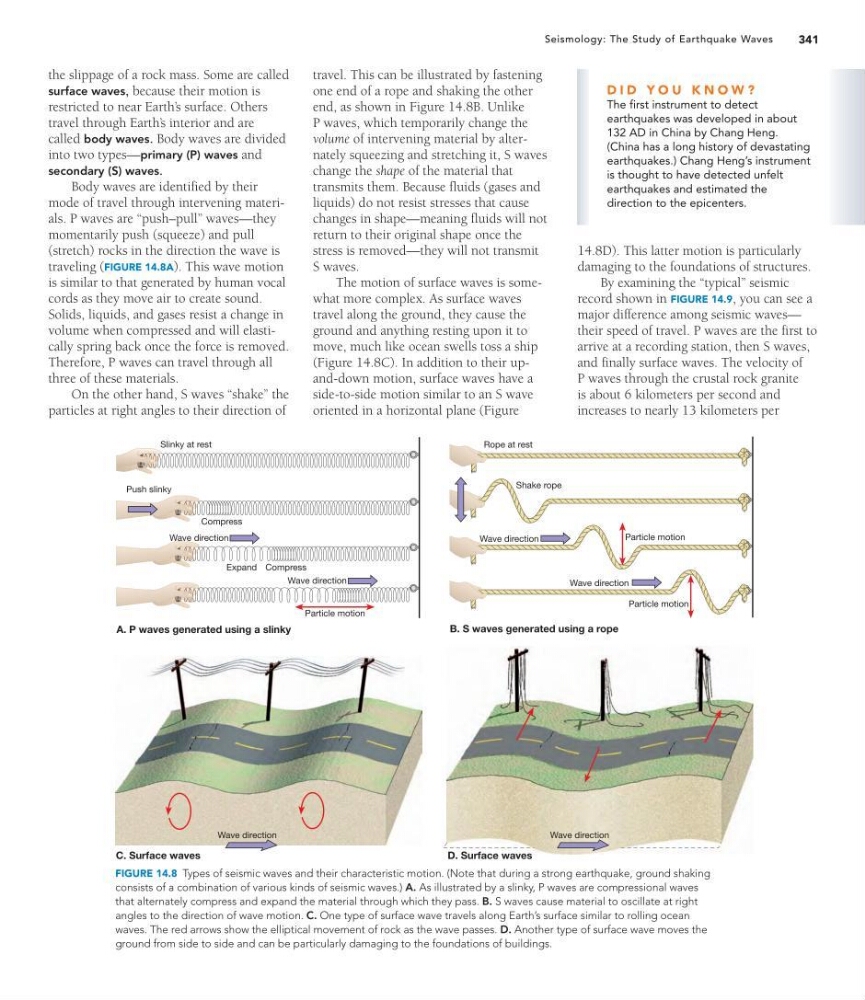
Body waves are identified by their
mode of travel through intervening materials. P waves are “push–pull” waves—they
momentarily push (squeeze) and pull
(stretch) rocks in the direction the wave is
traveling (FIGURE 14.8A). This wave motion
is similar to that generated by human vocal
cords as they move air to create sound.
Solids, liquids, and gases resist a change in
volume when compressed and will elastically spring back once the force is removed.
Therefore, P waves can travel through all
three of these materials.
On the other hand, S waves “shake” the
particles at right angles to their direction of
travel. This can be illustrated by fastening
one end of a rope and shaking the other
end, as shown in Figure 14.8B. Unlike
P waves, which temporarily change the
volume of intervening material by alternately squeezing and stretching it, S waves
change the shape of the material that
transmits them. Because fluids (gases and
liquids) do not resist stresses that cause
changes in shape—meaning fluids will not
return to their original shape once the
stress is removed—they will not transmit
S waves.
The motion of surface waves is somewhat more complex. As surface waves
travel along the ground, they cause the
ground and anything resting upon it to
move, much like ocean swells toss a ship
(Figure 14.8C). In addition to their upand-down motion, surface waves have a
side-to-side motion similar to an S wave
oriented in a horizontal plane (Figure
14.8D). This latter motion is particularly
damaging to the foundations of structures.
By examining the “typical” seismic
record shown in FIGURE 14.9, you can see a
major difference among seismic waves—
their speed of travel. P waves are the first to
arrive at a recording station, then S waves,
and finally surface waves. The velocity of
P waves through the crustal rock granite
is about 6 kilometers per second and
increases to nearly 13 kilometers per
Slinky at rest
Push slinky
Compress
Expand Compress
Wave direction
Particle motion
Wave direction
Particle motion
Rope at rest
Shake rope
Wave direction
Wave direction
Wave direction
Particle motion
Wave direction
A. P waves generated using a slinky
B. S waves generated using a rope
C. Surface waves
D. Surface waves
FIGURE 14.8 Types of seismic waves and their characteristic motion. (Note that during a strong earthquake, ground shaking
consists of a combination of various kinds of seismic waves.) A. As illustrated by a slinky, P waves are compressional waves
that alternately compress and expand the material through which they pass. B. S waves cause material to oscillate at right
angles to the direction of wave motion. C. One type of surface wave travels along Earth’s surface similar to rolling ocean
waves. The red arrows show the elliptical movement of rock as the wave passes. D. Another type of surface wave moves the
ground from side to side and can be particularly damaging to the foundations of buildings.
D I D Y O U K N O W ?
The first instrument to detect
earthquakes was developed in about
132 AD in China by Chang Heng.
(China has a long history of devastating
earthquakes.) Chang Heng’s instrument
is thought to have detected unfelt
earthquakes and estimated the
direction to the epicenters.
Seismology: The Study of Earthquake Waves
the slippage of a rock mass. Some are called
surface waves, because their motion is
restricted to near Earth’ s surface. Others
travel through Earth’ s interior and are
called body waves. Body waves are divided
into two types—primary (P) waves and
secondary (S) waves.
Body waves are identified by their
mode of travel through intervening materials. P waves are “push–pull” waves—they
momentarily push (squeeze) and pull
(stretch) rocks in the direction the wave is
traveling (FIGURE 14.8A). This wave motion
is similar to that generated by human vocal
cords as they move air to create sound.
Solids, liquids, and gases resist a change in
volume when compressed and will elastically spring back once the force is removed.
Therefore, P waves can travel through all
three of these materials.
On the other hand, S waves “shake” the
particles at right angles to their direction of
travel. This can be illustrated by fastening
one end of a rope and shaking the other
end, as shown in Figure 14.8B. Unlike
P waves, which temporarily change the
volume of intervening material by alternately squeezing and stretching it, S waves
change the shape of the material that
transmits them. Because fluids (gases and
liquids) do not resist stresses that cause
changes in shape—meaning fluids will not
return to their original shape once the
stress is removed—they will not transmit
S waves.
The motion of surface waves is somewhat more complex. As surface waves
travel along the ground, they cause the
ground and anything resting upon it to
move, much like ocean swells toss a ship
(Figure 14.8C). In addition to their upand-down motion, surface waves have a
side-to-side motion similar to an S wave
oriented in a horizontal plane (Figure
14.8D). This latter motion is particularly
damaging to the foundations of structures.
By examining the “typical” seismic
record shown in FIGURE 14.9, you can see a
major difference among seismic waves—
their speed of travel. P waves are the first to
arrive at a recording station, then S waves,
and finally surface waves. The velocity of
P waves through the crustal rock granite
is about 6 kilometers per second and
increases to nearly 13 kilometers per
Slinky at rest
Push slinky
Compress
Expand Compress
Wave direction
Particle motion
Wave direction
Particle motion
Rope at rest
Shake rope
Wave direction
Wave direction
Wave direction
Particle motion
Wave direction
A. P waves generated using a slinky
B. S waves generated using a rope
C. Surface waves
D. Surface waves
FIGURE 14.8 Types of seismic waves and their characteristic motion. (Note that during a strong earthquake, ground shaking
consists of a combination of various kinds of seismic waves.) A. As illustrated by a slinky, P waves are compressional waves
that alternately compress and expand the material through which they pass. B. S waves cause material to oscillate at right
angles to the direction of wave motion. C. One type of surface wave travels along Earth’s surface similar to rolling ocean
waves. The red arrows show the elliptical movement of rock as the wave passes. D. Another type of surface wave moves the
ground from side to side and can be particularly damaging to the foundations of buildings.
D I D Y O U K N O W ?
The first instrument to detect
earthquakes was developed in about
132 AD in China by Chang Heng.
(China has a long history of devastating
earthquakes.) Chang Heng’s instrument
is thought to have detected unfelt
earthquakes and estimated the
direction to the epicenters.