

S
a
n
A
n
d
r e a s
F a u l t
Garlock
Fault
Imperial Fault
San Jacinto Fault
C A L I F O R N I A
Los Angeles
San
Francisco
Calaveras
Fault
Hayward
Fault
E E a s te rn C a lif o rn ia S h e a r Z o n e
E a s te rn C a lif o rn ia S h e a r Z o n e
San Andreas Fault
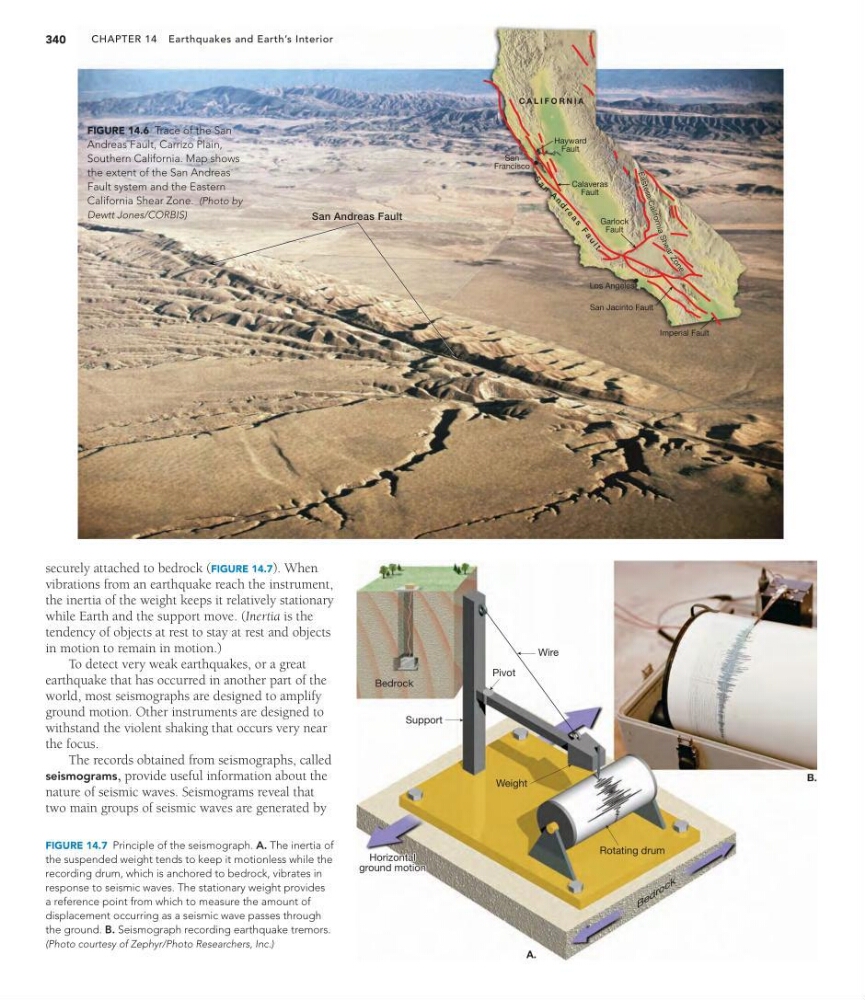
FIGURE 14.6 Trace of the San
Andreas Fault, Carrizo Plain,
Southern California. Map shows
the extent of the San Andreas
Fault system and the Eastern
California Shear Zone. (Photo by
Dewtt Jones/CORBIS)
CHAPTER 14 Earthquakes and Earth’s Interior
340
securely attached to bedrock (FIGURE 14.7). When
vibrations from an earthquake reach the instrument,
the inertia of the weight keeps it relatively stationary
while Earth and the support move. (Inertia is the
tendency of objects at rest to stay at rest and objects
in motion to remain in motion.)
To detect very weak earthquakes, or a great
earthquake that has occurred in another part of the
world, most seismographs are designed to amplify
ground motion. Other instruments are designed to
withstand the violent shaking that occurs very near
the focus.
The records obtained from seismographs, called
seismograms, provide useful information about the
nature of seismic waves. Seismograms reveal that
two main groups of seismic waves are generated by
Support
Bedrock
B e d r o c k
Wire
Pivot
Weight
Rotating drum
Horizontal
Horizontal
ground motion
ground motion
Horizontal
ground motion
A.
B.
FIGURE 14.7 Principle of the seismograph. A. The inertia of
the suspended weight tends to keep it motionless while the
recording drum, which is anchored to bedrock, vibrates in
response to seismic waves. The stationary weight provides
a reference point from which to measure the amount of
displacement occurring as a seismic wave passes through
the ground. B. Seismograph recording earthquake tremors.
(Photo courtesy of Zephyr/Photo Researchers, Inc.)
a
n
A
n
d
r e a s
F a u l t
Garlock
Fault
Imperial Fault
San Jacinto Fault
C A L I F O R N I A
Los Angeles
San
Francisco
Calaveras
Fault
Hayward
Fault
E E a s te rn C a lif o rn ia S h e a r Z o n e
E a s te rn C a lif o rn ia S h e a r Z o n e
San Andreas Fault
FIGURE 14.6 Trace of the San
Andreas Fault, Carrizo Plain,
Southern California. Map shows
the extent of the San Andreas
Fault system and the Eastern
California Shear Zone. (Photo by
Dewtt Jones/CORBIS)
CHAPTER 14 Earthquakes and Earth’s Interior
340
securely attached to bedrock (FIGURE 14.7). When
vibrations from an earthquake reach the instrument,
the inertia of the weight keeps it relatively stationary
while Earth and the support move. (Inertia is the
tendency of objects at rest to stay at rest and objects
in motion to remain in motion.)
To detect very weak earthquakes, or a great
earthquake that has occurred in another part of the
world, most seismographs are designed to amplify
ground motion. Other instruments are designed to
withstand the violent shaking that occurs very near
the focus.
The records obtained from seismographs, called
seismograms, provide useful information about the
nature of seismic waves. Seismograms reveal that
two main groups of seismic waves are generated by
Support
Bedrock
B e d r o c k
Wire
Pivot
Weight
Rotating drum
Horizontal
Horizontal
ground motion
ground motion
Horizontal
ground motion
A.
B.
FIGURE 14.7 Principle of the seismograph. A. The inertia of
the suspended weight tends to keep it motionless while the
recording drum, which is anchored to bedrock, vibrates in
response to seismic waves. The stationary weight provides
a reference point from which to measure the amount of
displacement occurring as a seismic wave passes through
the ground. B. Seismograph recording earthquake tremors.
(Photo courtesy of Zephyr/Photo Researchers, Inc.)