

tsunami
339
Seismology: The Study of Earthquake Waves
D I D Y O U K N O W ?
Humans have inadvertently triggered
earthquakes. In 1962 Denver began
experiencing frequent tremors. The
earthquakes were located near an army
waste-disposal well used to inject waste
into the ground. Investigators
concluded that the pressurized fluids
made their way along a buried fault
surface, which reduced friction and
triggered fault slippage and
earthquakes. Sure enough, when the
pumping halted, so did the tremors.
28 aftershocks were recorded, 10 of which
had magnitudes that exceeded 6. More
than 10,000 aftershocks with magnitudes
of 3.5 or above occurred in the following
69 days and thousands of minor tremors
were recorded over a span of 18 months.
Because aftershocks happen mainly on the
section of the fault that has slipped, they
provide geologists with data that is useful
in establishing the dimensions of the
rupture surface.
Although aftershocks are weaker than
the main earthquake, they can trigger the
destruction of already weakened structures.
This occurred in northwestern Armenia
(1988) where many people lived in large
apartment buildings constructed of brick
and concrete slabs. After a moderate
earthquake of magnitude 6.9 weakened
the buildings, a strong aftershock of magnitude 5.8 completed the demolition.
In contrast to aftershocks, small earthquakes called foreshocks often precede a
major earthquake by days or in some cases
years. Monitoring of foreshocks to predict
forthcoming earthquakes has been
attempted with limited success.
C O N C E P T C H E C K 1 4 . 2
What is an earthquake? Under what
circumstances do earthquakes occur?
How are faults, foci, and epicenters
related?
Who was first to explain the actual mechanism by which earthquakes are generated?
Sketch or explain what is meant by elastic
rebound.
4
3
2
1
Earthquakes
and Faults
Earthquakes take place along faults both
new and old that occur in places where
differential stresses have ruptured Earth’ s
crust. Some faults are large and capable of
generating major earthquakes. One example is the San Andreas Fault, which is the
transform fault boundary that separates two
great sections of Earth’ s lithosphere: the
North American plate and the Pacific plate.
Other faults are small and capable of
producing only minor earthquakes.
Most of the displacement that occurs
along faults can be satisfactorily explained
by the plate tectonics theory, which states
that large slabs of Earth’ s lithosphere are in
continual slow motion. These mobile plates
interact with neighboring plates, straining
and deforming the rocks at their margins.
Faults associated with plate boundaries are
the source of most large earthquakes.
Large faults are not perfectly straight or
continuous; instead, they consist of numerous branches and smaller fractures that
display kinks and offsets. Such a pattern is
displayed in FIGURE 14.6, which shows the
San Andreas Fault as a system of several
faults of various sizes.
The San Andreas is undoubtedly the
most studied fault system in the world.
Over the years, research has shown that
displacement occurs along discrete segments that behave somewhat differently
from one another. A few sections of the San
Andreas exhibit a slow, gradual displacement known as fault creep, which occurs
without the buildup of significant
strain. These sections produce
only minor seismic shaking.
Other segments slip at
regular intervals,
producing small to moderate earthquakes. Still
other segments remain
locked and store energy
for a few hundred years
before rupturing in
great earthquakes.
Earthquakes that
occur along locked
segments of the San
Andreas Fault tend to
be repetitive. As soon as one is over, the
continuous motion of the plates begins
building strain anew. Decades or centuries
later, the fault fails again.
C O N C E P T C H E C K 1 4 . 3
Faults that are experiencing no active
creep may be considered safe. Rebut or
defend this statement.
Why is the San Andreas sometimes
referred to as a fault system?
Seismology:
The Study
of Earthquake Waves
Earthquakes
Seismology
The study of earthquake waves,
seismology, dates back to attempts made
by the Chinese almost 2000 years ago to
determine the direction from which these
waves originated. Modern seismographs,
instruments that record earthquake waves,
are similar to the instruments used by the
Chinese. Seismographs have
a weight freely suspended
from a support that is
GEODe
ESSENTIALS
OF GEOLOGY
2
1
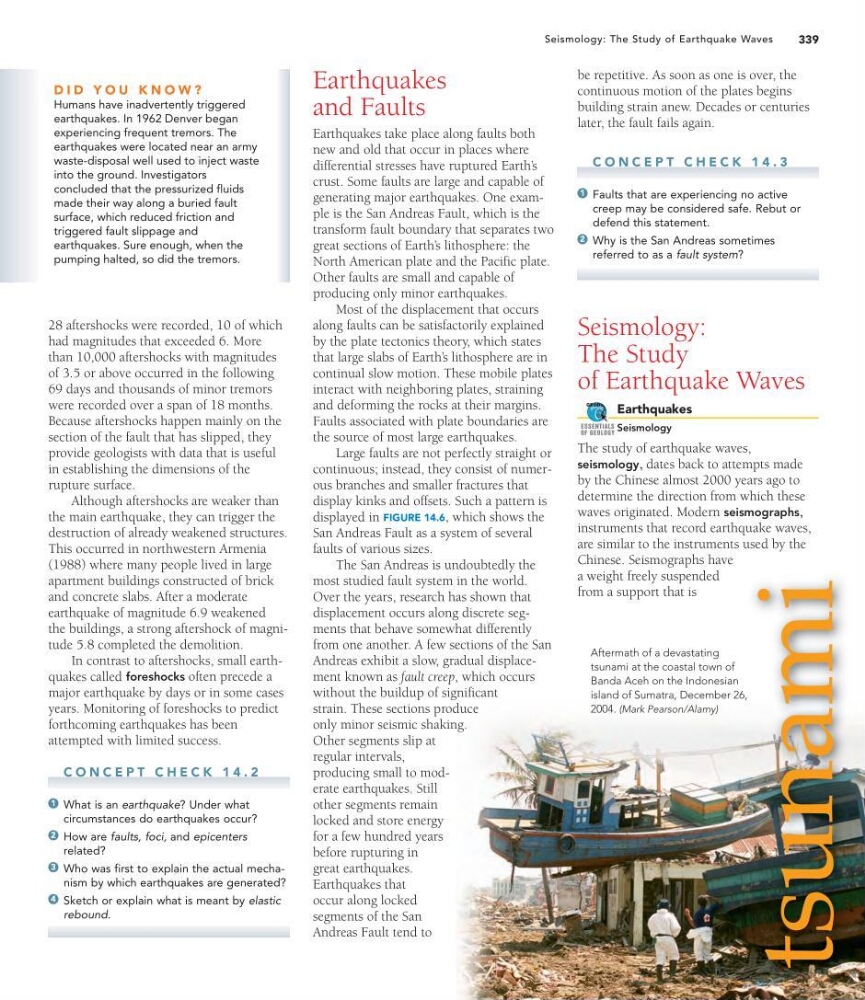
Aftermath of a devastating
tsunami at the coastal town of
Banda Aceh on the Indonesian
island of Sumatra, December 26,
2004. (Mark Pearson/Alamy)
339
Seismology: The Study of Earthquake Waves
D I D Y O U K N O W ?
Humans have inadvertently triggered
earthquakes. In 1962 Denver began
experiencing frequent tremors. The
earthquakes were located near an army
waste-disposal well used to inject waste
into the ground. Investigators
concluded that the pressurized fluids
made their way along a buried fault
surface, which reduced friction and
triggered fault slippage and
earthquakes. Sure enough, when the
pumping halted, so did the tremors.
28 aftershocks were recorded, 10 of which
had magnitudes that exceeded 6. More
than 10,000 aftershocks with magnitudes
of 3.5 or above occurred in the following
69 days and thousands of minor tremors
were recorded over a span of 18 months.
Because aftershocks happen mainly on the
section of the fault that has slipped, they
provide geologists with data that is useful
in establishing the dimensions of the
rupture surface.
Although aftershocks are weaker than
the main earthquake, they can trigger the
destruction of already weakened structures.
This occurred in northwestern Armenia
(1988) where many people lived in large
apartment buildings constructed of brick
and concrete slabs. After a moderate
earthquake of magnitude 6.9 weakened
the buildings, a strong aftershock of magnitude 5.8 completed the demolition.
In contrast to aftershocks, small earthquakes called foreshocks often precede a
major earthquake by days or in some cases
years. Monitoring of foreshocks to predict
forthcoming earthquakes has been
attempted with limited success.
C O N C E P T C H E C K 1 4 . 2
What is an earthquake? Under what
circumstances do earthquakes occur?
How are faults, foci, and epicenters
related?
Who was first to explain the actual mechanism by which earthquakes are generated?
Sketch or explain what is meant by elastic
rebound.
4
3
2
1
Earthquakes
and Faults
Earthquakes take place along faults both
new and old that occur in places where
differential stresses have ruptured Earth’ s
crust. Some faults are large and capable of
generating major earthquakes. One example is the San Andreas Fault, which is the
transform fault boundary that separates two
great sections of Earth’ s lithosphere: the
North American plate and the Pacific plate.
Other faults are small and capable of
producing only minor earthquakes.
Most of the displacement that occurs
along faults can be satisfactorily explained
by the plate tectonics theory, which states
that large slabs of Earth’ s lithosphere are in
continual slow motion. These mobile plates
interact with neighboring plates, straining
and deforming the rocks at their margins.
Faults associated with plate boundaries are
the source of most large earthquakes.
Large faults are not perfectly straight or
continuous; instead, they consist of numerous branches and smaller fractures that
display kinks and offsets. Such a pattern is
displayed in FIGURE 14.6, which shows the
San Andreas Fault as a system of several
faults of various sizes.
The San Andreas is undoubtedly the
most studied fault system in the world.
Over the years, research has shown that
displacement occurs along discrete segments that behave somewhat differently
from one another. A few sections of the San
Andreas exhibit a slow, gradual displacement known as fault creep, which occurs
without the buildup of significant
strain. These sections produce
only minor seismic shaking.
Other segments slip at
regular intervals,
producing small to moderate earthquakes. Still
other segments remain
locked and store energy
for a few hundred years
before rupturing in
great earthquakes.
Earthquakes that
occur along locked
segments of the San
Andreas Fault tend to
be repetitive. As soon as one is over, the
continuous motion of the plates begins
building strain anew. Decades or centuries
later, the fault fails again.
C O N C E P T C H E C K 1 4 . 3
Faults that are experiencing no active
creep may be considered safe. Rebut or
defend this statement.
Why is the San Andreas sometimes
referred to as a fault system?
Seismology:
The Study
of Earthquake Waves
Earthquakes
Seismology
The study of earthquake waves,
seismology, dates back to attempts made
by the Chinese almost 2000 years ago to
determine the direction from which these
waves originated. Modern seismographs,
instruments that record earthquake waves,
are similar to the instruments used by the
Chinese. Seismographs have
a weight freely suspended
from a support that is
GEODe
ESSENTIALS
OF GEOLOGY
2
1
Aftermath of a devastating
tsunami at the coastal town of
Banda Aceh on the Indonesian
island of Sumatra, December 26,
2004. (Mark Pearson/Alamy)