

Deformation of rocks
T I M E
Fault
A. Original position
B. Buildup of strain
C. Slippage (earthquake)
D. Strain released
Deformation of a
limber stick
Seconds to a few minutes
Tens to hundreds of years
Stream
Fault
A. Original position
B. Buildup of strain
C. Slippage (earthquake)
D. Strain released
CHAPTER 14 Earthquakes and Earth’s Interior
338
FIGURE 14.4 Slippage
along a fault produced an
offset in this orange grove
east of Calexico, California.
(Photo by John S. Shelton)
Inset photo shows a fence
offset 2.5 meters (8.5 feet)
during the 1906 San
Francisco earthquake.
(Photo by G. K. Gilbert,
U.S. Geological Survey)
in fence lines, roads, and other structures
indicate that horizontal movements are also
common (FIGURE 14.4).
The actual mechanism of earthquake
generation eluded geologists until
H. F. Reid of Johns Hopkins University
conducted a study following the great 1906
San Francisco earthquake. The earthquake
was accompanied by horizontal surface
displacements of several meters along the
northern portion of the San Andreas Fault.
Field studies determined that during this
single earthquake, the Pacific plate lurched
as much as 4.7 meters (15 feet) northward
past the adjacent North American plate.
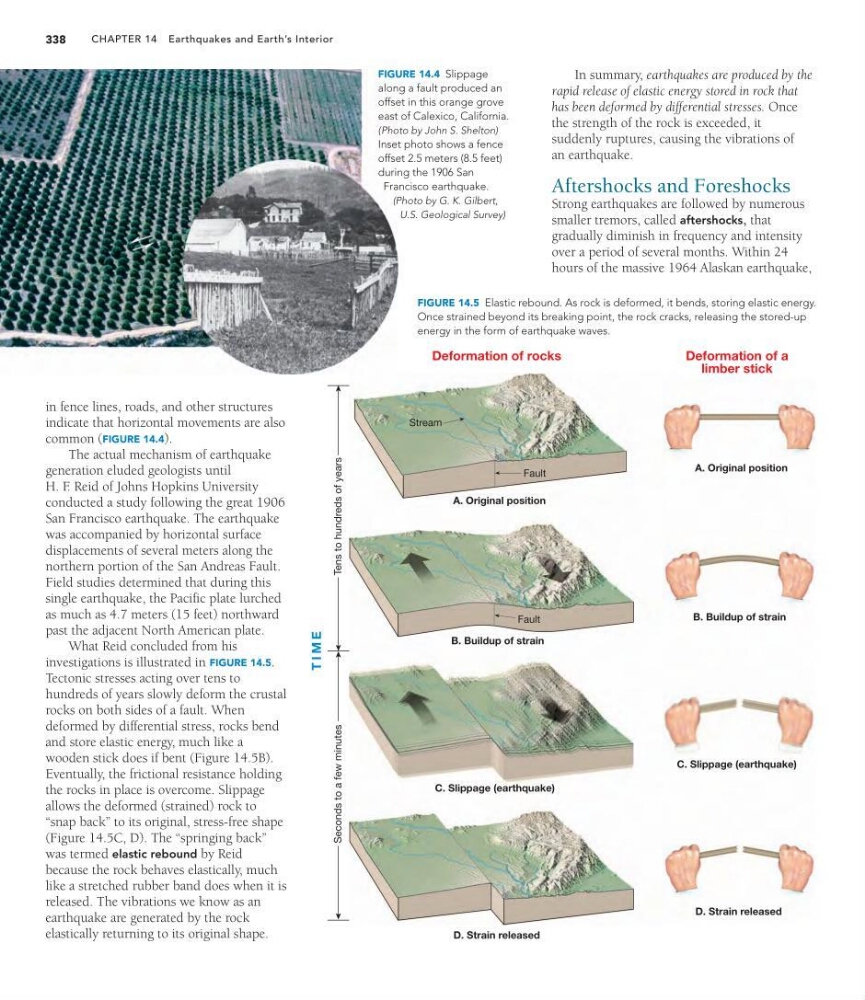
What Reid concluded from his
investigations is illustrated in FIGURE 14.5.
Tectonic stresses acting over tens to
hundreds of years slowly deform the crustal
rocks on both sides of a fault. When
deformed by differential stress, rocks bend
and store elastic energy, much like a
wooden stick does if bent (Figure 14.5B).
Eventually, the frictional resistance holding
the rocks in place is overcome. Slippage
allows the deformed (strained) rock to
“snap back” to its original, stress-free shape
(Figure 14.5C, D). The “springing back”
was termed elastic rebound by Reid
because the rock behaves elastically, much
like a stretched rubber band does when it is
released. The vibrations we know as an
earthquake are generated by the rock
elastically returning to its original shape.
In summary, earthquakes are produced by the
rapid release of elastic energy stored in rock that
has been deformed by differential stresses. Once
the strength of the rock is exceeded, it
suddenly ruptures, causing the vibrations of
an earthquake.
Aftershocks and Foreshocks
Strong earthquakes are followed by numerous
smaller tremors, called aftershocks, that
gradually diminish in frequency and intensity
over a period of several months. Within 24
hours of the massive 1964 Alaskan earthquake,
FIGURE 14.5 Elastic rebound. As rock is deformed, it bends, storing elastic energy.
Once strained beyond its breaking point, the rock cracks, releasing the stored-up
energy in the form of earthquake waves.
T I M E
Fault
A. Original position
B. Buildup of strain
C. Slippage (earthquake)
D. Strain released
Deformation of a
limber stick
Seconds to a few minutes
Tens to hundreds of years
Stream
Fault
A. Original position
B. Buildup of strain
C. Slippage (earthquake)
D. Strain released
CHAPTER 14 Earthquakes and Earth’s Interior
338
FIGURE 14.4 Slippage
along a fault produced an
offset in this orange grove
east of Calexico, California.
(Photo by John S. Shelton)
Inset photo shows a fence
offset 2.5 meters (8.5 feet)
during the 1906 San
Francisco earthquake.
(Photo by G. K. Gilbert,
U.S. Geological Survey)
in fence lines, roads, and other structures
indicate that horizontal movements are also
common (FIGURE 14.4).
The actual mechanism of earthquake
generation eluded geologists until
H. F. Reid of Johns Hopkins University
conducted a study following the great 1906
San Francisco earthquake. The earthquake
was accompanied by horizontal surface
displacements of several meters along the
northern portion of the San Andreas Fault.
Field studies determined that during this
single earthquake, the Pacific plate lurched
as much as 4.7 meters (15 feet) northward
past the adjacent North American plate.
What Reid concluded from his
investigations is illustrated in FIGURE 14.5.
Tectonic stresses acting over tens to
hundreds of years slowly deform the crustal
rocks on both sides of a fault. When
deformed by differential stress, rocks bend
and store elastic energy, much like a
wooden stick does if bent (Figure 14.5B).
Eventually, the frictional resistance holding
the rocks in place is overcome. Slippage
allows the deformed (strained) rock to
“snap back” to its original, stress-free shape
(Figure 14.5C, D). The “springing back”
was termed elastic rebound by Reid
because the rock behaves elastically, much
like a stretched rubber band does when it is
released. The vibrations we know as an
earthquake are generated by the rock
elastically returning to its original shape.
In summary, earthquakes are produced by the
rapid release of elastic energy stored in rock that
has been deformed by differential stresses. Once
the strength of the rock is exceeded, it
suddenly ruptures, causing the vibrations of
an earthquake.
Aftershocks and Foreshocks
Strong earthquakes are followed by numerous
smaller tremors, called aftershocks, that
gradually diminish in frequency and intensity
over a period of several months. Within 24
hours of the massive 1964 Alaskan earthquake,
FIGURE 14.5 Elastic rebound. As rock is deformed, it bends, storing elastic energy.
Once strained beyond its breaking point, the rock cracks, releasing the stored-up
energy in the form of earthquake waves.