

CHAPTER 13 Shorelines
322
BEACH NOURISHMENT. Beach nourishment represents an approach to stabilizing
shoreline sands without hard stabilization.
As the term implies, this practice simply
involves the addition of large quantities of
sand to the beach system (FIGURE 13.22). By
building the beaches seaward storm protection is improved. Beach nourishment, however, is not a permanent solution to the
problem of shrinking beaches. The same
processes that removed the sand in the first
place will eventually remove the replacement sand as well. In addition, beach
nourishment is very expensive because
huge volumes of sand must be transported
to the beach from offshore areas, nearby
rivers, or other source areas. Orrin Pilkey, a
respected coasted scientist, described the
situation this way:
Nourishment has been carried out on beaches on both sides
of the continent, but by far the greatest effort in dollars
and sand volume has been expended on the East Coast
barrier islands between the southern shore of Long Island,
New York, and southern Florida. Over this shoreline reach,
communities have added a total of 500 million cubic yards
of sand on 195 beaches in 680 separate instances. Some
beaches...have been renourished more than 20 times each
since 1965. Virginia Beach has been renourished more than
50 times. Nourished beaches typically cost between $2 million and $10 million per mile.*
In some instances, beach nourishment
can lead to unwanted environmental
effects. For example, beach replenishment
at Waikiki Beach, Hawaii, involved replacFIGURE 13.21 Seabright in northern New Jersey once had a broad, sandy
beach. A seawall 5 to 6 meters (16 to 20 feet) high and 8 kilometers
(5 miles) long was built to protect the town and the railroad that brought
tourists to the beach. As you can see, after the wall was built, the beach
narrowed dramatically. (Photo by Rafael Macia/Photo Researchers, Inc.)
is designed to armor the coast and defend
property from the force of breaking waves.
Waves expend much of their energy as they
move across an open beach. Seawalls cut
this process short by reflecting the force of
unspent waves seaward. As a consequence,
the beach to the seaward side of the seawall
experiences significant erosion and may, in
some instances, be eliminated entirely
(FIGURE 13.21). Once the width of the beach
is reduced, the seawall is subjected to even
greater pounding by the waves. Eventually
this battering will cause the wall to fail, and a larger, more expensive wall
must be built to take its place.
The wisdom of building temporary protective structures along shorelines is increasingly questioned. The feelings of many coastal scientists and
engineers are expressed in the following excerpt from a position paper that
grew out of a conference on America’ s eroding shoreline:
It is now clear that halting the receding shoreline with protective structures benefits only a few and seriously degrades
or destroys the natural beach and the value it holds for the majority. Protective structures divert the ocean’s energy temporarily from private properties, but usually refocus the energy on the adjacent natural beaches. Many interrupt the
natural sand flow in coastal currents, robbing many beaches of vital sand replacement.*
Alternatives to Hard Stabilization
Armoring the coast with hard stabilization has several potential drawbacks, including the
cost of the structure and the loss of sand on the beach. Alternatives to hard stabilization
include beach nourishment and relocation.
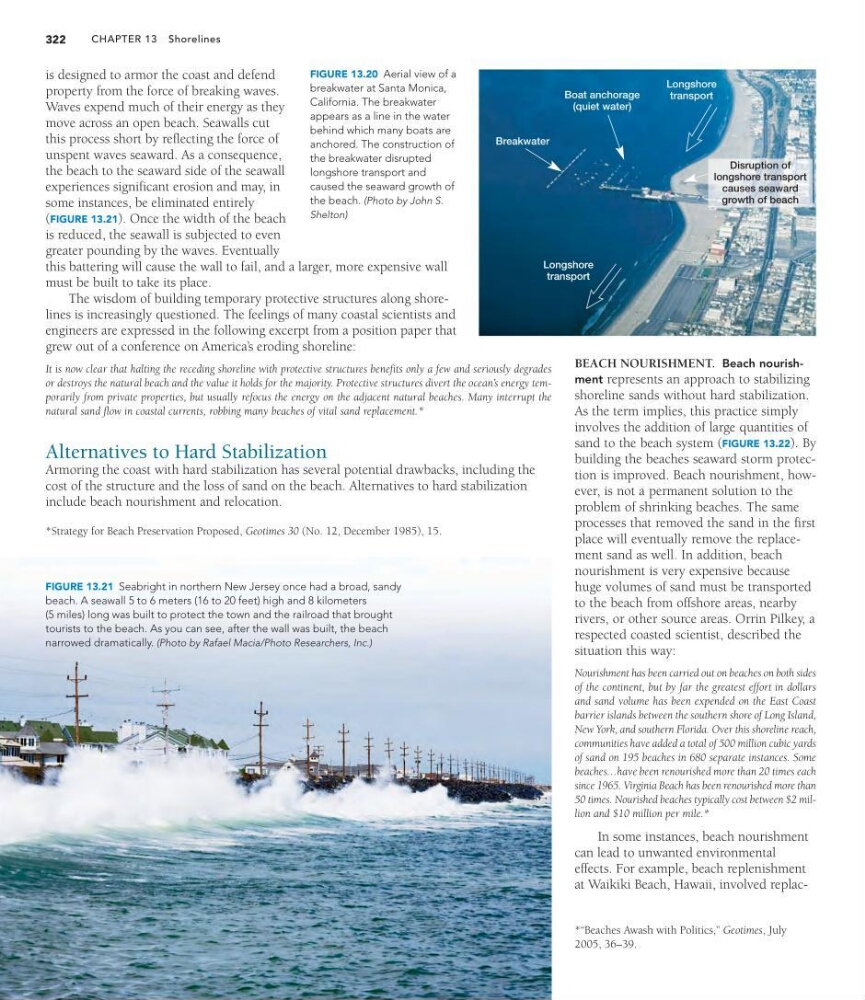
Breakwater
Boat anchorage
(quiet water)
Disruption of
longshore transport
causes seaward
growth of beach
Longshore
transport
Longshore
transport
FIGURE 13.20 Aerial view of a
breakwater at Santa Monica,
California. The breakwater
appears as a line in the water
behind which many boats are
anchored. The construction of
the breakwater disrupted
longshore transport and
caused the seaward growth of
the beach. (Photo by John S.
Shelton)
*Strategy for Beach Preservation Proposed, Geotimes 30 (No. 12, December 1985), 15.
*“Beaches Awash with Politics,” Geotimes, July
2005, 36–39.
322
BEACH NOURISHMENT. Beach nourishment represents an approach to stabilizing
shoreline sands without hard stabilization.
As the term implies, this practice simply
involves the addition of large quantities of
sand to the beach system (FIGURE 13.22). By
building the beaches seaward storm protection is improved. Beach nourishment, however, is not a permanent solution to the
problem of shrinking beaches. The same
processes that removed the sand in the first
place will eventually remove the replacement sand as well. In addition, beach
nourishment is very expensive because
huge volumes of sand must be transported
to the beach from offshore areas, nearby
rivers, or other source areas. Orrin Pilkey, a
respected coasted scientist, described the
situation this way:
Nourishment has been carried out on beaches on both sides
of the continent, but by far the greatest effort in dollars
and sand volume has been expended on the East Coast
barrier islands between the southern shore of Long Island,
New York, and southern Florida. Over this shoreline reach,
communities have added a total of 500 million cubic yards
of sand on 195 beaches in 680 separate instances. Some
beaches...have been renourished more than 20 times each
since 1965. Virginia Beach has been renourished more than
50 times. Nourished beaches typically cost between $2 million and $10 million per mile.*
In some instances, beach nourishment
can lead to unwanted environmental
effects. For example, beach replenishment
at Waikiki Beach, Hawaii, involved replacFIGURE 13.21 Seabright in northern New Jersey once had a broad, sandy
beach. A seawall 5 to 6 meters (16 to 20 feet) high and 8 kilometers
(5 miles) long was built to protect the town and the railroad that brought
tourists to the beach. As you can see, after the wall was built, the beach
narrowed dramatically. (Photo by Rafael Macia/Photo Researchers, Inc.)
is designed to armor the coast and defend
property from the force of breaking waves.
Waves expend much of their energy as they
move across an open beach. Seawalls cut
this process short by reflecting the force of
unspent waves seaward. As a consequence,
the beach to the seaward side of the seawall
experiences significant erosion and may, in
some instances, be eliminated entirely
(FIGURE 13.21). Once the width of the beach
is reduced, the seawall is subjected to even
greater pounding by the waves. Eventually
this battering will cause the wall to fail, and a larger, more expensive wall
must be built to take its place.
The wisdom of building temporary protective structures along shorelines is increasingly questioned. The feelings of many coastal scientists and
engineers are expressed in the following excerpt from a position paper that
grew out of a conference on America’ s eroding shoreline:
It is now clear that halting the receding shoreline with protective structures benefits only a few and seriously degrades
or destroys the natural beach and the value it holds for the majority. Protective structures divert the ocean’s energy temporarily from private properties, but usually refocus the energy on the adjacent natural beaches. Many interrupt the
natural sand flow in coastal currents, robbing many beaches of vital sand replacement.*
Alternatives to Hard Stabilization
Armoring the coast with hard stabilization has several potential drawbacks, including the
cost of the structure and the loss of sand on the beach. Alternatives to hard stabilization
include beach nourishment and relocation.
Breakwater
Boat anchorage
(quiet water)
Disruption of
longshore transport
causes seaward
growth of beach
Longshore
transport
Longshore
transport
FIGURE 13.20 Aerial view of a
breakwater at Santa Monica,
California. The breakwater
appears as a line in the water
behind which many boats are
anchored. The construction of
the breakwater disrupted
longshore transport and
caused the seaward growth of
the beach. (Photo by John S.
Shelton)
*Strategy for Beach Preservation Proposed, Geotimes 30 (No. 12, December 1985), 15.
*“Beaches Awash with Politics,” Geotimes, July
2005, 36–39.