

321
Stabilizing the Shore
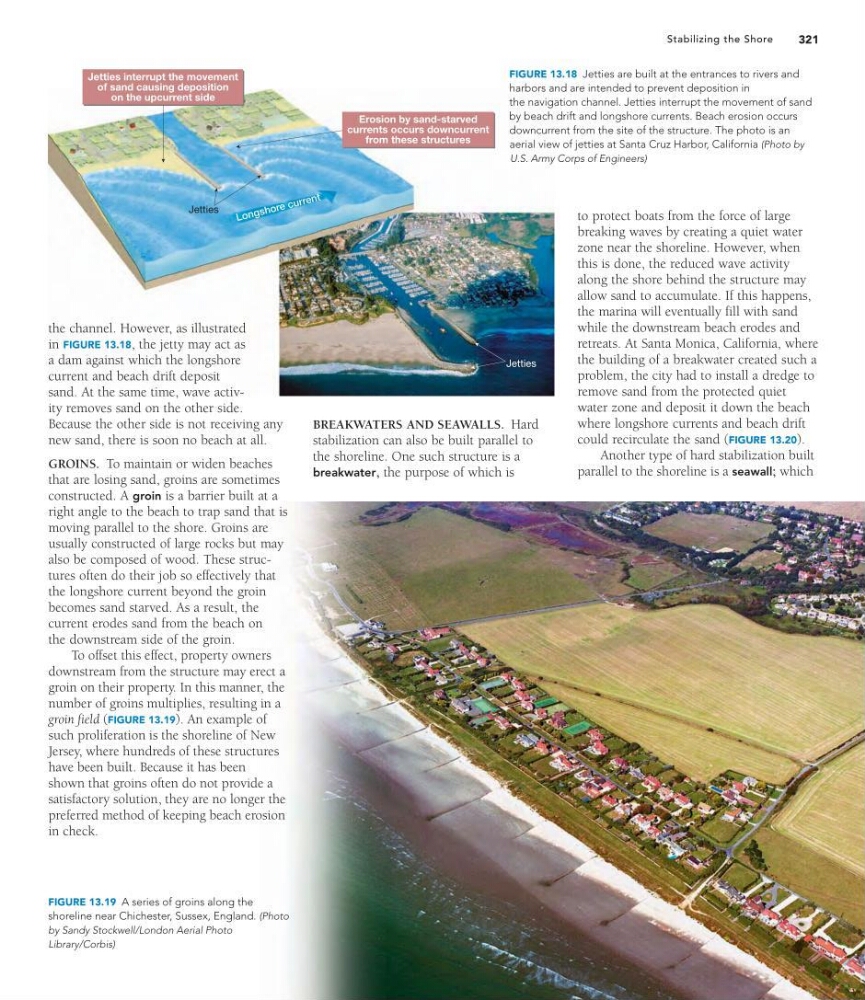
Jetties interrupt the movement
of sand causing deposition
on the upcurrent side
Erosion by sand-starved
currents occurs downcurrent
from these structures
Jetties
L o n g s h o re c u rr e n t
Jetties
FIGURE 13.18 Jetties are built at the entrances to rivers and
harbors and are intended to prevent deposition in
the navigation channel. Jetties interrupt the movement of sand
by beach drift and longshore currents. Beach erosion occurs
downcurrent from the site of the structure. The photo is an
aerial view of jetties at Santa Cruz Harbor, California (Photo by
U.S. Army Corps of Engineers)
FIGURE 13.19 A series of groins along the
shoreline near Chichester, Sussex, England. (Photo
by Sandy Stockwell/London Aerial Photo
Library/Corbis)
the channel. However, as illustrated
in FIGURE 13.18, the jetty may act as
a dam against which the longshore
current and beach drift deposit
sand. At the same time, wave activity removes sand on the other side.
Because the other side is not receiving any
new sand, there is soon no beach at all.
GROINS. To maintain or widen beaches
that are losing sand, groins are sometimes
constructed. A groin is a barrier built at a
right angle to the beach to trap sand that is
moving parallel to the shore. Groins are
usually constructed of large rocks but may
also be composed of wood. These structures often do their job so effectively that
the longshore current beyond the groin
becomes sand starved. As a result, the
current erodes sand from the beach on
the downstream side of the groin.
To offset this effect, property owners
downstream from the structure may erect a
groin on their property. In this manner, the
number of groins multiplies, resulting in a
groin field (FIGURE 13.19). An example of
such proliferation is the shoreline of New
Jersey, where hundreds of these structures
have been built. Because it has been
shown that groins often do not provide a
satisfactory solution, they are no longer the
preferred method of keeping beach erosion
in check.
BREAKWATERS AND SEAWALLS. Hard
stabilization can also be built parallel to
the shoreline. One such structure is a
breakwater, the purpose of which is
to protect boats from the force of large
breaking waves by creating a quiet water
zone near the shoreline. However, when
this is done, the reduced wave activity
along the shore behind the structure may
allow sand to accumulate. If this happens,
the marina will eventually fill with sand
while the downstream beach erodes and
retreats. At Santa Monica, California, where
the building of a breakwater created such a
problem, the city had to install a dredge to
remove sand from the protected quiet
water zone and deposit it down the beach
where longshore currents and beach drift
could recirculate the sand (FIGURE 13.20).
Another type of hard stabilization built
parallel to the shoreline is a seawall; which
Stabilizing the Shore
Jetties interrupt the movement
of sand causing deposition
on the upcurrent side
Erosion by sand-starved
currents occurs downcurrent
from these structures
Jetties
L o n g s h o re c u rr e n t
Jetties
FIGURE 13.18 Jetties are built at the entrances to rivers and
harbors and are intended to prevent deposition in
the navigation channel. Jetties interrupt the movement of sand
by beach drift and longshore currents. Beach erosion occurs
downcurrent from the site of the structure. The photo is an
aerial view of jetties at Santa Cruz Harbor, California (Photo by
U.S. Army Corps of Engineers)
FIGURE 13.19 A series of groins along the
shoreline near Chichester, Sussex, England. (Photo
by Sandy Stockwell/London Aerial Photo
Library/Corbis)
the channel. However, as illustrated
in FIGURE 13.18, the jetty may act as
a dam against which the longshore
current and beach drift deposit
sand. At the same time, wave activity removes sand on the other side.
Because the other side is not receiving any
new sand, there is soon no beach at all.
GROINS. To maintain or widen beaches
that are losing sand, groins are sometimes
constructed. A groin is a barrier built at a
right angle to the beach to trap sand that is
moving parallel to the shore. Groins are
usually constructed of large rocks but may
also be composed of wood. These structures often do their job so effectively that
the longshore current beyond the groin
becomes sand starved. As a result, the
current erodes sand from the beach on
the downstream side of the groin.
To offset this effect, property owners
downstream from the structure may erect a
groin on their property. In this manner, the
number of groins multiplies, resulting in a
groin field (FIGURE 13.19). An example of
such proliferation is the shoreline of New
Jersey, where hundreds of these structures
have been built. Because it has been
shown that groins often do not provide a
satisfactory solution, they are no longer the
preferred method of keeping beach erosion
in check.
BREAKWATERS AND SEAWALLS. Hard
stabilization can also be built parallel to
the shoreline. One such structure is a
breakwater, the purpose of which is
to protect boats from the force of large
breaking waves by creating a quiet water
zone near the shoreline. However, when
this is done, the reduced wave activity
along the shore behind the structure may
allow sand to accumulate. If this happens,
the marina will eventually fill with sand
while the downstream beach erodes and
retreats. At Santa Monica, California, where
the building of a breakwater created such a
problem, the city had to install a dredge to
remove sand from the protected quiet
water zone and deposit it down the beach
where longshore currents and beach drift
could recirculate the sand (FIGURE 13.20).
Another type of hard stabilization built
parallel to the shoreline is a seawall; which