

CHAPTER 13 Shorelines
320
A.
B.
C.
Bay
Sea arch
Island
T
I
M
E
Spit
Wave-cut cliff
Sea stack
Tombolo
Baymouth
bar
Wave-cut
cliff
Spit
Beach
deposits
Lo ng sh or e cu rre nt
Wave-cut
platform
Sea arch
Tombolo
Spit
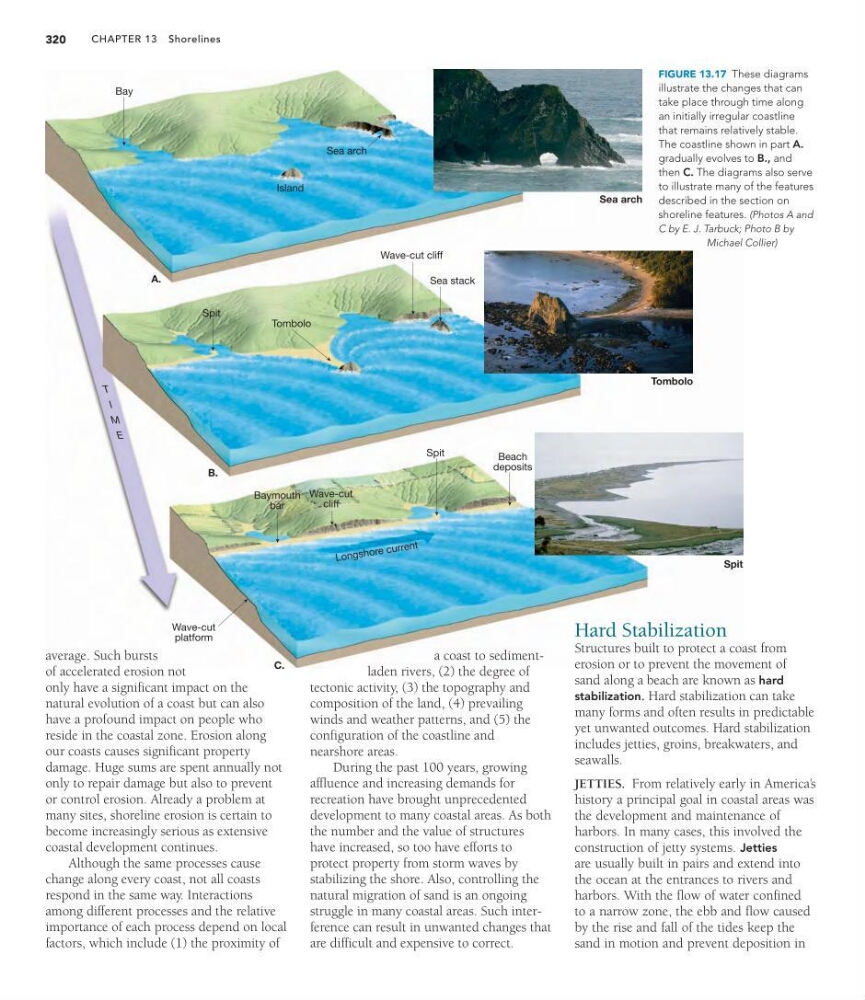
FIGURE 13.17 These diagrams
illustrate the changes that can
take place through time along
an initially irregular coastline
that remains relatively stable.
The coastline shown in part A.
gradually evolves to B., and
then C. The diagrams also serve
to illustrate many of the features
described in the section on
shoreline features. (Photos A and
C by E. J. Tarbuck; Photo B by
Michael Collier)
average. Such bursts
of accelerated erosion not
only have a significant impact on the
natural evolution of a coast but can also
have a profound impact on people who
reside in the coastal zone. Erosion along
our coasts causes significant property
damage. Huge sums are spent annually not
only to repair damage but also to prevent
or control erosion. Already a problem at
many sites, shoreline erosion is certain to
become increasingly serious as extensive
coastal development continues.
Although the same processes cause
change along every coast, not all coasts
respond in the same way. Interactions
among different processes and the relative
importance of each process depend on local
factors, which include (1) the proximity of
a coast to sedimentladen rivers, (2) the degree of
tectonic activity, (3) the topography and
composition of the land, (4) prevailing
winds and weather patterns, and (5) the
configuration of the coastline and
nearshore areas.
During the past 100 years, growing
affluence and increasing demands for
recreation have brought unprecedented
development to many coastal areas. As both
the number and the value of structures
have increased, so too have efforts to
protect property from storm waves by
stabilizing the shore. Also, controlling the
natural migration of sand is an ongoing
struggle in many coastal areas. Such interference can result in unwanted changes that
are difficult and expensive to correct.
Hard Stabilization
Structures built to protect a coast from
erosion or to prevent the movement of
sand along a beach are known as hard
stabilization. Hard stabilization can take
many forms and often results in predictable
yet unwanted outcomes. Hard stabilization
includes jetties, groins, breakwaters, and
seawalls.
JETTIES. From relatively early in America’ s
history a principal goal in coastal areas was
the development and maintenance of
harbors. In many cases, this involved the
construction of jetty systems. Jetties
are usually built in pairs and extend into
the ocean at the entrances to rivers and
harbors. With the flow of water confined
to a narrow zone, the ebb and flow caused
by the rise and fall of the tides keep the
sand in motion and prevent deposition in
320
A.
B.
C.
Bay
Sea arch
Island
T
I
M
E
Spit
Wave-cut cliff
Sea stack
Tombolo
Baymouth
bar
Wave-cut
cliff
Spit
Beach
deposits
Lo ng sh or e cu rre nt
Wave-cut
platform
Sea arch
Tombolo
Spit
FIGURE 13.17 These diagrams
illustrate the changes that can
take place through time along
an initially irregular coastline
that remains relatively stable.
The coastline shown in part A.
gradually evolves to B., and
then C. The diagrams also serve
to illustrate many of the features
described in the section on
shoreline features. (Photos A and
C by E. J. Tarbuck; Photo B by
Michael Collier)
average. Such bursts
of accelerated erosion not
only have a significant impact on the
natural evolution of a coast but can also
have a profound impact on people who
reside in the coastal zone. Erosion along
our coasts causes significant property
damage. Huge sums are spent annually not
only to repair damage but also to prevent
or control erosion. Already a problem at
many sites, shoreline erosion is certain to
become increasingly serious as extensive
coastal development continues.
Although the same processes cause
change along every coast, not all coasts
respond in the same way. Interactions
among different processes and the relative
importance of each process depend on local
factors, which include (1) the proximity of
a coast to sedimentladen rivers, (2) the degree of
tectonic activity, (3) the topography and
composition of the land, (4) prevailing
winds and weather patterns, and (5) the
configuration of the coastline and
nearshore areas.
During the past 100 years, growing
affluence and increasing demands for
recreation have brought unprecedented
development to many coastal areas. As both
the number and the value of structures
have increased, so too have efforts to
protect property from storm waves by
stabilizing the shore. Also, controlling the
natural migration of sand is an ongoing
struggle in many coastal areas. Such interference can result in unwanted changes that
are difficult and expensive to correct.
Hard Stabilization
Structures built to protect a coast from
erosion or to prevent the movement of
sand along a beach are known as hard
stabilization. Hard stabilization can take
many forms and often results in predictable
yet unwanted outcomes. Hard stabilization
includes jetties, groins, breakwaters, and
seawalls.
JETTIES. From relatively early in America’ s
history a principal goal in coastal areas was
the development and maintenance of
harbors. In many cases, this involved the
construction of jetty systems. Jetties
are usually built in pairs and extend into
the ocean at the entrances to rivers and
harbors. With the flow of water confined
to a narrow zone, the ebb and flow caused
by the rise and fall of the tides keep the
sand in motion and prevent deposition in