

sea arch
317
Shoreline Features
seaward-sloping shape and are often
desirable sites for coastal roads, buildings,
or agriculture.
SEA ARCHES AND SEA STACKS.
Headlands that extend into the sea are
vigorously attacked by waves because of
refraction. The surf erodes the rock selectively, wearing away the softer or more
highly fractured rock at the fastest rate. At
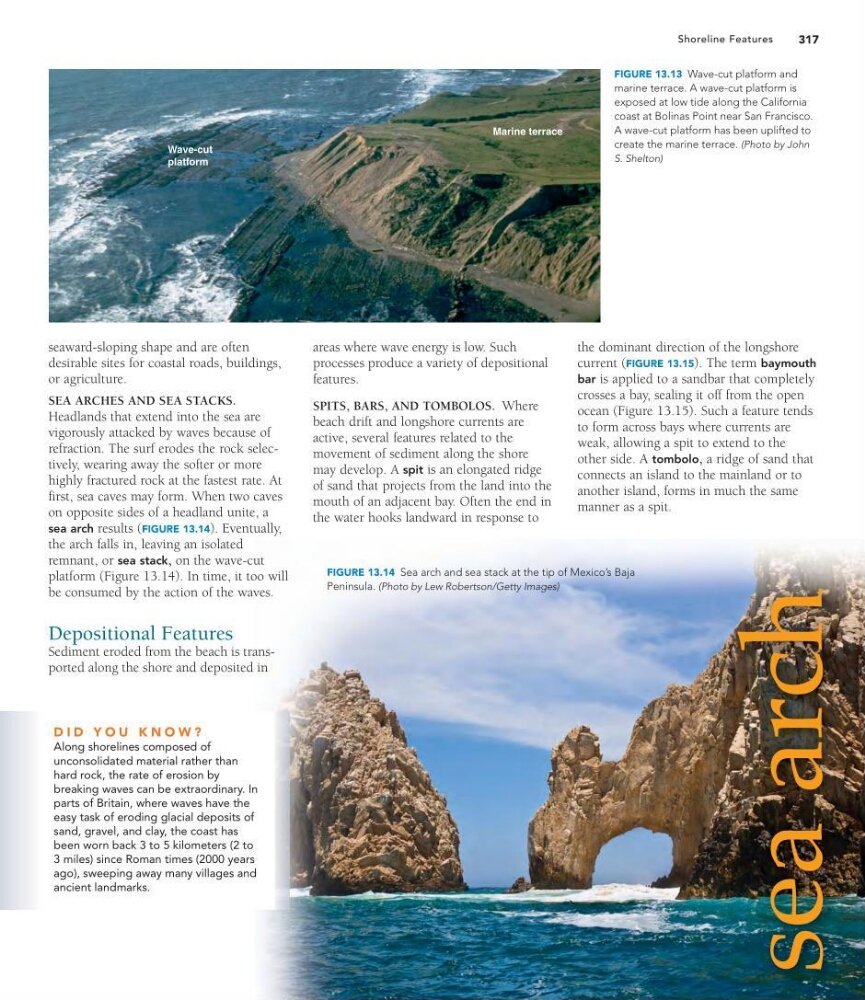
first, sea caves may form. When two caves
on opposite sides of a headland unite, a
sea arch results (FIGURE 13.14). Eventually,
the arch falls in, leaving an isolated
remnant, or sea stack, on the wave-cut
platform (Figure 13.14). In time, it too will
be consumed by the action of the waves.
Depositional Features
Sediment eroded from the beach is transported along the shore and deposited in
areas where wave energy is low. Such
processes produce a variety of depositional
features.
SPITS, BARS, AND TOMBOLOS. Where
beach drift and longshore currents are
active, several features related to the
movement of sediment along the shore
may develop. A spit is an elongated ridge
of sand that projects from the land into the
mouth of an adjacent bay. Often the end in
the water hooks landward in response to
the dominant direction of the longshore
current (FIGURE 13.15). The term baymouth
bar is applied to a sandbar that completely
crosses a bay, sealing it off from the open
ocean (Figure 13.15). Such a feature tends
to form across bays where currents are
weak, allowing a spit to extend to the
other side. A tombolo, a ridge of sand that
connects an island to the mainland or to
another island, forms in much the same
manner as a spit.
Wave-cut
platform
Marine terrace
FIGURE 13.13 Wave-cut platform and
marine terrace. A wave-cut platform is
exposed at low tide along the California
coast at Bolinas Point near San Francisco.
A wave-cut platform has been uplifted to
create the marine terrace. (Photo by John
S. Shelton)
FIGURE 13.14 Sea arch and sea stack at the tip of Mexico’s Baja
Peninsula. (Photo by Lew Robertson/Getty Images)
D I D Y O U K N O W ?
Along shorelines composed of
unconsolidated material rather than
hard rock, the rate of erosion by
breaking waves can be extraordinary. In
parts of Britain, where waves have the
easy task of eroding glacial deposits of
sand, gravel, and clay, the coast has
been worn back 3 to 5 kilometers (2 to
3 miles) since Roman times (2000 years
ago), sweeping away many villages and
ancient landmarks.
317
Shoreline Features
seaward-sloping shape and are often
desirable sites for coastal roads, buildings,
or agriculture.
SEA ARCHES AND SEA STACKS.
Headlands that extend into the sea are
vigorously attacked by waves because of
refraction. The surf erodes the rock selectively, wearing away the softer or more
highly fractured rock at the fastest rate. At
first, sea caves may form. When two caves
on opposite sides of a headland unite, a
sea arch results (FIGURE 13.14). Eventually,
the arch falls in, leaving an isolated
remnant, or sea stack, on the wave-cut
platform (Figure 13.14). In time, it too will
be consumed by the action of the waves.
Depositional Features
Sediment eroded from the beach is transported along the shore and deposited in
areas where wave energy is low. Such
processes produce a variety of depositional
features.
SPITS, BARS, AND TOMBOLOS. Where
beach drift and longshore currents are
active, several features related to the
movement of sediment along the shore
may develop. A spit is an elongated ridge
of sand that projects from the land into the
mouth of an adjacent bay. Often the end in
the water hooks landward in response to
the dominant direction of the longshore
current (FIGURE 13.15). The term baymouth
bar is applied to a sandbar that completely
crosses a bay, sealing it off from the open
ocean (Figure 13.15). Such a feature tends
to form across bays where currents are
weak, allowing a spit to extend to the
other side. A tombolo, a ridge of sand that
connects an island to the mainland or to
another island, forms in much the same
manner as a spit.
Wave-cut
platform
Marine terrace
FIGURE 13.13 Wave-cut platform and
marine terrace. A wave-cut platform is
exposed at low tide along the California
coast at Bolinas Point near San Francisco.
A wave-cut platform has been uplifted to
create the marine terrace. (Photo by John
S. Shelton)
FIGURE 13.14 Sea arch and sea stack at the tip of Mexico’s Baja
Peninsula. (Photo by Lew Robertson/Getty Images)
D I D Y O U K N O W ?
Along shorelines composed of
unconsolidated material rather than
hard rock, the rate of erosion by
breaking waves can be extraordinary. In
parts of Britain, where waves have the
easy task of eroding glacial deposits of
sand, gravel, and clay, the coast has
been worn back 3 to 5 kilometers (2 to
3 miles) since Roman times (2000 years
ago), sweeping away many villages and
ancient landmarks.