

back-wash from spent waves finds its way
back to the open ocean as an unconfined
flow across the ocean bottom called sheet
flow. However, sometimes a portion of the
returning water moves seaward in the form
of surface rip currents. These currents do
not travel far beyond the surf zone before
breaking up and can be recognized by the
way they interfere with incoming waves or
by the sediment that is often suspended
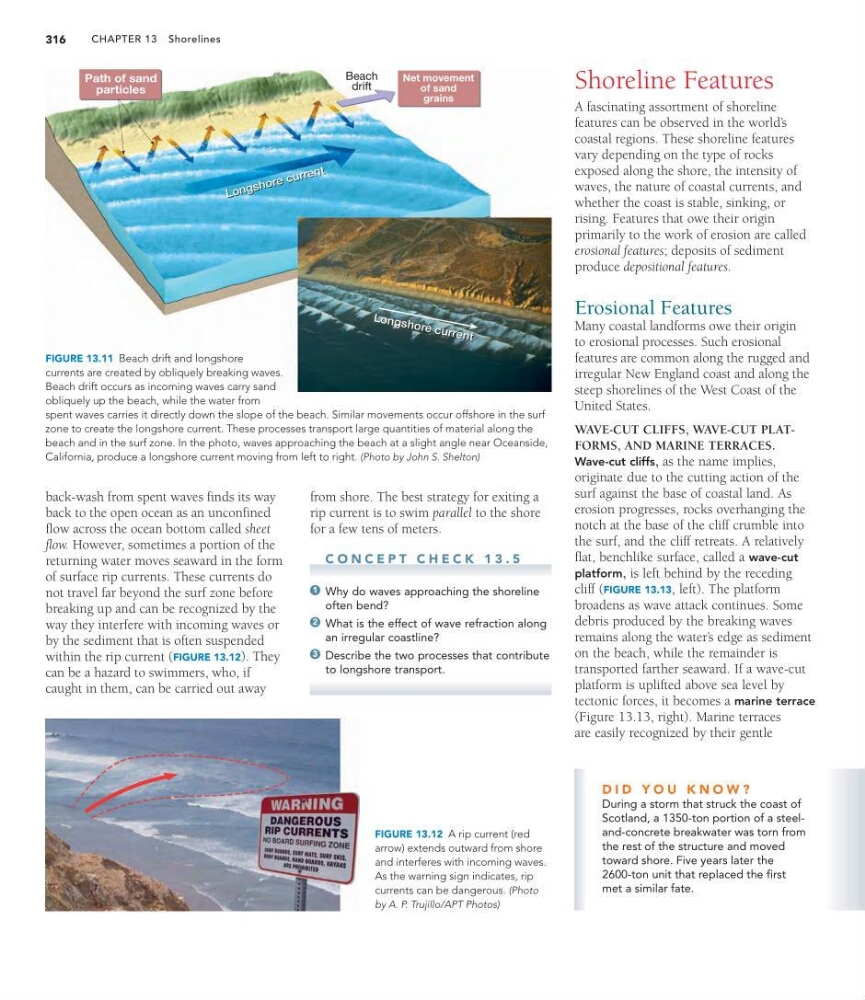
within the rip current (FIGURE 13.12). They
can be a hazard to swimmers, who, if
caught in them, can be carried out away
CHAPTER 13 Shorelines
316
D I D Y O U K N O W ?
During a storm that struck the coast of
Scotland, a 1350-ton portion of a steeland-concrete breakwater was torn from
the rest of the structure and moved
toward shore. Five years later the
2600-ton unit that replaced the first
met a similar fate.
Path of sand
particles
L o n g s h o re c u rr e n t
L o n g s h o re c u rr e n t
Net movement
of sand
grains
Beach
drift
L o n g sh o re cu rr en t
L o n g sh o re cu rr en t
FIGURE 13.11 Beach drift and longshore
currents are created by obliquely breaking waves.
Beach drift occurs as incoming waves carry sand
obliquely up the beach, while the water from
spent waves carries it directly down the slope of the beach. Similar movements occur offshore in the surf
zone to create the longshore current. These processes transport large quantities of material along the
beach and in the surf zone. In the photo, waves approaching the beach at a slight angle near Oceanside,
California, produce a longshore current moving from left to right. (Photo by John S. Shelton)
FIGURE 13.12 A rip current (red
arrow) extends outward from shore
and interferes with incoming waves.
As the warning sign indicates, rip
currents can be dangerous. (Photo
by A. P. Trujillo/APT Photos)
Shoreline Features
A fascinating assortment of shoreline
features can be observed in the world’ s
coastal regions. These shoreline features
vary depending on the type of rocks
exposed along the shore, the intensity of
waves, the nature of coastal currents, and
whether the coast is stable, sinking, or
rising. Features that owe their origin
primarily to the work of erosion are called
erosional features; deposits of sediment
produce depositional features.
Erosional Features
Many coastal landforms owe their origin
to erosional processes. Such erosional
features are common along the rugged and
irregular New England coast and along the
steep shorelines of the West Coast of the
United States.
WAVE-CUT CLIFFS, WAVE-CUT PLATFORMS, AND MARINE TERRACES.
Wave-cut cliffs, as the name implies,
originate due to the cutting action of the
surf against the base of coastal land. As
erosion progresses, rocks overhanging the
notch at the base of the cliff crumble into
the surf, and the cliff retreats. A relatively
flat, benchlike surface, called a wave-cut
platform, is left behind by the receding
cliff (FIGURE 13.13, left). The platform
broadens as wave attack continues. Some
debris produced by the breaking waves
remains along the water’ s edge as sediment
on the beach, while the remainder is
transported farther seaward. If a wave-cut
platform is uplifted above sea level by
tectonic forces, it becomes a marine terrace
(Figure 13.13, right). Marine terraces
are easily recognized by their gentle
from shore. The best strategy for exiting a
rip current is to swim parallel to the shore
for a few tens of meters.
C O N C E P T C H E C K 1 3 . 5
Why do waves approaching the shoreline
often bend?
What is the effect of wave refraction along
an irregular coastline?
Describe the two processes that contribute
to longshore transport.
3
2
1
back to the open ocean as an unconfined
flow across the ocean bottom called sheet
flow. However, sometimes a portion of the
returning water moves seaward in the form
of surface rip currents. These currents do
not travel far beyond the surf zone before
breaking up and can be recognized by the
way they interfere with incoming waves or
by the sediment that is often suspended
within the rip current (FIGURE 13.12). They
can be a hazard to swimmers, who, if
caught in them, can be carried out away
CHAPTER 13 Shorelines
316
D I D Y O U K N O W ?
During a storm that struck the coast of
Scotland, a 1350-ton portion of a steeland-concrete breakwater was torn from
the rest of the structure and moved
toward shore. Five years later the
2600-ton unit that replaced the first
met a similar fate.
Path of sand
particles
L o n g s h o re c u rr e n t
L o n g s h o re c u rr e n t
Net movement
of sand
grains
Beach
drift
L o n g sh o re cu rr en t
L o n g sh o re cu rr en t
FIGURE 13.11 Beach drift and longshore
currents are created by obliquely breaking waves.
Beach drift occurs as incoming waves carry sand
obliquely up the beach, while the water from
spent waves carries it directly down the slope of the beach. Similar movements occur offshore in the surf
zone to create the longshore current. These processes transport large quantities of material along the
beach and in the surf zone. In the photo, waves approaching the beach at a slight angle near Oceanside,
California, produce a longshore current moving from left to right. (Photo by John S. Shelton)
FIGURE 13.12 A rip current (red
arrow) extends outward from shore
and interferes with incoming waves.
As the warning sign indicates, rip
currents can be dangerous. (Photo
by A. P. Trujillo/APT Photos)
Shoreline Features
A fascinating assortment of shoreline
features can be observed in the world’ s
coastal regions. These shoreline features
vary depending on the type of rocks
exposed along the shore, the intensity of
waves, the nature of coastal currents, and
whether the coast is stable, sinking, or
rising. Features that owe their origin
primarily to the work of erosion are called
erosional features; deposits of sediment
produce depositional features.
Erosional Features
Many coastal landforms owe their origin
to erosional processes. Such erosional
features are common along the rugged and
irregular New England coast and along the
steep shorelines of the West Coast of the
United States.
WAVE-CUT CLIFFS, WAVE-CUT PLATFORMS, AND MARINE TERRACES.
Wave-cut cliffs, as the name implies,
originate due to the cutting action of the
surf against the base of coastal land. As
erosion progresses, rocks overhanging the
notch at the base of the cliff crumble into
the surf, and the cliff retreats. A relatively
flat, benchlike surface, called a wave-cut
platform, is left behind by the receding
cliff (FIGURE 13.13, left). The platform
broadens as wave attack continues. Some
debris produced by the breaking waves
remains along the water’ s edge as sediment
on the beach, while the remainder is
transported farther seaward. If a wave-cut
platform is uplifted above sea level by
tectonic forces, it becomes a marine terrace
(Figure 13.13, right). Marine terraces
are easily recognized by their gentle
from shore. The best strategy for exiting a
rip current is to swim parallel to the shore
for a few tens of meters.
C O N C E P T C H E C K 1 3 . 5
Why do waves approaching the shoreline
often bend?
What is the effect of wave refraction along
an irregular coastline?
Describe the two processes that contribute
to longshore transport.
3
2
1