

311
Waves
wave erosion
cally irresistible force confronts an almost immovable object. The conflict that results is
neverending and sometimes dramatic.
Wave Characteristics
Most ocean waves derive their energy and motion from the wind. When a breeze is
less than 3 kilometers (2 miles) per hour, only small wavelets appear. At greater
wind speeds, more stable waves gradually form and advance with the wind.
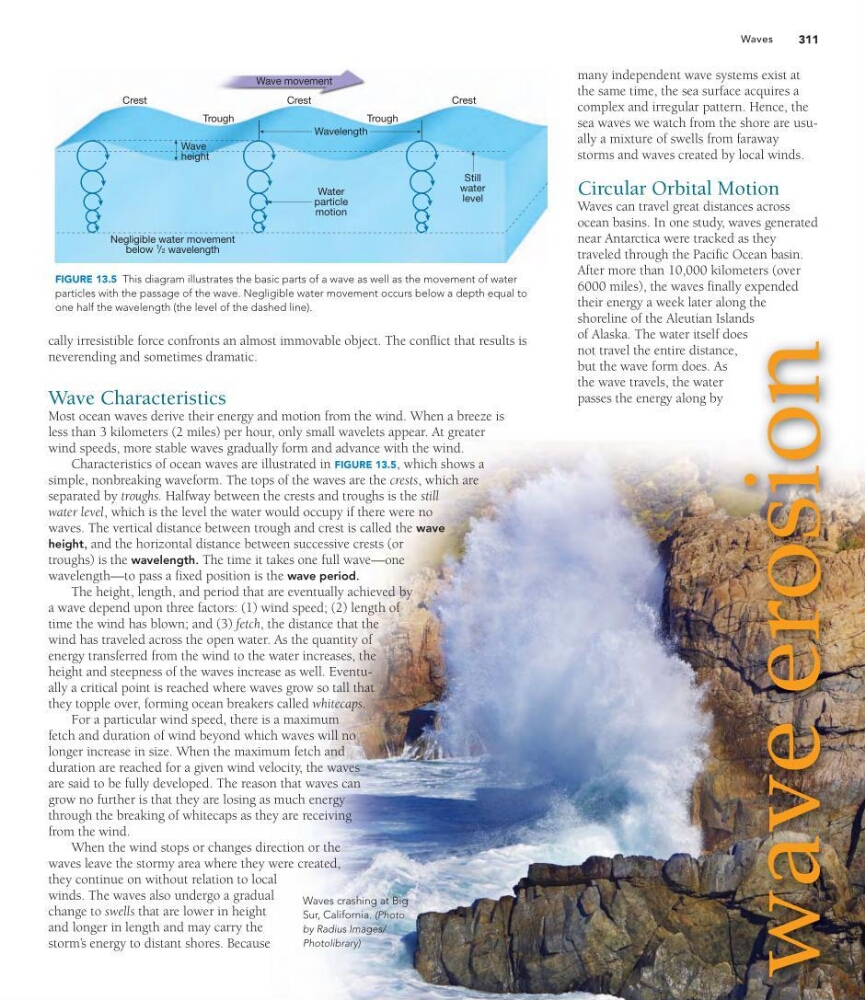
Characteristics of ocean waves are illustrated in FIGURE 13.5, which shows a
simple, nonbreaking waveform. The tops of the waves are the crests, which are
separated by troughs. Halfway between the crests and troughs is the still
water level, which is the level the water would occupy if there were no
waves. The vertical distance between trough and crest is called the wave
height, and the horizontal distance between successive crests (or
troughs) is the wavelength. The time it takes one full wave—one
wavelength—to pass a fixed position is the wave period.
The height, length, and period that are eventually achieved by
a wave depend upon three factors: (1) wind speed; (2) length of
time the wind has blown; and (3) fetch, the distance that the
wind has traveled across the open water. As the quantity of
energy transferred from the wind to the water increases, the
height and steepness of the waves increase as well. Eventually a critical point is reached where waves grow so tall that
they topple over, forming ocean breakers called whitecaps.
For a particular wind speed, there is a maximum
fetch and duration of wind beyond which waves will no
longer increase in size. When the maximum fetch and
duration are reached for a given wind velocity, the waves
are said to be fully developed. The reason that waves can
grow no further is that they are losing as much energy
through the breaking of whitecaps as they are receiving
from the wind.
When the wind stops or changes direction or the
waves leave the stormy area where they were created,
they continue on without relation to local
winds. The waves also undergo a gradual
change to swells that are lower in height
and longer in length and may carry the
storm’ s energy to distant shores. Because
many independent wave systems exist at
the same time, the sea surface acquires a
complex and irregular pattern. Hence, the
sea waves we watch from the shore are usually a mixture of swells from faraway
storms and waves created by local winds.
Circular Orbital Motion
Waves can travel great distances across
ocean basins. In one study, waves generated
near Antarctica were tracked as they
traveled through the Pacific Ocean basin.
After more than 10,000 kilometers (over
6000 miles), the waves finally expended
their energy a week later along the
shoreline of the Aleutian Islands
of Alaska. The water itself does
not travel the entire distance,
but the wave form does. As
the wave travels, the water
passes the energy along by
Wave movement
Wavelength
Crest
Crest
Crest
Trough
Trough
Wave
height
Negligible water movement
below
1
/2 wavelength
Water
particle
motion
Still
water
level
FIGURE 13.5 This diagram illustrates the basic parts of a wave as well as the movement of water
particles with the passage of the wave. Negligible water movement occurs below a depth equal to
one half the wavelength (the level of the dashed line).
Waves crashing at Big
Sur, California. (Photo
by Radius Images/
Photolibrary)
Waves
wave erosion
cally irresistible force confronts an almost immovable object. The conflict that results is
neverending and sometimes dramatic.
Wave Characteristics
Most ocean waves derive their energy and motion from the wind. When a breeze is
less than 3 kilometers (2 miles) per hour, only small wavelets appear. At greater
wind speeds, more stable waves gradually form and advance with the wind.
Characteristics of ocean waves are illustrated in FIGURE 13.5, which shows a
simple, nonbreaking waveform. The tops of the waves are the crests, which are
separated by troughs. Halfway between the crests and troughs is the still
water level, which is the level the water would occupy if there were no
waves. The vertical distance between trough and crest is called the wave
height, and the horizontal distance between successive crests (or
troughs) is the wavelength. The time it takes one full wave—one
wavelength—to pass a fixed position is the wave period.
The height, length, and period that are eventually achieved by
a wave depend upon three factors: (1) wind speed; (2) length of
time the wind has blown; and (3) fetch, the distance that the
wind has traveled across the open water. As the quantity of
energy transferred from the wind to the water increases, the
height and steepness of the waves increase as well. Eventually a critical point is reached where waves grow so tall that
they topple over, forming ocean breakers called whitecaps.
For a particular wind speed, there is a maximum
fetch and duration of wind beyond which waves will no
longer increase in size. When the maximum fetch and
duration are reached for a given wind velocity, the waves
are said to be fully developed. The reason that waves can
grow no further is that they are losing as much energy
through the breaking of whitecaps as they are receiving
from the wind.
When the wind stops or changes direction or the
waves leave the stormy area where they were created,
they continue on without relation to local
winds. The waves also undergo a gradual
change to swells that are lower in height
and longer in length and may carry the
storm’ s energy to distant shores. Because
many independent wave systems exist at
the same time, the sea surface acquires a
complex and irregular pattern. Hence, the
sea waves we watch from the shore are usually a mixture of swells from faraway
storms and waves created by local winds.
Circular Orbital Motion
Waves can travel great distances across
ocean basins. In one study, waves generated
near Antarctica were tracked as they
traveled through the Pacific Ocean basin.
After more than 10,000 kilometers (over
6000 miles), the waves finally expended
their energy a week later along the
shoreline of the Aleutian Islands
of Alaska. The water itself does
not travel the entire distance,
but the wave form does. As
the wave travels, the water
passes the energy along by
Wave movement
Wavelength
Crest
Crest
Crest
Trough
Trough
Wave
height
Negligible water movement
below
1
/2 wavelength
Water
particle
motion
Still
water
level
FIGURE 13.5 This diagram illustrates the basic parts of a wave as well as the movement of water
particles with the passage of the wave. Negligible water movement occurs below a depth equal to
one half the wavelength (the level of the dashed line).
Waves crashing at Big
Sur, California. (Photo
by Radius Images/
Photolibrary)