

Surf zone
(breakers form)
Approaching shore –
waves touch bottom
(wavelength decreases)
Deep water –
waves with constant
wavelength
Velocity decreases
(wave height increases)
Depth is >
1
/2 wavelength
Wave movement
CHAPTER 13 Shorelines
312
Toy boat
Wave movement
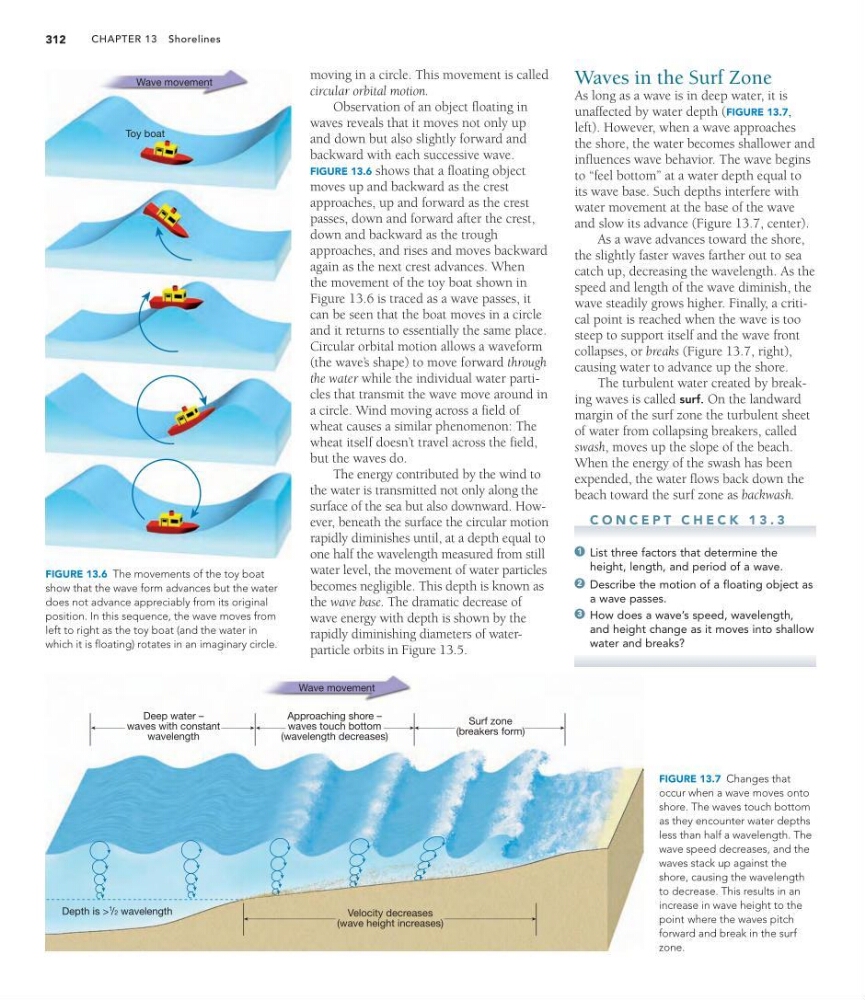
FIGURE 13.7 Changes that
occur when a wave moves onto
shore. The waves touch bottom
as they encounter water depths
less than half a wavelength. The
wave speed decreases, and the
waves stack up against the
shore, causing the wavelength
to decrease. This results in an
increase in wave height to the
point where the waves pitch
forward and break in the surf
zone.
FIGURE 13.6 The movements of the toy boat
show that the wave form advances but the water
does not advance appreciably from its original
position. In this sequence, the wave moves from
left to right as the toy boat (and the water in
which it is floating) rotates in an imaginary circle.
moving in a circle. This movement is called
circular orbital motion.
Observation of an object floating in
waves reveals that it moves not only up
and down but also slightly forward and
backward with each successive wave.
FIGURE 13.6 shows that a floating object
moves up and backward as the crest
approaches, up and forward as the crest
passes, down and forward after the crest,
down and backward as the trough
approaches, and rises and moves backward
again as the next crest advances. When
the movement of the toy boat shown in
Figure 13.6 is traced as a wave passes, it
can be seen that the boat moves in a circle
and it returns to essentially the same place.
Circular orbital motion allows a waveform
(the wave’ s shape) to move forward through
the water while the individual water particles that transmit the wave move around in
a circle. Wind moving across a field of
wheat causes a similar phenomenon: The
wheat itself doesn’t travel across the field,
but the waves do.
The energy contributed by the wind to
the water is transmitted not only along the
surface of the sea but also downward. However, beneath the surface the circular motion
rapidly diminishes until, at a depth equal to
one half the wavelength measured from still
water level, the movement of water particles
becomes negligible. This depth is known as
the wave base. The dramatic decrease of
wave energy with depth is shown by the
rapidly diminishing diameters of waterparticle orbits in Figure 13.5.
Waves in the Surf Zone
As long as a wave is in deep water, it is
unaffected by water depth (FIGURE 13.7,
left). However, when a wave approaches
the shore, the water becomes shallower and
influences wave behavior. The wave begins
to “feel bottom” at a water depth equal to
its wave base. Such depths interfere with
water movement at the base of the wave
and slow its advance (Figure 13.7, center).
As a wave advances toward the shore,
the slightly faster waves farther out to sea
catch up, decreasing the wavelength. As the
speed and length of the wave diminish, the
wave steadily grows higher. Finally, a critical point is reached when the wave is too
steep to support itself and the wave front
collapses, or breaks (Figure 13.7, right),
causing water to advance up the shore.
The turbulent water created by breaking waves is called surf. On the landward
margin of the surf zone the turbulent sheet
of water from collapsing breakers, called
swash, moves up the slope of the beach.
When the energy of the swash has been
expended, the water flows back down the
beach toward the surf zone as backwash.
C O N C E P T C H E C K 1 3 . 3
List three factors that determine the
height, length, and period of a wave.
Describe the motion of a floating object as
a wave passes.
How does a wave’s speed, wavelength,
and height change as it moves into shallow
water and breaks?
3
2
1
(breakers form)
Approaching shore –
waves touch bottom
(wavelength decreases)
Deep water –
waves with constant
wavelength
Velocity decreases
(wave height increases)
Depth is >
1
/2 wavelength
Wave movement
CHAPTER 13 Shorelines
312
Toy boat
Wave movement
FIGURE 13.7 Changes that
occur when a wave moves onto
shore. The waves touch bottom
as they encounter water depths
less than half a wavelength. The
wave speed decreases, and the
waves stack up against the
shore, causing the wavelength
to decrease. This results in an
increase in wave height to the
point where the waves pitch
forward and break in the surf
zone.
FIGURE 13.6 The movements of the toy boat
show that the wave form advances but the water
does not advance appreciably from its original
position. In this sequence, the wave moves from
left to right as the toy boat (and the water in
which it is floating) rotates in an imaginary circle.
moving in a circle. This movement is called
circular orbital motion.
Observation of an object floating in
waves reveals that it moves not only up
and down but also slightly forward and
backward with each successive wave.
FIGURE 13.6 shows that a floating object
moves up and backward as the crest
approaches, up and forward as the crest
passes, down and forward after the crest,
down and backward as the trough
approaches, and rises and moves backward
again as the next crest advances. When
the movement of the toy boat shown in
Figure 13.6 is traced as a wave passes, it
can be seen that the boat moves in a circle
and it returns to essentially the same place.
Circular orbital motion allows a waveform
(the wave’ s shape) to move forward through
the water while the individual water particles that transmit the wave move around in
a circle. Wind moving across a field of
wheat causes a similar phenomenon: The
wheat itself doesn’t travel across the field,
but the waves do.
The energy contributed by the wind to
the water is transmitted not only along the
surface of the sea but also downward. However, beneath the surface the circular motion
rapidly diminishes until, at a depth equal to
one half the wavelength measured from still
water level, the movement of water particles
becomes negligible. This depth is known as
the wave base. The dramatic decrease of
wave energy with depth is shown by the
rapidly diminishing diameters of waterparticle orbits in Figure 13.5.
Waves in the Surf Zone
As long as a wave is in deep water, it is
unaffected by water depth (FIGURE 13.7,
left). However, when a wave approaches
the shore, the water becomes shallower and
influences wave behavior. The wave begins
to “feel bottom” at a water depth equal to
its wave base. Such depths interfere with
water movement at the base of the wave
and slow its advance (Figure 13.7, center).
As a wave advances toward the shore,
the slightly faster waves farther out to sea
catch up, decreasing the wavelength. As the
speed and length of the wave diminish, the
wave steadily grows higher. Finally, a critical point is reached when the wave is too
steep to support itself and the wave front
collapses, or breaks (Figure 13.7, right),
causing water to advance up the shore.
The turbulent water created by breaking waves is called surf. On the landward
margin of the surf zone the turbulent sheet
of water from collapsing breakers, called
swash, moves up the slope of the beach.
When the energy of the swash has been
expended, the water flows back down the
beach toward the surf zone as backwash.
C O N C E P T C H E C K 1 3 . 3
List three factors that determine the
height, length, and period of a wave.
Describe the motion of a floating object as
a wave passes.
How does a wave’s speed, wavelength,
and height change as it moves into shallow
water and breaks?
3
2
1