

The shore is the area that extends between the lowest tide level
and the highest elevation on land that is affected by storm waves.
By contrast, the coast extends inland from the shore as far as
ocean-related features can be found. The coastline marks the coast’ s
seaward edge, whereas the inland boundary is not always obvious
or easy to determine.
As Figure 13.3 illustrates, the shore is divided into the foreshore
and the backshore. The foreshore is the area exposed when the tide
is out (low tide) and submerged when the tide is in (high tide). The
backshore is landward of the high-tide shoreline. It is usually dry,
being affected by waves only during storms. Two other zones are
commonly identified. The nearshore zone lies between the
low-tide shoreline and the line where waves break at low tide.
Seaward of the nearshore zone is the offshore zone.
Beaches
For many, a beach is the sandy area where people lie in the sun and
walk along the water’ s edge. Technically, a beach is an accumulation of sediment found along the landward margin of the ocean
or a lake. Along straight coasts, beaches may extend for tens or
hundreds of kilometers. Where coasts are irregular, beach formation may be confined to the relatively quiet waters of bays.
Beaches consist of one or more berms, which are relatively flat
platforms often composed of sand that are adjacent to coastal
dunes or cliffs and marked by a change in slope at the seaward
edge. Another part of the beach is the beach face, which is the wet
sloping surface that extends from the berm to the shoreline. Where
beaches are sandy, sunbathers usually prefer the berm, whereas
joggers prefer the wet, hard-packed sand of the beach face.
Beaches are composed of whatever material is locally abundant. The sediment for some beaches is derived from the erosion of
adjacent cliffs or nearby coastal mountains. Other beaches are built
from sediment delivered to the coast by rivers.
Although the mineral makeup of many beaches is dominated
by durable quartz grains, other minerals may be dominant. For
example, in areas such as southern Florida where there are no
mountains or other sources of rock-forming minerals nearby, most
beaches are composed of shell fragments and the remains of organisms that live in coastal waters (see Figure 6.9A p. 157). Some
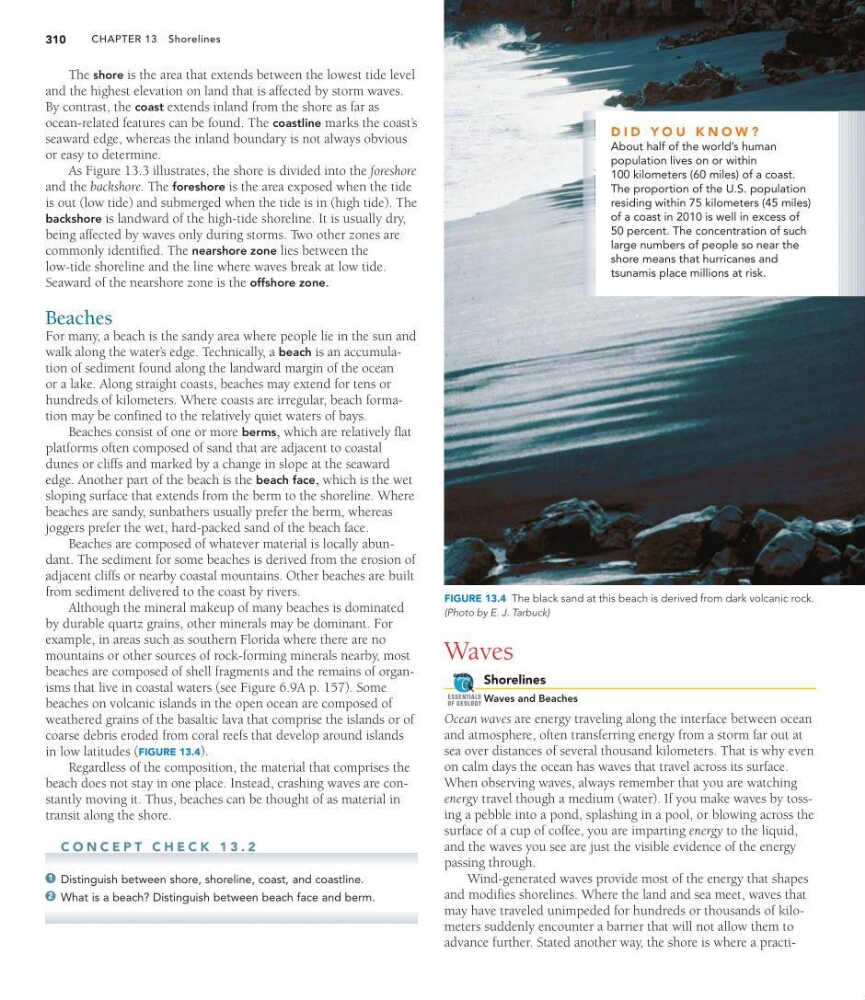
beaches on volcanic islands in the open ocean are composed of
weathered grains of the basaltic lava that comprise the islands or of
coarse debris eroded from coral reefs that develop around islands
in low latitudes (FIGURE 13.4).
Regardless of the composition, the material that comprises the
beach does not stay in one place. Instead, crashing waves are constantly moving it. Thus, beaches can be thought of as material in
transit along the shore.
C O N C E P T C H E C K 1 3 . 2
Distinguish between shore, shoreline, coast, and coastline.
What is a beach? Distinguish between beach face and berm.
2
1
CHAPTER 13 Shorelines
310
FIGURE 13.4 The black sand at this beach is derived from dark volcanic rock.
(Photo by E. J. Tarbuck)
D I D Y O U K N O W ?
About half of the world’s human
population lives on or within
100 kilometers (60 miles) of a coast.
The proportion of the U.S. population
residing within 75 kilometers (45 miles)
of a coast in 2010 is well in excess of
50 percent. The concentration of such
large numbers of people so near the
shore means that hurricanes and
tsunamis place millions at risk.
Waves
Shorelines
Waves and Beaches
Ocean waves are energy traveling along the interface between ocean
and atmosphere, often transferring energy from a storm far out at
sea over distances of several thousand kilometers. That is why even
on calm days the ocean has waves that travel across its surface.
When observing waves, always remember that you are watching
energy travel though a medium (water). If you make waves by tossing a pebble into a pond, splashing in a pool, or blowing across the
surface of a cup of coffee, you are imparting energy to the liquid,
and the waves you see are just the visible evidence of the energy
passing through.
Wind-generated waves provide most of the energy that shapes
and modifies shorelines. Where the land and sea meet, waves that
may have traveled unimpeded for hundreds or thousands of kilometers suddenly encounter a barrier that will not allow them to
advance further. Stated another way, the shore is where a practiGEODe
ESSENTIALS
OF GEOLOGY
and the highest elevation on land that is affected by storm waves.
By contrast, the coast extends inland from the shore as far as
ocean-related features can be found. The coastline marks the coast’ s
seaward edge, whereas the inland boundary is not always obvious
or easy to determine.
As Figure 13.3 illustrates, the shore is divided into the foreshore
and the backshore. The foreshore is the area exposed when the tide
is out (low tide) and submerged when the tide is in (high tide). The
backshore is landward of the high-tide shoreline. It is usually dry,
being affected by waves only during storms. Two other zones are
commonly identified. The nearshore zone lies between the
low-tide shoreline and the line where waves break at low tide.
Seaward of the nearshore zone is the offshore zone.
Beaches
For many, a beach is the sandy area where people lie in the sun and
walk along the water’ s edge. Technically, a beach is an accumulation of sediment found along the landward margin of the ocean
or a lake. Along straight coasts, beaches may extend for tens or
hundreds of kilometers. Where coasts are irregular, beach formation may be confined to the relatively quiet waters of bays.
Beaches consist of one or more berms, which are relatively flat
platforms often composed of sand that are adjacent to coastal
dunes or cliffs and marked by a change in slope at the seaward
edge. Another part of the beach is the beach face, which is the wet
sloping surface that extends from the berm to the shoreline. Where
beaches are sandy, sunbathers usually prefer the berm, whereas
joggers prefer the wet, hard-packed sand of the beach face.
Beaches are composed of whatever material is locally abundant. The sediment for some beaches is derived from the erosion of
adjacent cliffs or nearby coastal mountains. Other beaches are built
from sediment delivered to the coast by rivers.
Although the mineral makeup of many beaches is dominated
by durable quartz grains, other minerals may be dominant. For
example, in areas such as southern Florida where there are no
mountains or other sources of rock-forming minerals nearby, most
beaches are composed of shell fragments and the remains of organisms that live in coastal waters (see Figure 6.9A p. 157). Some
beaches on volcanic islands in the open ocean are composed of
weathered grains of the basaltic lava that comprise the islands or of
coarse debris eroded from coral reefs that develop around islands
in low latitudes (FIGURE 13.4).
Regardless of the composition, the material that comprises the
beach does not stay in one place. Instead, crashing waves are constantly moving it. Thus, beaches can be thought of as material in
transit along the shore.
C O N C E P T C H E C K 1 3 . 2
Distinguish between shore, shoreline, coast, and coastline.
What is a beach? Distinguish between beach face and berm.
2
1
CHAPTER 13 Shorelines
310
FIGURE 13.4 The black sand at this beach is derived from dark volcanic rock.
(Photo by E. J. Tarbuck)
D I D Y O U K N O W ?
About half of the world’s human
population lives on or within
100 kilometers (60 miles) of a coast.
The proportion of the U.S. population
residing within 75 kilometers (45 miles)
of a coast in 2010 is well in excess of
50 percent. The concentration of such
large numbers of people so near the
shore means that hurricanes and
tsunamis place millions at risk.
Waves
Shorelines
Waves and Beaches
Ocean waves are energy traveling along the interface between ocean
and atmosphere, often transferring energy from a storm far out at
sea over distances of several thousand kilometers. That is why even
on calm days the ocean has waves that travel across its surface.
When observing waves, always remember that you are watching
energy travel though a medium (water). If you make waves by tossing a pebble into a pond, splashing in a pool, or blowing across the
surface of a cup of coffee, you are imparting energy to the liquid,
and the waves you see are just the visible evidence of the energy
passing through.
Wind-generated waves provide most of the energy that shapes
and modifies shorelines. Where the land and sea meet, waves that
may have traveled unimpeded for hundreds or thousands of kilometers suddenly encounter a barrier that will not allow them to
advance further. Stated another way, the shore is where a practiGEODe
ESSENTIALS
OF GEOLOGY