

CHAPTER 12 Deserts and Wind
302
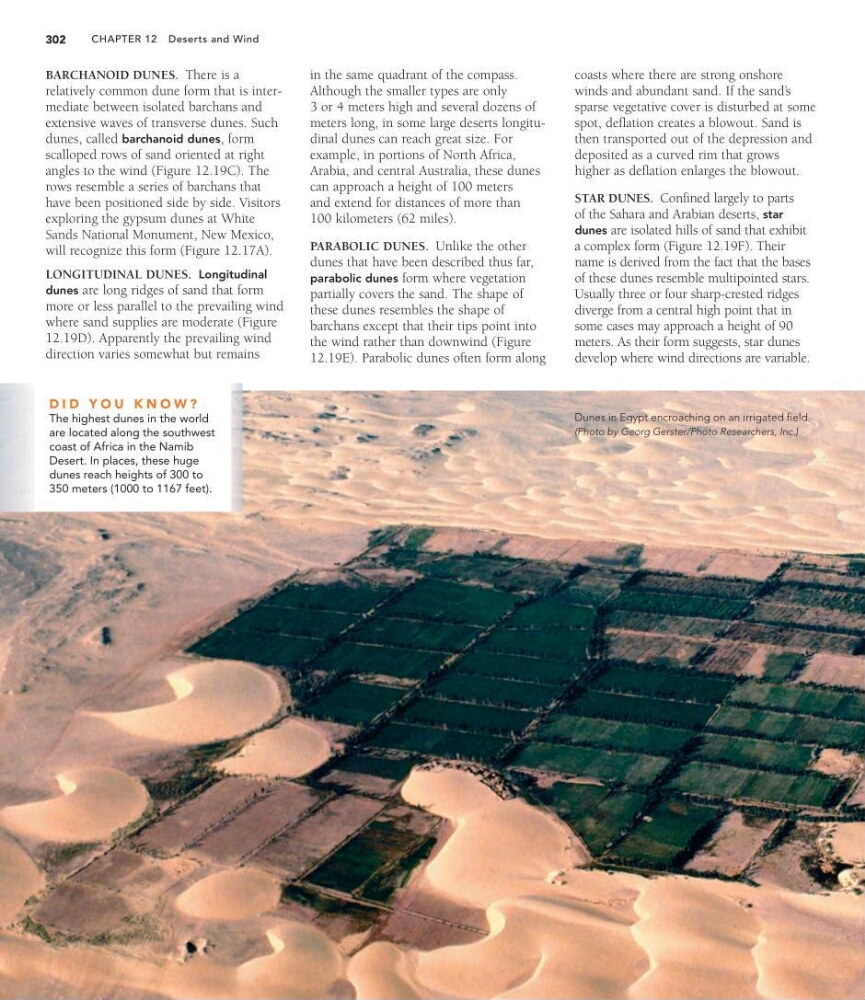
Dunes in Egypt encroaching on an irrigated field.
(Photo by Georg Gerster/Photo Researchers, Inc.)
BARCHANOID DUNES. There is a
relatively common dune form that is intermediate between isolated barchans and
extensive waves of transverse dunes. Such
dunes, called barchanoid dunes, form
scalloped rows of sand oriented at right
angles to the wind (Figure 12.19C). The
rows resemble a series of barchans that
have been positioned side by side. Visitors
exploring the gypsum dunes at White
Sands National Monument, New Mexico,
will recognize this form (Figure 12.17A).
LONGITUDINAL DUNES. Longitudinal
dunes are long ridges of sand that form
more or less parallel to the prevailing wind
where sand supplies are moderate (Figure
12.19D). Apparently the prevailing wind
direction varies somewhat but remains
in the same quadrant of the compass.
Although the smaller types are only
3 or 4 meters high and several dozens of
meters long, in some large deserts longitudinal dunes can reach great size. For
example, in portions of North Africa,
Arabia, and central Australia, these dunes
can approach a height of 100 meters
and extend for distances of more than
100 kilometers (62 miles).
PARABOLIC DUNES. Unlike the other
dunes that have been described thus far,
parabolic dunes form where vegetation
partially covers the sand. The shape of
these dunes resembles the shape of
barchans except that their tips point into
the wind rather than downwind (Figure
12.19E). Parabolic dunes often form along
coasts where there are strong onshore
winds and abundant sand. If the sand’ s
sparse vegetative cover is disturbed at some
spot, deflation creates a blowout. Sand is
then transported out of the depression and
deposited as a curved rim that grows
higher as deflation enlarges the blowout.
STAR DUNES. Confined largely to parts
of the Sahara and Arabian deserts, star
dunes are isolated hills of sand that exhibit
a complex form (Figure 12.19F). Their
name is derived from the fact that the bases
of these dunes resemble multipointed stars.
Usually three or four sharp-crested ridges
diverge from a central high point that in
some cases may approach a height of 90
meters. As their form suggests, star dunes
develop where wind directions are variable.
D I D Y O U K N O W ?
The highest dunes in the world
are located along the southwest
coast of Africa in the Namib
Desert. In places, these huge
dunes reach heights of 300 to
350 meters (1000 to 1167 feet).
302
Dunes in Egypt encroaching on an irrigated field.
(Photo by Georg Gerster/Photo Researchers, Inc.)
BARCHANOID DUNES. There is a
relatively common dune form that is intermediate between isolated barchans and
extensive waves of transverse dunes. Such
dunes, called barchanoid dunes, form
scalloped rows of sand oriented at right
angles to the wind (Figure 12.19C). The
rows resemble a series of barchans that
have been positioned side by side. Visitors
exploring the gypsum dunes at White
Sands National Monument, New Mexico,
will recognize this form (Figure 12.17A).
LONGITUDINAL DUNES. Longitudinal
dunes are long ridges of sand that form
more or less parallel to the prevailing wind
where sand supplies are moderate (Figure
12.19D). Apparently the prevailing wind
direction varies somewhat but remains
in the same quadrant of the compass.
Although the smaller types are only
3 or 4 meters high and several dozens of
meters long, in some large deserts longitudinal dunes can reach great size. For
example, in portions of North Africa,
Arabia, and central Australia, these dunes
can approach a height of 100 meters
and extend for distances of more than
100 kilometers (62 miles).
PARABOLIC DUNES. Unlike the other
dunes that have been described thus far,
parabolic dunes form where vegetation
partially covers the sand. The shape of
these dunes resembles the shape of
barchans except that their tips point into
the wind rather than downwind (Figure
12.19E). Parabolic dunes often form along
coasts where there are strong onshore
winds and abundant sand. If the sand’ s
sparse vegetative cover is disturbed at some
spot, deflation creates a blowout. Sand is
then transported out of the depression and
deposited as a curved rim that grows
higher as deflation enlarges the blowout.
STAR DUNES. Confined largely to parts
of the Sahara and Arabian deserts, star
dunes are isolated hills of sand that exhibit
a complex form (Figure 12.19F). Their
name is derived from the fact that the bases
of these dunes resemble multipointed stars.
Usually three or four sharp-crested ridges
diverge from a central high point that in
some cases may approach a height of 90
meters. As their form suggests, star dunes
develop where wind directions are variable.
D I D Y O U K N O W ?
The highest dunes in the world
are located along the southwest
coast of Africa in the Namib
Desert. In places, these huge
dunes reach heights of 300 to
350 meters (1000 to 1167 feet).