

301
Wind Deposits
Wind
Wind
Slip face
Cross beds
Wind
A.
B.
C.
D.
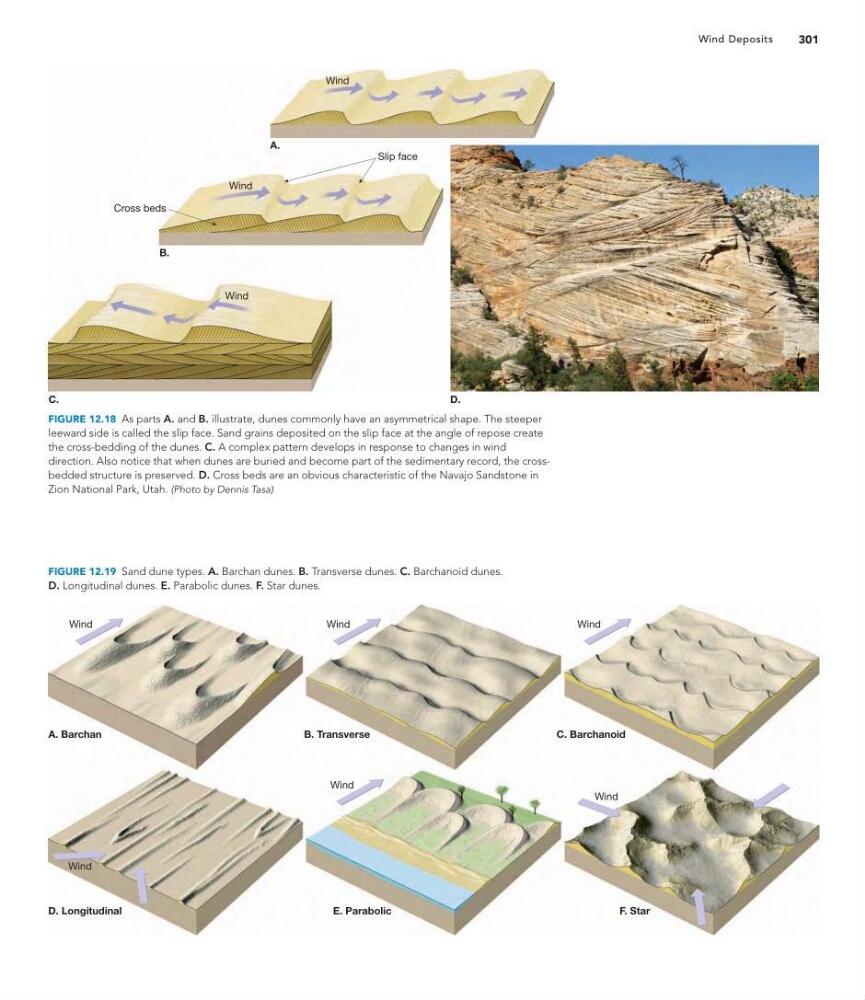
FIGURE 12.18 As parts A. and B. illustrate, dunes commonly have an asymmetrical shape. The steeper
leeward side is called the slip face. Sand grains deposited on the slip face at the angle of repose create
the cross-bedding of the dunes. C. A complex pattern develops in response to changes in wind
direction. Also notice that when dunes are buried and become part of the sedimentary record, the crossbedded structure is preserved. D. Cross beds are an obvious characteristic of the Navajo Sandstone in
Zion National Park, Utah. (Photo by Dennis Tasa)
A. Barchan
B. Transverse
Wind
C. Barchanoid
D. Longitudinal
Wind
E. Parabolic
F. Star
Wind
Wind
Wind
Wind
FIGURE 12.19 Sand dune types. A. Barchan dunes. B. Transverse dunes. C. Barchanoid dunes.
D. Longitudinal dunes. E. Parabolic dunes. F. Star dunes.
Wind Deposits
Wind
Wind
Slip face
Cross beds
Wind
A.
B.
C.
D.
FIGURE 12.18 As parts A. and B. illustrate, dunes commonly have an asymmetrical shape. The steeper
leeward side is called the slip face. Sand grains deposited on the slip face at the angle of repose create
the cross-bedding of the dunes. C. A complex pattern develops in response to changes in wind
direction. Also notice that when dunes are buried and become part of the sedimentary record, the crossbedded structure is preserved. D. Cross beds are an obvious characteristic of the Navajo Sandstone in
Zion National Park, Utah. (Photo by Dennis Tasa)
A. Barchan
B. Transverse
Wind
C. Barchanoid
D. Longitudinal
Wind
E. Parabolic
F. Star
Wind
Wind
Wind
Wind
FIGURE 12.19 Sand dune types. A. Barchan dunes. B. Transverse dunes. C. Barchanoid dunes.
D. Longitudinal dunes. E. Parabolic dunes. F. Star dunes.