

sand dunes
CHAPTER 12 Deserts and Wind
298
D I D Y O U K N O W ?
The driest place on Earth is in Chile’s
Atacama Desert, a narrow belt of dry
land that extends along the Pacific
Coast of South America. The town of
Arica has an average rainfall of just 0.03
inch per year. Over a span of 59 years,
this region received a total of less than
2 inches of rain.
A.
Deflation
Deflation begins
Deflation
Deflation continues
to remove finer
particles
Desert pavement
established,
deflation ends
Desert pavement
B.
Weathered pebbles
and cobbles on
bedrock
Wind-blown silt
accumulates and sifts
downward through
coarse particles
Silt continues to
accumulate and lift
desert pavement
T i m e
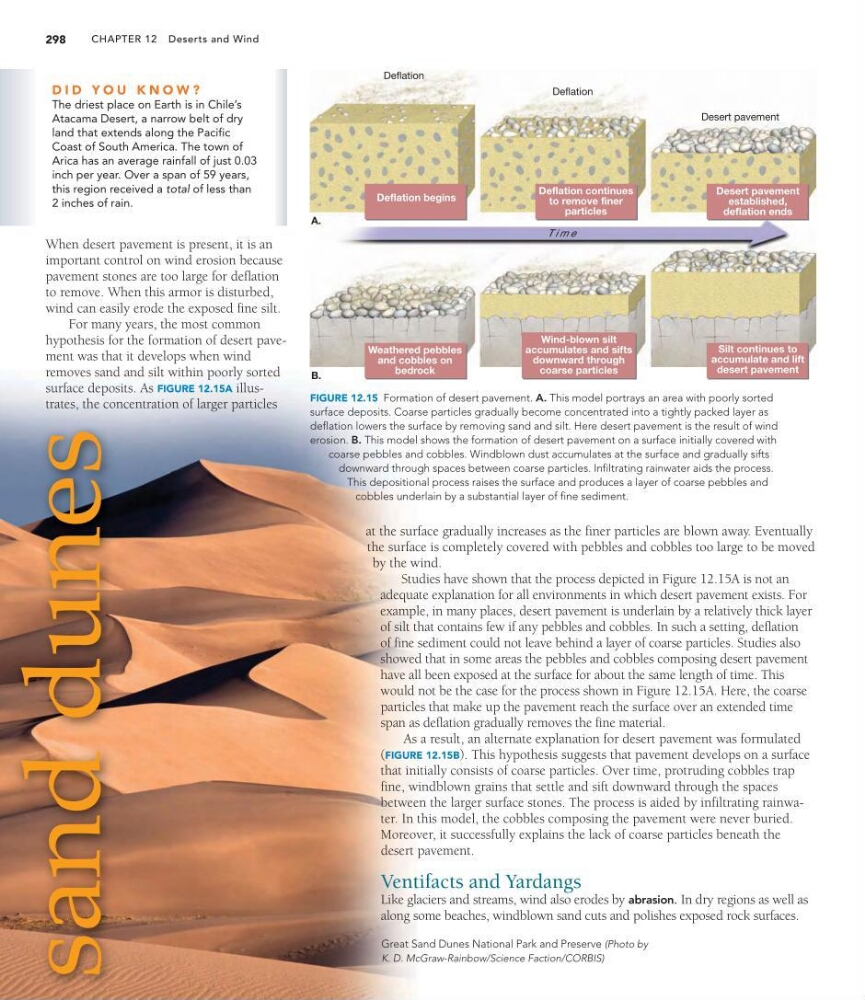
at the surface gradually increases as the finer particles are blown away. Eventually
the surface is completely covered with pebbles and cobbles too large to be moved
by the wind.
Studies have shown that the process depicted in Figure 12.15A is not an
adequate explanation for all environments in which desert pavement exists. For
example, in many places, desert pavement is underlain by a relatively thick layer
of silt that contains few if any pebbles and cobbles. In such a setting, deflation
of fine sediment could not leave behind a layer of coarse particles. Studies also
showed that in some areas the pebbles and cobbles composing desert pavement
have all been exposed at the surface for about the same length of time. This
would not be the case for the process shown in Figure 12.15A. Here, the coarse
particles that make up the pavement reach the surface over an extended time
span as deflation gradually removes the fine material.
As a result, an alternate explanation for desert pavement was formulated
(FIGURE 12.15B). This hypothesis suggests that pavement develops on a surface
that initially consists of coarse particles. Over time, protruding cobbles trap
fine, windblown grains that settle and sift downward through the spaces
between the larger surface stones. The process is aided by infiltrating rainwater. In this model, the cobbles composing the pavement were never buried.
Moreover, it successfully explains the lack of coarse particles beneath the
desert pavement.
Ventifacts and Yardangs
Like glaciers and streams, wind also erodes by abrasion. In dry regions as well as
along some beaches, windblown sand cuts and polishes exposed rock surfaces.
FIGURE 12.15 Formation of desert pavement. A. This model portrays an area with poorly sorted
surface deposits. Coarse particles gradually become concentrated into a tightly packed layer as
deflation lowers the surface by removing sand and silt. Here desert pavement is the result of wind
erosion. B. This model shows the formation of desert pavement on a surface initially covered with
coarse pebbles and cobbles. Windblown dust accumulates at the surface and gradually sifts
downward through spaces between coarse particles. Infiltrating rainwater aids the process.
This depositional process raises the surface and produces a layer of coarse pebbles and
cobbles underlain by a substantial layer of fine sediment.
When desert pavement is present, it is an
important control on wind erosion because
pavement stones are too large for deflation
to remove. When this armor is disturbed,
wind can easily erode the exposed fine silt.
For many years, the most common
hypothesis for the formation of desert pavement was that it develops when wind
removes sand and silt within poorly sorted
surface deposits. As FIGURE 12.15A illustrates, the concentration of larger particles
Great Sand Dunes National Park and Preserve (Photo by
K. D. McGraw-Rainbow/Science Faction/CORBIS)
CHAPTER 12 Deserts and Wind
298
D I D Y O U K N O W ?
The driest place on Earth is in Chile’s
Atacama Desert, a narrow belt of dry
land that extends along the Pacific
Coast of South America. The town of
Arica has an average rainfall of just 0.03
inch per year. Over a span of 59 years,
this region received a total of less than
2 inches of rain.
A.
Deflation
Deflation begins
Deflation
Deflation continues
to remove finer
particles
Desert pavement
established,
deflation ends
Desert pavement
B.
Weathered pebbles
and cobbles on
bedrock
Wind-blown silt
accumulates and sifts
downward through
coarse particles
Silt continues to
accumulate and lift
desert pavement
T i m e
at the surface gradually increases as the finer particles are blown away. Eventually
the surface is completely covered with pebbles and cobbles too large to be moved
by the wind.
Studies have shown that the process depicted in Figure 12.15A is not an
adequate explanation for all environments in which desert pavement exists. For
example, in many places, desert pavement is underlain by a relatively thick layer
of silt that contains few if any pebbles and cobbles. In such a setting, deflation
of fine sediment could not leave behind a layer of coarse particles. Studies also
showed that in some areas the pebbles and cobbles composing desert pavement
have all been exposed at the surface for about the same length of time. This
would not be the case for the process shown in Figure 12.15A. Here, the coarse
particles that make up the pavement reach the surface over an extended time
span as deflation gradually removes the fine material.
As a result, an alternate explanation for desert pavement was formulated
(FIGURE 12.15B). This hypothesis suggests that pavement develops on a surface
that initially consists of coarse particles. Over time, protruding cobbles trap
fine, windblown grains that settle and sift downward through the spaces
between the larger surface stones. The process is aided by infiltrating rainwater. In this model, the cobbles composing the pavement were never buried.
Moreover, it successfully explains the lack of coarse particles beneath the
desert pavement.
Ventifacts and Yardangs
Like glaciers and streams, wind also erodes by abrasion. In dry regions as well as
along some beaches, windblown sand cuts and polishes exposed rock surfaces.
FIGURE 12.15 Formation of desert pavement. A. This model portrays an area with poorly sorted
surface deposits. Coarse particles gradually become concentrated into a tightly packed layer as
deflation lowers the surface by removing sand and silt. Here desert pavement is the result of wind
erosion. B. This model shows the formation of desert pavement on a surface initially covered with
coarse pebbles and cobbles. Windblown dust accumulates at the surface and gradually sifts
downward through spaces between coarse particles. Infiltrating rainwater aids the process.
This depositional process raises the surface and produces a layer of coarse pebbles and
cobbles underlain by a substantial layer of fine sediment.
When desert pavement is present, it is an
important control on wind erosion because
pavement stones are too large for deflation
to remove. When this armor is disturbed,
wind can easily erode the exposed fine silt.
For many years, the most common
hypothesis for the formation of desert pavement was that it develops when wind
removes sand and silt within poorly sorted
surface deposits. As FIGURE 12.15A illustrates, the concentration of larger particles
Great Sand Dunes National Park and Preserve (Photo by
K. D. McGraw-Rainbow/Science Faction/CORBIS)