

A.
Saudi
Arabia
Yem
Eritrea
Sudan
B.
R
e
d
S
e
a
M
o v e m e n t o f d u s t
CHAPTER 12 Deserts and Wind
296
FIGURE 12.11 The bed load carried by wind consists of sand grains that move by bouncing along the
surface. Sand never travels far from the surface, even when winds are very strong. (Photo by Bernd Zoller/
Photolibrary)
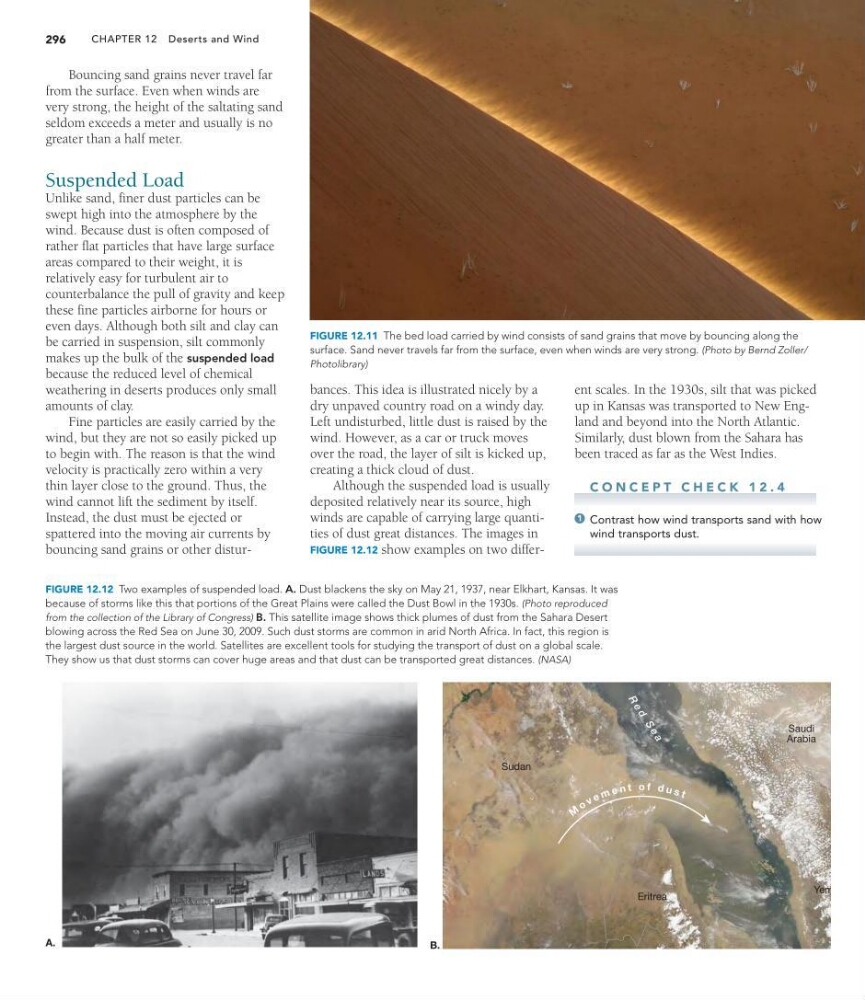
FIGURE 12.12 Two examples of suspended load. A. Dust blackens the sky on May 21, 1937, near Elkhart, Kansas. It was
because of storms like this that portions of the Great Plains were called the Dust Bowl in the 1930s. (Photo reproduced
from the collection of the Library of Congress) B. This satellite image shows thick plumes of dust from the Sahara Desert
blowing across the Red Sea on June 30, 2009. Such dust storms are common in arid North Africa. In fact, this region is
the largest dust source in the world. Satellites are excellent tools for studying the transport of dust on a global scale.
They show us that dust storms can cover huge areas and that dust can be transported great distances. (NASA)
Bouncing sand grains never travel far
from the surface. Even when winds are
very strong, the height of the saltating sand
seldom exceeds a meter and usually is no
greater than a half meter.
Suspended Load
Unlike sand, finer dust particles can be
swept high into the atmosphere by the
wind. Because dust is often composed of
rather flat particles that have large surface
areas compared to their weight, it is
relatively easy for turbulent air to
counterbalance the pull of gravity and keep
these fine particles airborne for hours or
even days. Although both silt and clay can
be carried in suspension, silt commonly
makes up the bulk of the suspended load
because the reduced level of chemical
weathering in deserts produces only small
amounts of clay.
Fine particles are easily carried by the
wind, but they are not so easily picked up
to begin with. The reason is that the wind
velocity is practically zero within a very
thin layer close to the ground. Thus, the
wind cannot lift the sediment by itself.
Instead, the dust must be ejected or
spattered into the moving air currents by
bouncing sand grains or other disturbances. This idea is illustrated nicely by a
dry unpaved country road on a windy day.
Left undisturbed, little dust is raised by the
wind. However, as a car or truck moves
over the road, the layer of silt is kicked up,
creating a thick cloud of dust.
Although the suspended load is usually
deposited relatively near its source, high
winds are capable of carrying large quantities of dust great distances. The images in
FIGURE 12.12 show examples on two different scales. In the 1930s, silt that was picked
up in Kansas was transported to New England and beyond into the North Atlantic.
Similarly, dust blown from the Sahara has
been traced as far as the West Indies.
C O N C E P T C H E C K 1 2 . 4
Contrast how wind transports sand with how
wind transports dust.
1
Saudi
Arabia
Yem
Eritrea
Sudan
B.
R
e
d
S
e
a
M
o v e m e n t o f d u s t
CHAPTER 12 Deserts and Wind
296
FIGURE 12.11 The bed load carried by wind consists of sand grains that move by bouncing along the
surface. Sand never travels far from the surface, even when winds are very strong. (Photo by Bernd Zoller/
Photolibrary)
FIGURE 12.12 Two examples of suspended load. A. Dust blackens the sky on May 21, 1937, near Elkhart, Kansas. It was
because of storms like this that portions of the Great Plains were called the Dust Bowl in the 1930s. (Photo reproduced
from the collection of the Library of Congress) B. This satellite image shows thick plumes of dust from the Sahara Desert
blowing across the Red Sea on June 30, 2009. Such dust storms are common in arid North Africa. In fact, this region is
the largest dust source in the world. Satellites are excellent tools for studying the transport of dust on a global scale.
They show us that dust storms can cover huge areas and that dust can be transported great distances. (NASA)
Bouncing sand grains never travel far
from the surface. Even when winds are
very strong, the height of the saltating sand
seldom exceeds a meter and usually is no
greater than a half meter.
Suspended Load
Unlike sand, finer dust particles can be
swept high into the atmosphere by the
wind. Because dust is often composed of
rather flat particles that have large surface
areas compared to their weight, it is
relatively easy for turbulent air to
counterbalance the pull of gravity and keep
these fine particles airborne for hours or
even days. Although both silt and clay can
be carried in suspension, silt commonly
makes up the bulk of the suspended load
because the reduced level of chemical
weathering in deserts produces only small
amounts of clay.
Fine particles are easily carried by the
wind, but they are not so easily picked up
to begin with. The reason is that the wind
velocity is practically zero within a very
thin layer close to the ground. Thus, the
wind cannot lift the sediment by itself.
Instead, the dust must be ejected or
spattered into the moving air currents by
bouncing sand grains or other disturbances. This idea is illustrated nicely by a
dry unpaved country road on a windy day.
Left undisturbed, little dust is raised by the
wind. However, as a car or truck moves
over the road, the layer of silt is kicked up,
creating a thick cloud of dust.
Although the suspended load is usually
deposited relatively near its source, high
winds are capable of carrying large quantities of dust great distances. The images in
FIGURE 12.12 show examples on two different scales. In the 1930s, silt that was picked
up in Kansas was transported to New England and beyond into the North Atlantic.
Similarly, dust blown from the Sahara has
been traced as far as the West Indies.
C O N C E P T C H E C K 1 2 . 4
Contrast how wind transports sand with how
wind transports dust.
1