

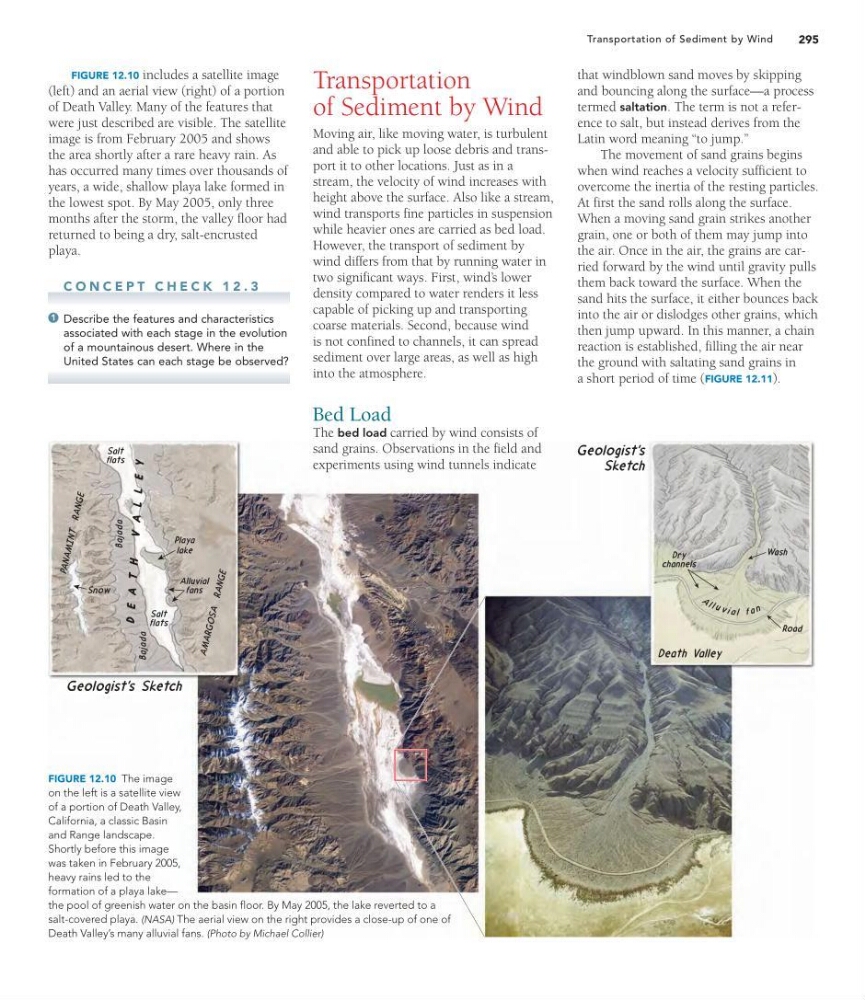
FIGURE 12.10 The image
on the left is a satellite view
of a portion of Death Valley,
California, a classic Basin
and Range landscape.
Shortly before this image
was taken in February 2005,
heavy rains led to the
formation of a playa lake—
the pool of greenish water on the basin floor. By May 2005, the lake reverted to a
salt-covered playa. (NASA) The aerial view on the right provides a close-up of one of
Death Valley’s many alluvial fans. (Photo by Michael Collier)
295
Transportation of Sediment by Wind
FIGURE 12.10 includes a satellite image
(left) and an aerial view (right) of a portion
of Death Valley. Many of the features that
were just described are visible. The satellite
image is from February 2005 and shows
the area shortly after a rare heavy rain. As
has occurred many times over thousands of
years, a wide, shallow playa lake formed in
the lowest spot. By May 2005, only three
months after the storm, the valley floor had
returned to being a dry, salt-encrusted
playa.
C O N C E P T C H E C K 1 2 . 3
Describe the features and characteristics
associated with each stage in the evolution
of a mountainous desert. Where in the
United States can each stage be observed?
1
Transportation
of Sediment by Wind
Moving air, like moving water, is turbulent
and able to pick up loose debris and transport it to other locations. Just as in a
stream, the velocity of wind increases with
height above the surface. Also like a stream,
wind transports fine particles in suspension
while heavier ones are carried as bed load.
However, the transport of sediment by
wind differs from that by running water in
two significant ways. First, wind’ s lower
density compared to water renders it less
capable of picking up and transporting
coarse materials. Second, because wind
is not confined to channels, it can spread
sediment over large areas, as well as high
into the atmosphere.
Bed Load
The bed load carried by wind consists of
sand grains. Observations in the field and
experiments using wind tunnels indicate
that windblown sand moves by skipping
and bouncing along the surface—a process
termed saltation. The term is not a reference to salt, but instead derives from the
Latin word meaning “to jump.”
The movement of sand grains begins
when wind reaches a velocity sufficient to
overcome the inertia of the resting particles.
At first the sand rolls along the surface.
When a moving sand grain strikes another
grain, one or both of them may jump into
the air. Once in the air, the grains are carried forward by the wind until gravity pulls
them back toward the surface. When the
sand hits the surface, it either bounces back
into the air or dislodges other grains, which
then jump upward. In this manner, a chain
reaction is established, filling the air near
the ground with saltating sand grains in
a short period of time (FIGURE 12.11).
on the left is a satellite view
of a portion of Death Valley,
California, a classic Basin
and Range landscape.
Shortly before this image
was taken in February 2005,
heavy rains led to the
formation of a playa lake—
the pool of greenish water on the basin floor. By May 2005, the lake reverted to a
salt-covered playa. (NASA) The aerial view on the right provides a close-up of one of
Death Valley’s many alluvial fans. (Photo by Michael Collier)
295
Transportation of Sediment by Wind
FIGURE 12.10 includes a satellite image
(left) and an aerial view (right) of a portion
of Death Valley. Many of the features that
were just described are visible. The satellite
image is from February 2005 and shows
the area shortly after a rare heavy rain. As
has occurred many times over thousands of
years, a wide, shallow playa lake formed in
the lowest spot. By May 2005, only three
months after the storm, the valley floor had
returned to being a dry, salt-encrusted
playa.
C O N C E P T C H E C K 1 2 . 3
Describe the features and characteristics
associated with each stage in the evolution
of a mountainous desert. Where in the
United States can each stage be observed?
1
Transportation
of Sediment by Wind
Moving air, like moving water, is turbulent
and able to pick up loose debris and transport it to other locations. Just as in a
stream, the velocity of wind increases with
height above the surface. Also like a stream,
wind transports fine particles in suspension
while heavier ones are carried as bed load.
However, the transport of sediment by
wind differs from that by running water in
two significant ways. First, wind’ s lower
density compared to water renders it less
capable of picking up and transporting
coarse materials. Second, because wind
is not confined to channels, it can spread
sediment over large areas, as well as high
into the atmosphere.
Bed Load
The bed load carried by wind consists of
sand grains. Observations in the field and
experiments using wind tunnels indicate
that windblown sand moves by skipping
and bouncing along the surface—a process
termed saltation. The term is not a reference to salt, but instead derives from the
Latin word meaning “to jump.”
The movement of sand grains begins
when wind reaches a velocity sufficient to
overcome the inertia of the resting particles.
At first the sand rolls along the surface.
When a moving sand grain strikes another
grain, one or both of them may jump into
the air. Once in the air, the grains are carried forward by the wind until gravity pulls
them back toward the surface. When the
sand hits the surface, it either bounces back
into the air or dislodges other grains, which
then jump upward. In this manner, a chain
reaction is established, filling the air near
the ground with saltating sand grains in
a short period of time (FIGURE 12.11).