

CHAPTER 1 An Introduction to Geology
8
Notice that units having the same designations do not necessarily extend for the
same number of years. For example, the
Cambrian period lasted about 54 million
years, whereas the Silurian period spanned
only about 28 million years. As we will
emphasize again in Chapter 18, this situation exists because the basis for establishing
the time scale was not the regular rhythm
of a clock, but rather the changing character of life forms through time. Specific dates
were added long after the time scale was
established. A glance at Figure 1.8 also
reveals that the Phanerozoic eon is divided
into many more units than earlier eons
even though it encompasses only about 12
percent of Earth history. The meager fossil
record for these earlier eons is the primary
reason for the lack of detail on this portion
of the time scale. Without abundant fossils,
geologists lose a very important tool for
subdividing geologic time.
C O N C E P T C H E C K 1 . 4
How old is Earth?
Describe two principles used to develop
the geologic time scale.
The Nature
of Scientific Inquiry
As members of a modern society, we are constantly reminded of the benefits derived from
science. But what exactly is the nature of scientific inquiry? Developing an understanding
of how science is done and how scientists
work is an important theme that appears
throughout this book. You will explore the
difficulties in gathering data and some of the
ingenious methods that have been developed
to overcome these difficulties. You will also
see many examples of how hypotheses are
formulated and tested, as well as learn about
the evolution and development of some
major scientific theories.
All science is based on the assumption
that the natural world behaves in a consistent and predictable manner that is comprehensible through careful, systematic
study. The overall goal of science is to discover the underlying patterns in nature and
then to use this knowledge to make predic2
1
tions about what should or should not be
expected, given certain facts or circumstances. For example, by knowing how oil
deposits form, geologists are able to predict
the most favorable sites for exploration
and, perhaps as important, to avoid regions
having little or no potential.
The development of new scientific
knowledge involves some basic logical
processes that are universally accepted. To
determine what is occurring in the natural
world, scientists collect scientific “facts”
through observation and measurement
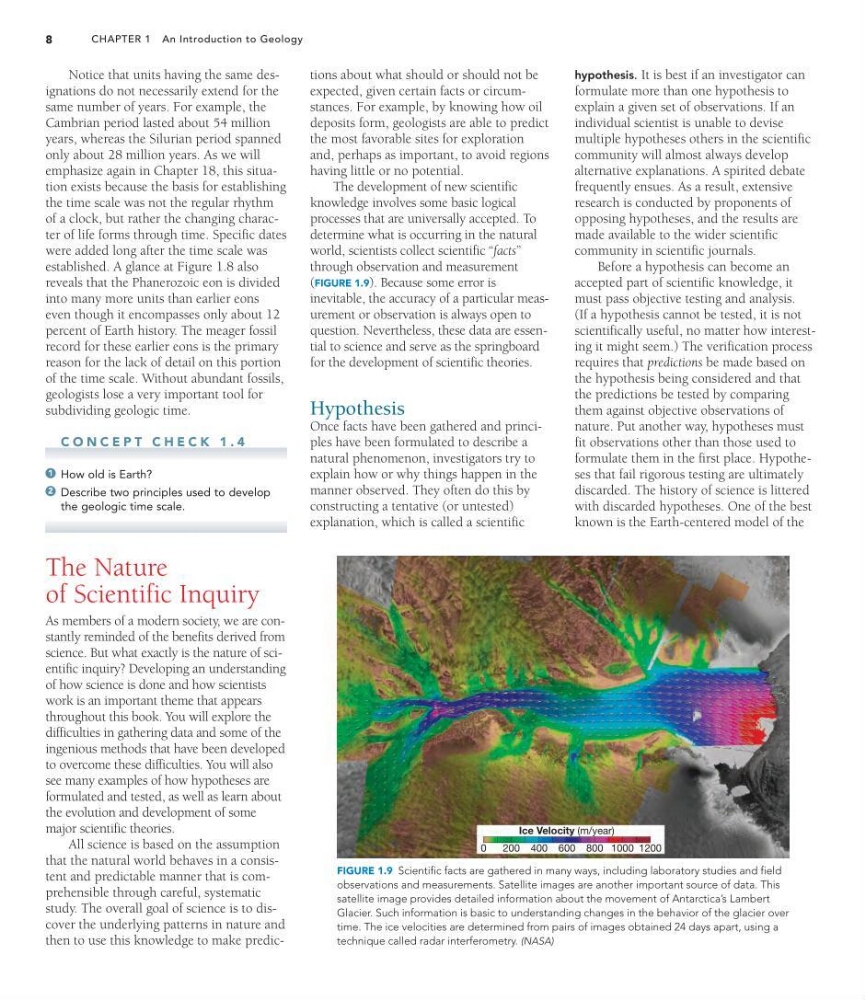
(FIGURE 1.9). Because some error is
inevitable, the accuracy of a particular measurement or observation is always open to
question. Nevertheless, these data are essential to science and serve as the springboard
for the development of scientific theories.
Hypothesis
Once facts have been gathered and principles have been formulated to describe a
natural phenomenon, investigators try to
explain how or why things happen in the
manner observed. They often do this by
constructing a tentative (or untested)
explanation, which is called a scientific
hypothesis. It is best if an investigator can
formulate more than one hypothesis to
explain a given set of observations. If an
individual scientist is unable to devise
multiple hypotheses others in the scientific
community will almost always develop
alternative explanations. A spirited debate
frequently ensues. As a result, extensive
research is conducted by proponents of
opposing hypotheses, and the results are
made available to the wider scientific
community in scientific journals.
Before a hypothesis can become an
accepted part of scientific knowledge, it
must pass objective testing and analysis.
(If a hypothesis cannot be tested, it is not
scientifically useful, no matter how interesting it might seem.) The verification process
requires that predictions be made based on
the hypothesis being considered and that
the predictions be tested by comparing
them against objective observations of
nature. Put another way, hypotheses must
fit observations other than those used to
formulate them in the first place. Hypotheses that fail rigorous testing are ultimately
discarded. The history of science is littered
with discarded hypotheses. One of the best
known is the Earth-centered model of the
1200
1000
800
600
400
200
0
Ice Velocity (m/year)
FIGURE 1.9 Scientific facts are gathered in many ways, including laboratory studies and field
observations and measurements. Satellite images are another important source of data. This
satellite image provides detailed information about the movement of Antarctica’s Lambert
Glacier. Such information is basic to understanding changes in the behavior of the glacier over
time. The ice velocities are determined from pairs of images obtained 24 days apart, using a
technique called radar interferometry. (NASA)
8
Notice that units having the same designations do not necessarily extend for the
same number of years. For example, the
Cambrian period lasted about 54 million
years, whereas the Silurian period spanned
only about 28 million years. As we will
emphasize again in Chapter 18, this situation exists because the basis for establishing
the time scale was not the regular rhythm
of a clock, but rather the changing character of life forms through time. Specific dates
were added long after the time scale was
established. A glance at Figure 1.8 also
reveals that the Phanerozoic eon is divided
into many more units than earlier eons
even though it encompasses only about 12
percent of Earth history. The meager fossil
record for these earlier eons is the primary
reason for the lack of detail on this portion
of the time scale. Without abundant fossils,
geologists lose a very important tool for
subdividing geologic time.
C O N C E P T C H E C K 1 . 4
How old is Earth?
Describe two principles used to develop
the geologic time scale.
The Nature
of Scientific Inquiry
As members of a modern society, we are constantly reminded of the benefits derived from
science. But what exactly is the nature of scientific inquiry? Developing an understanding
of how science is done and how scientists
work is an important theme that appears
throughout this book. You will explore the
difficulties in gathering data and some of the
ingenious methods that have been developed
to overcome these difficulties. You will also
see many examples of how hypotheses are
formulated and tested, as well as learn about
the evolution and development of some
major scientific theories.
All science is based on the assumption
that the natural world behaves in a consistent and predictable manner that is comprehensible through careful, systematic
study. The overall goal of science is to discover the underlying patterns in nature and
then to use this knowledge to make predic2
1
tions about what should or should not be
expected, given certain facts or circumstances. For example, by knowing how oil
deposits form, geologists are able to predict
the most favorable sites for exploration
and, perhaps as important, to avoid regions
having little or no potential.
The development of new scientific
knowledge involves some basic logical
processes that are universally accepted. To
determine what is occurring in the natural
world, scientists collect scientific “facts”
through observation and measurement
(FIGURE 1.9). Because some error is
inevitable, the accuracy of a particular measurement or observation is always open to
question. Nevertheless, these data are essential to science and serve as the springboard
for the development of scientific theories.
Hypothesis
Once facts have been gathered and principles have been formulated to describe a
natural phenomenon, investigators try to
explain how or why things happen in the
manner observed. They often do this by
constructing a tentative (or untested)
explanation, which is called a scientific
hypothesis. It is best if an investigator can
formulate more than one hypothesis to
explain a given set of observations. If an
individual scientist is unable to devise
multiple hypotheses others in the scientific
community will almost always develop
alternative explanations. A spirited debate
frequently ensues. As a result, extensive
research is conducted by proponents of
opposing hypotheses, and the results are
made available to the wider scientific
community in scientific journals.
Before a hypothesis can become an
accepted part of scientific knowledge, it
must pass objective testing and analysis.
(If a hypothesis cannot be tested, it is not
scientifically useful, no matter how interesting it might seem.) The verification process
requires that predictions be made based on
the hypothesis being considered and that
the predictions be tested by comparing
them against objective observations of
nature. Put another way, hypotheses must
fit observations other than those used to
formulate them in the first place. Hypotheses that fail rigorous testing are ultimately
discarded. The history of science is littered
with discarded hypotheses. One of the best
known is the Earth-centered model of the
1200
1000
800
600
400
200
0
Ice Velocity (m/year)
FIGURE 1.9 Scientific facts are gathered in many ways, including laboratory studies and field
observations and measurements. Satellite images are another important source of data. This
satellite image provides detailed information about the movement of Antarctica’s Lambert
Glacier. Such information is basic to understanding changes in the behavior of the glacier over
time. The ice velocities are determined from pairs of images obtained 24 days apart, using a
technique called radar interferometry. (NASA)