

rocks
9
The Nature of Scientific Inquiry
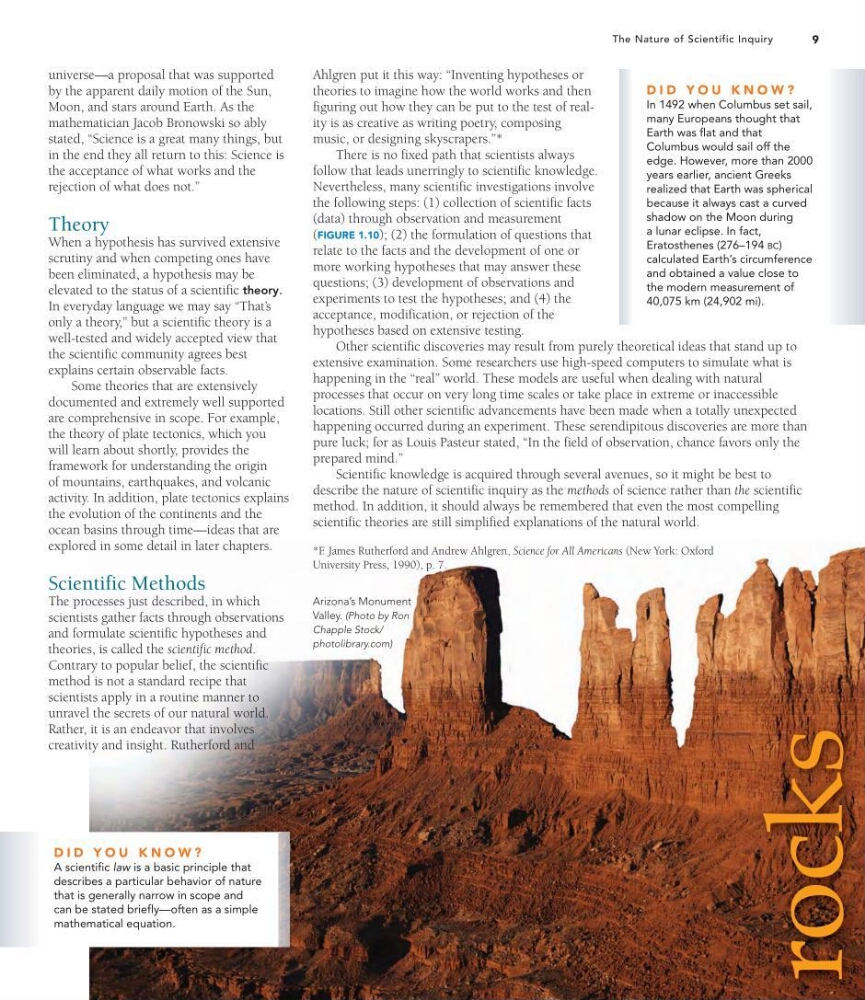
Arizona’s Monument
Valley. (Photo by Ron
Chapple Stock/
photolibrary.com)
Ahlgren put it this way: “Inventing hypotheses or
theories to imagine how the world works and then
figuring out how they can be put to the test of reality is as creative as writing poetry, composing
music, or designing skyscrapers.”*
There is no fixed path that scientists always
follow that leads unerringly to scientific knowledge.
Nevertheless, many scientific investigations involve
the following steps: (1) collection of scientific facts
(data) through observation and measurement
(FIGURE 1.10); (2) the formulation of questions that
relate to the facts and the development of one or
more working hypotheses that may answer these
questions; (3) development of observations and
experiments to test the hypotheses; and (4) the
acceptance, modification, or rejection of the
hypotheses based on extensive testing.
Other scientific discoveries may result from purely theoretical ideas that stand up to
extensive examination. Some researchers use high-speed computers to simulate what is
happening in the “real” world. These models are useful when dealing with natural
processes that occur on very long time scales or take place in extreme or inaccessible
locations. Still other scientific advancements have been made when a totally unexpected
happening occurred during an experiment. These serendipitous discoveries are more than
pure luck; for as Louis Pasteur stated, “In the field of observation, chance favors only the
prepared mind.”
Scientific knowledge is acquired through several avenues, so it might be best to
describe the nature of scientific inquiry as the methods of science rather than the scientific
method. In addition, it should always be remembered that even the most compelling
scientific theories are still simplified explanations of the natural world.
*F. James Rutherford and Andrew Ahlgren, Science for All Americans (New York: Oxford
University Press, 1990), p. 7.
D I D Y O U K N O W ?
In 1492 when Columbus set sail,
many Europeans thought that
Earth was flat and that
Columbus would sail off the
edge. However, more than 2000
years earlier, ancient Greeks
realized that Earth was spherical
because it always cast a curved
shadow on the Moon during
a lunar eclipse. In fact,
Eratosthenes (276–194 BC)
calculated Earth’s circumference
and obtained a value close to
the modern measurement of
40,075 km (24,902 mi).
D I D Y O U K N O W ?
A scientific law is a basic principle that
describes a particular behavior of nature
that is generally narrow in scope and
can be stated briefly—often as a simple
mathematical equation.
universe—a proposal that was supported
by the apparent daily motion of the Sun,
Moon, and stars around Earth. As the
mathematician Jacob Bronowski so ably
stated, “Science is a great many things, but
in the end they all return to this: Science is
the acceptance of what works and the
rejection of what does not.”
Theory
When a hypothesis has survived extensive
scrutiny and when competing ones have
been eliminated, a hypothesis may be
elevated to the status of a scientific theory.
In everyday language we may say “That’ s
only a theory,” but a scientific theory is a
well-tested and widely accepted view that
the scientific community agrees best
explains certain observable facts.
Some theories that are extensively
documented and extremely well supported
are comprehensive in scope. For example,
the theory of plate tectonics, which you
will learn about shortly, provides the
framework for understanding the origin
of mountains, earthquakes, and volcanic
activity. In addition, plate tectonics explains
the evolution of the continents and the
ocean basins through time—ideas that are
explored in some detail in later chapters.
Scientific Methods
The processes just described, in which
scientists gather facts through observations
and formulate scientific hypotheses and
theories, is called the scientific method.
Contrary to popular belief, the scientific
method is not a standard recipe that
scientists apply in a routine manner to
unravel the secrets of our natural world.
Rather, it is an endeavor that involves
creativity and insight. Rutherford and
9
The Nature of Scientific Inquiry
Arizona’s Monument
Valley. (Photo by Ron
Chapple Stock/
photolibrary.com)
Ahlgren put it this way: “Inventing hypotheses or
theories to imagine how the world works and then
figuring out how they can be put to the test of reality is as creative as writing poetry, composing
music, or designing skyscrapers.”*
There is no fixed path that scientists always
follow that leads unerringly to scientific knowledge.
Nevertheless, many scientific investigations involve
the following steps: (1) collection of scientific facts
(data) through observation and measurement
(FIGURE 1.10); (2) the formulation of questions that
relate to the facts and the development of one or
more working hypotheses that may answer these
questions; (3) development of observations and
experiments to test the hypotheses; and (4) the
acceptance, modification, or rejection of the
hypotheses based on extensive testing.
Other scientific discoveries may result from purely theoretical ideas that stand up to
extensive examination. Some researchers use high-speed computers to simulate what is
happening in the “real” world. These models are useful when dealing with natural
processes that occur on very long time scales or take place in extreme or inaccessible
locations. Still other scientific advancements have been made when a totally unexpected
happening occurred during an experiment. These serendipitous discoveries are more than
pure luck; for as Louis Pasteur stated, “In the field of observation, chance favors only the
prepared mind.”
Scientific knowledge is acquired through several avenues, so it might be best to
describe the nature of scientific inquiry as the methods of science rather than the scientific
method. In addition, it should always be remembered that even the most compelling
scientific theories are still simplified explanations of the natural world.
*F. James Rutherford and Andrew Ahlgren, Science for All Americans (New York: Oxford
University Press, 1990), p. 7.
D I D Y O U K N O W ?
In 1492 when Columbus set sail,
many Europeans thought that
Earth was flat and that
Columbus would sail off the
edge. However, more than 2000
years earlier, ancient Greeks
realized that Earth was spherical
because it always cast a curved
shadow on the Moon during
a lunar eclipse. In fact,
Eratosthenes (276–194 BC)
calculated Earth’s circumference
and obtained a value close to
the modern measurement of
40,075 km (24,902 mi).
D I D Y O U K N O W ?
A scientific law is a basic principle that
describes a particular behavior of nature
that is generally narrow in scope and
can be stated briefly—often as a simple
mathematical equation.
universe—a proposal that was supported
by the apparent daily motion of the Sun,
Moon, and stars around Earth. As the
mathematician Jacob Bronowski so ably
stated, “Science is a great many things, but
in the end they all return to this: Science is
the acceptance of what works and the
rejection of what does not.”
Theory
When a hypothesis has survived extensive
scrutiny and when competing ones have
been eliminated, a hypothesis may be
elevated to the status of a scientific theory.
In everyday language we may say “That’ s
only a theory,” but a scientific theory is a
well-tested and widely accepted view that
the scientific community agrees best
explains certain observable facts.
Some theories that are extensively
documented and extremely well supported
are comprehensive in scope. For example,
the theory of plate tectonics, which you
will learn about shortly, provides the
framework for understanding the origin
of mountains, earthquakes, and volcanic
activity. In addition, plate tectonics explains
the evolution of the continents and the
ocean basins through time—ideas that are
explored in some detail in later chapters.
Scientific Methods
The processes just described, in which
scientists gather facts through observations
and formulate scientific hypotheses and
theories, is called the scientific method.
Contrary to popular belief, the scientific
method is not a standard recipe that
scientists apply in a routine manner to
unravel the secrets of our natural world.
Rather, it is an endeavor that involves
creativity and insight. Rutherford and