

7
Geologic Time
How long is 4.6 billion years? If you were to begin counting at the rate
of one number per second and continued 24 hours a day, 7 days a week
and never stopped, it would take about two lifetimes (150 years) to reach
4.6 billion!
Relative Dating and the Geologic Time Scale
During the 19
th century, long before the discovery of radioactivity, which
eventually allowed for the establishment of reliable numerical dates, a
geologic time scale was developed using principles of relative dating.
Relative dating means that events are placed in their proper sequence or
order without knowing their age in years. This is done by applying
principles such as the law of superposition. This basic rule applies to
materials that were originally deposited at Earth’ s surface, such as layers of
sedimentary rock and volcanic lava flows. The law simply states that the
youngest layer is on top, and the oldest layer is on the bottom (assuming
that nothing has turned the layers upside down, which sometimes happens). Stated another way, a layer is older than the ones above it and
younger than the ones below. Arizona’ s Grand Canyon provides a fine
example where the oldest rocks are located in the inner gorge while the
youngest rocks are found on the rim (See Figure 1.6). So the law of superposition establishes the sequence of rock layers but not, of course, their
numerical ages. Today such a proposal appears to be elementary, but
300 years ago it amounted to a major breakthrough in scientific reasoning
by establishing a rational basis for relative time measurements.
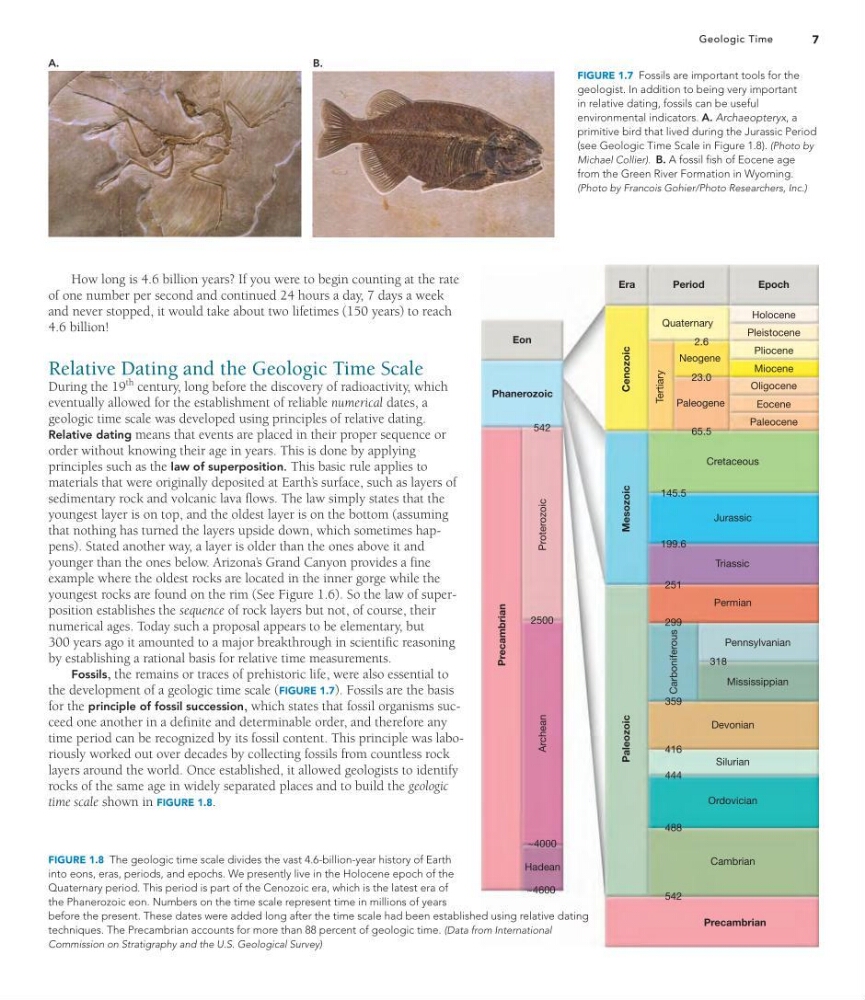
Fossils, the remains or traces of prehistoric life, were also essential to
the development of a geologic time scale (FIGURE 1.7). Fossils are the basis
for the principle of fossil succession, which states that fossil organisms succeed one another in a definite and determinable order, and therefore any
time period can be recognized by its fossil content. This principle was laboriously worked out over decades by collecting fossils from countless rock
layers around the world. Once established, it allowed geologists to identify
rocks of the same age in widely separated places and to build the geologic
time scale shown in FIGURE 1.8.
FIGURE 1.7 Fossils are important tools for the
geologist. In addition to being very important
in relative dating, fossils can be useful
environmental indicators. A. Archaeopteryx, a
primitive bird that lived during the Jurassic Period
(see Geologic Time Scale in Figure 1.8). (Photo by
Michael Collier). B. A fossil fish of Eocene age
from the Green River Formation in Wyoming.
(Photo by Francois Gohier/Photo Researchers, Inc.)
A.
B.
Eon
Era
Period
Epoch
Phanerozoic
Proterozoic
Archean
Cenozoic
Mesozoic
Paleozoic
2500
~4000
Quaternary
Tertiary
Cretaceous
Jurassic
Triassic
Permian
Carboniferous
Pennsylvanian
Mississippian
Devonian
Silurian
Ordovician
Cambrian
Precambrian
145.5
199.6
251
299
318
359
416
444
488
542
Holocene
Pleistocene
Pliocene
Miocene
Oligocene
Eocene
Paleocene
2.6
65.5
Precambrian
542
Neogene
Paleogene
~4600
Hadean
23.0
FIGURE 1.8 The geologic time scale divides the vast 4.6-billion-year history of Earth
into eons, eras, periods, and epochs. We presently live in the Holocene epoch of the
Quaternary period. This period is part of the Cenozoic era, which is the latest era of
the Phanerozoic eon. Numbers on the time scale represent time in millions of years
before the present. These dates were added long after the time scale had been established using relative dating
techniques. The Precambrian accounts for more than 88 percent of geologic time. (Data from International
Commission on Stratigraphy and the U.S. Geological Survey)
Geologic Time
How long is 4.6 billion years? If you were to begin counting at the rate
of one number per second and continued 24 hours a day, 7 days a week
and never stopped, it would take about two lifetimes (150 years) to reach
4.6 billion!
Relative Dating and the Geologic Time Scale
During the 19
th century, long before the discovery of radioactivity, which
eventually allowed for the establishment of reliable numerical dates, a
geologic time scale was developed using principles of relative dating.
Relative dating means that events are placed in their proper sequence or
order without knowing their age in years. This is done by applying
principles such as the law of superposition. This basic rule applies to
materials that were originally deposited at Earth’ s surface, such as layers of
sedimentary rock and volcanic lava flows. The law simply states that the
youngest layer is on top, and the oldest layer is on the bottom (assuming
that nothing has turned the layers upside down, which sometimes happens). Stated another way, a layer is older than the ones above it and
younger than the ones below. Arizona’ s Grand Canyon provides a fine
example where the oldest rocks are located in the inner gorge while the
youngest rocks are found on the rim (See Figure 1.6). So the law of superposition establishes the sequence of rock layers but not, of course, their
numerical ages. Today such a proposal appears to be elementary, but
300 years ago it amounted to a major breakthrough in scientific reasoning
by establishing a rational basis for relative time measurements.
Fossils, the remains or traces of prehistoric life, were also essential to
the development of a geologic time scale (FIGURE 1.7). Fossils are the basis
for the principle of fossil succession, which states that fossil organisms succeed one another in a definite and determinable order, and therefore any
time period can be recognized by its fossil content. This principle was laboriously worked out over decades by collecting fossils from countless rock
layers around the world. Once established, it allowed geologists to identify
rocks of the same age in widely separated places and to build the geologic
time scale shown in FIGURE 1.8.
FIGURE 1.7 Fossils are important tools for the
geologist. In addition to being very important
in relative dating, fossils can be useful
environmental indicators. A. Archaeopteryx, a
primitive bird that lived during the Jurassic Period
(see Geologic Time Scale in Figure 1.8). (Photo by
Michael Collier). B. A fossil fish of Eocene age
from the Green River Formation in Wyoming.
(Photo by Francois Gohier/Photo Researchers, Inc.)
A.
B.
Eon
Era
Period
Epoch
Phanerozoic
Proterozoic
Archean
Cenozoic
Mesozoic
Paleozoic
2500
~4000
Quaternary
Tertiary
Cretaceous
Jurassic
Triassic
Permian
Carboniferous
Pennsylvanian
Mississippian
Devonian
Silurian
Ordovician
Cambrian
Precambrian
145.5
199.6
251
299
318
359
416
444
488
542
Holocene
Pleistocene
Pliocene
Miocene
Oligocene
Eocene
Paleocene
2.6
65.5
Precambrian
542
Neogene
Paleogene
~4600
Hadean
23.0
FIGURE 1.8 The geologic time scale divides the vast 4.6-billion-year history of Earth
into eons, eras, periods, and epochs. We presently live in the Holocene epoch of the
Quaternary period. This period is part of the Cenozoic era, which is the latest era of
the Phanerozoic eon. Numbers on the time scale represent time in millions of years
before the present. These dates were added long after the time scale had been established using relative dating
techniques. The Precambrian accounts for more than 88 percent of geologic time. (Data from International
Commission on Stratigraphy and the U.S. Geological Survey)