

CHAPTER 12 Deserts and Wind
292
rain falls in such a short time that all of it cannot soak in (FIGURE 12.6).
Because desert vegetative cover is sparse, runoff is largely unhindered and
consequently rapid, often creating flash floods along valley floors (FIGURE
12.5B). These floods are quite unlike floods in humid regions. A flood on a
river such as the Mississippi may take several days to reach its crest and
then subside, but desert floods arrive suddenly and subside quickly.
Because much of the surface material in a desert is not anchored by vegetation, the amount of erosional work that occurs during a single, short-lived
rain event is impressive.
In the dry western United States, different names are used for
ephemeral streams, including wash and arroyo. In other parts of the world,
a dry stream may be a wadi (Arabia and North Africa), a donga (South
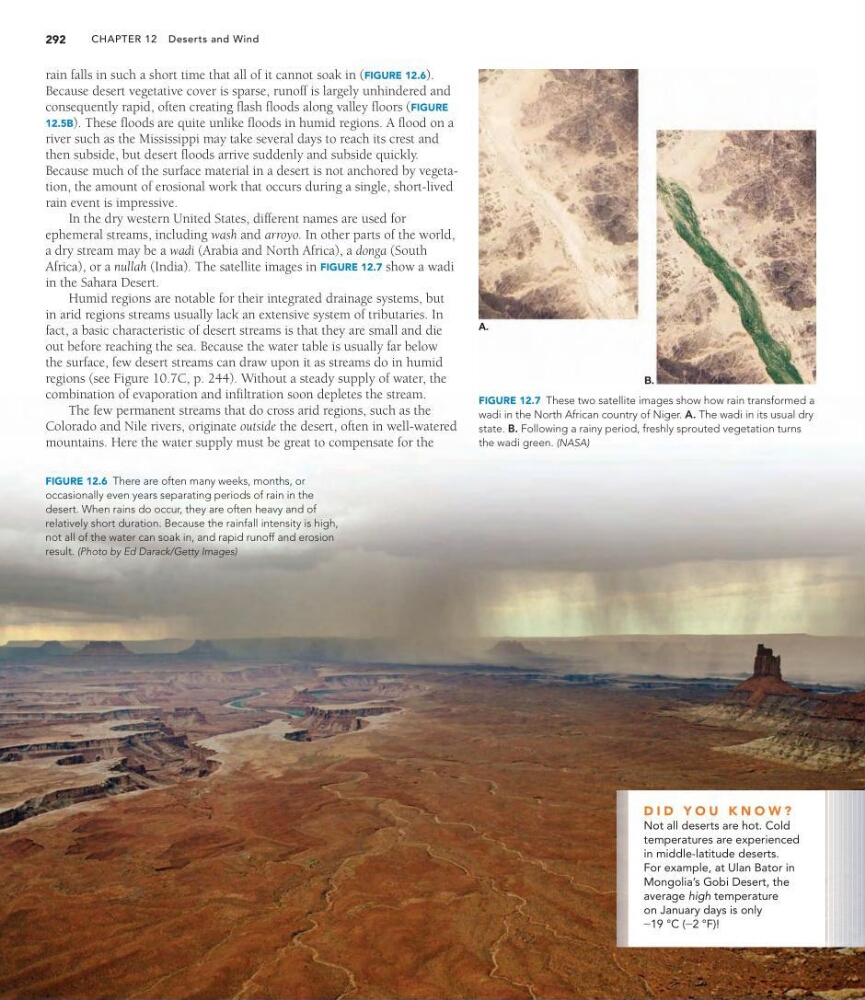
Africa), or a nullah (India). The satellite images in FIGURE 12.7 show a wadi
in the Sahara Desert.
Humid regions are notable for their integrated drainage systems, but
in arid regions streams usually lack an extensive system of tributaries. In
fact, a basic characteristic of desert streams is that they are small and die
out before reaching the sea. Because the water table is usually far below
the surface, few desert streams can draw upon it as streams do in humid
regions (see Figure 10.7C, p. 244). Without a steady supply of water, the
combination of evaporation and infiltration soon depletes the stream.
The few permanent streams that do cross arid regions, such as the
Colorado and Nile rivers, originate outside the desert, often in well-watered
mountains. Here the water supply must be great to compensate for the
FIGURE 12.6 There are often many weeks, months, or
occasionally even years separating periods of rain in the
desert. When rains do occur, they are often heavy and of
relatively short duration. Because the rainfall intensity is high,
not all of the water can soak in, and rapid runoff and erosion
result. (Photo by Ed Darack/Getty Images)
D I D Y O U K N O W ?
Not all deserts are hot. Cold
temperatures are experienced
in middle-latitude deserts.
For example, at Ulan Bator in
Mongolia’s Gobi Desert, the
average high temperature
on January days is only
-19 °C (-2 °F)!
A.
B.
FIGURE 12.7 These two satellite images show how rain transformed a
wadi in the North African country of Niger. A. The wadi in its usual dry
state. B. Following a rainy period, freshly sprouted vegetation turns
the wadi green. (NASA)
292
rain falls in such a short time that all of it cannot soak in (FIGURE 12.6).
Because desert vegetative cover is sparse, runoff is largely unhindered and
consequently rapid, often creating flash floods along valley floors (FIGURE
12.5B). These floods are quite unlike floods in humid regions. A flood on a
river such as the Mississippi may take several days to reach its crest and
then subside, but desert floods arrive suddenly and subside quickly.
Because much of the surface material in a desert is not anchored by vegetation, the amount of erosional work that occurs during a single, short-lived
rain event is impressive.
In the dry western United States, different names are used for
ephemeral streams, including wash and arroyo. In other parts of the world,
a dry stream may be a wadi (Arabia and North Africa), a donga (South
Africa), or a nullah (India). The satellite images in FIGURE 12.7 show a wadi
in the Sahara Desert.
Humid regions are notable for their integrated drainage systems, but
in arid regions streams usually lack an extensive system of tributaries. In
fact, a basic characteristic of desert streams is that they are small and die
out before reaching the sea. Because the water table is usually far below
the surface, few desert streams can draw upon it as streams do in humid
regions (see Figure 10.7C, p. 244). Without a steady supply of water, the
combination of evaporation and infiltration soon depletes the stream.
The few permanent streams that do cross arid regions, such as the
Colorado and Nile rivers, originate outside the desert, often in well-watered
mountains. Here the water supply must be great to compensate for the
FIGURE 12.6 There are often many weeks, months, or
occasionally even years separating periods of rain in the
desert. When rains do occur, they are often heavy and of
relatively short duration. Because the rainfall intensity is high,
not all of the water can soak in, and rapid runoff and erosion
result. (Photo by Ed Darack/Getty Images)
D I D Y O U K N O W ?
Not all deserts are hot. Cold
temperatures are experienced
in middle-latitude deserts.
For example, at Ulan Bator in
Mongolia’s Gobi Desert, the
average high temperature
on January days is only
-19 °C (-2 °F)!
A.
B.
FIGURE 12.7 These two satellite images show how rain transformed a
wadi in the North African country of Niger. A. The wadi in its usual dry
state. B. Following a rainy period, freshly sprouted vegetation turns
the wadi green. (NASA)