

CHAPTER 12 Deserts and Wind
290
D I D Y O U K N O W ?
The Sahara of North Africa is the
world’s largest desert. Extending from
the Atlantic Ocean to the Red Sea, it
covers about 9 million km
2 (3.5 million
mi
2 ), an area about the size of the
United States. By comparison, the
largest desert in the United States,
Nevada’s Great Basin Desert, has an
area that is less than 5 percent of the
Sahara.
are far removed from the ocean, which is
the ultimate source of moisture for cloud
formation and precipitation. One wellknown example is the Gobi Desert of central Asia, shown on the map north of India
(Figure 12.2).
The presence of high mountains across
the paths of prevailing winds further
separates these areas from water-bearing
maritime air masses. Also, the mountains
force the air to lose much of its water. The
mechanism is simple: As prevailing winds meet mountain barriers, the air is forced to
ascend. When air rises, it expands and cools, a process that can produce clouds and precipitation. The windward sides of mountains, therefore, often have high precipitation.
By contrast, the leeward sides of mountains are usually much drier (FIGURE 12.4). This
situation exists because air reaching the leeward side has lost much of its moisture, and if
the air descends, it is compressed and warmed, making cloud formation even less likely.
The dry region that results is often referred to as a rainshadow desert.
Because most mid-latitude deserts occupy sites on the leeward sides of mountains, they
can also be classified as rainshadow deserts. In North America, the Coast Ranges, Sierra
Nevada, and Cascades are the foremost mountain barriers to moisture from the Pacific. In
Asia, the great Himalayan chain prevents the summertime monsoon flow of moist Indian
Ocean air from reaching the interior.
Because the Southern Hemisphere lacks extensive land areas in the middle latitudes,
only a small area of desert and steppe occurs in this latitude range, existing primarily near
the southern tip of South America in the rainshadow of the towering Andes.
Middle-latitude deserts provide an example of how tectonic processes affect climate.
Rainshadow deserts exist by virtue of the mountains produced when plates collide. Without
such mountain-building episodes, wetter climates would prevail where many dry regions
exist today.
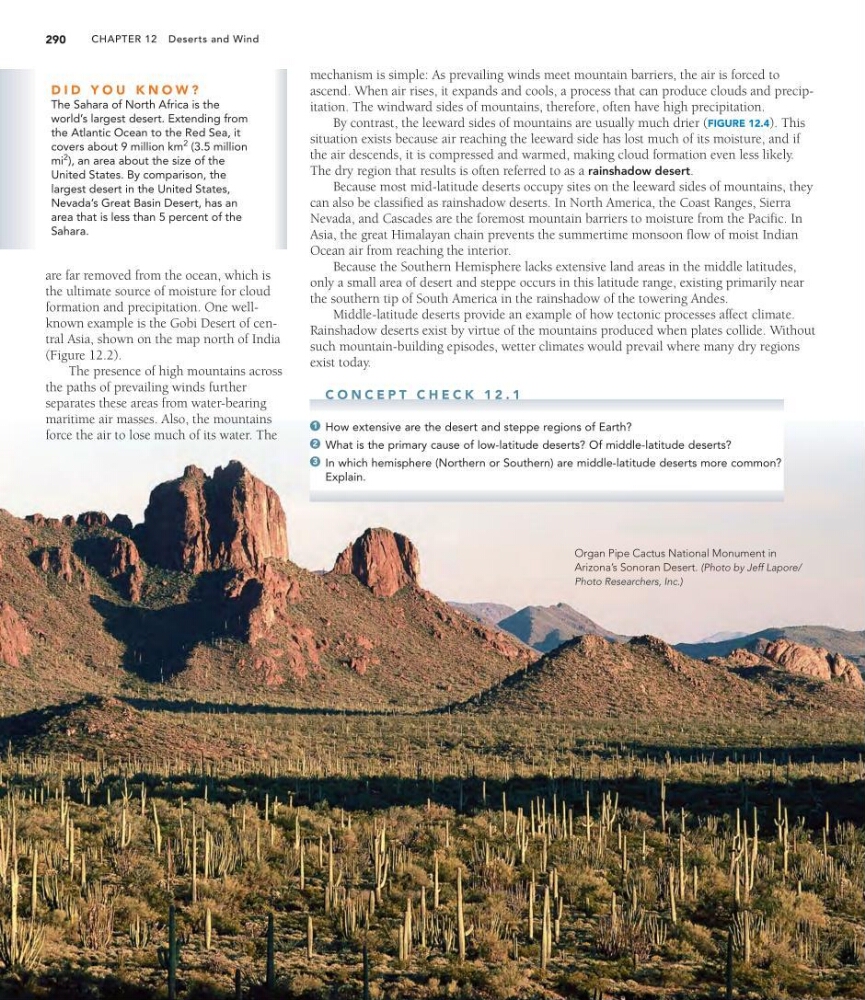
Organ Pipe Cactus National Monument in
Arizona’s Sonoran Desert. (Photo by Jeff Lapore/
Photo Researchers, Inc.)
C O N C E P T C H E C K 1 2 . 1
How extensive are the desert and steppe regions of Earth?
What is the primary cause of low-latitude deserts? Of middle-latitude deserts?
In which hemisphere (Northern or Southern) are middle-latitude deserts more common?
Explain.
3
2
1
290
D I D Y O U K N O W ?
The Sahara of North Africa is the
world’s largest desert. Extending from
the Atlantic Ocean to the Red Sea, it
covers about 9 million km
2 (3.5 million
mi
2 ), an area about the size of the
United States. By comparison, the
largest desert in the United States,
Nevada’s Great Basin Desert, has an
area that is less than 5 percent of the
Sahara.
are far removed from the ocean, which is
the ultimate source of moisture for cloud
formation and precipitation. One wellknown example is the Gobi Desert of central Asia, shown on the map north of India
(Figure 12.2).
The presence of high mountains across
the paths of prevailing winds further
separates these areas from water-bearing
maritime air masses. Also, the mountains
force the air to lose much of its water. The
mechanism is simple: As prevailing winds meet mountain barriers, the air is forced to
ascend. When air rises, it expands and cools, a process that can produce clouds and precipitation. The windward sides of mountains, therefore, often have high precipitation.
By contrast, the leeward sides of mountains are usually much drier (FIGURE 12.4). This
situation exists because air reaching the leeward side has lost much of its moisture, and if
the air descends, it is compressed and warmed, making cloud formation even less likely.
The dry region that results is often referred to as a rainshadow desert.
Because most mid-latitude deserts occupy sites on the leeward sides of mountains, they
can also be classified as rainshadow deserts. In North America, the Coast Ranges, Sierra
Nevada, and Cascades are the foremost mountain barriers to moisture from the Pacific. In
Asia, the great Himalayan chain prevents the summertime monsoon flow of moist Indian
Ocean air from reaching the interior.
Because the Southern Hemisphere lacks extensive land areas in the middle latitudes,
only a small area of desert and steppe occurs in this latitude range, existing primarily near
the southern tip of South America in the rainshadow of the towering Andes.
Middle-latitude deserts provide an example of how tectonic processes affect climate.
Rainshadow deserts exist by virtue of the mountains produced when plates collide. Without
such mountain-building episodes, wetter climates would prevail where many dry regions
exist today.
Organ Pipe Cactus National Monument in
Arizona’s Sonoran Desert. (Photo by Jeff Lapore/
Photo Researchers, Inc.)
C O N C E P T C H E C K 1 2 . 1
How extensive are the desert and steppe regions of Earth?
What is the primary cause of low-latitude deserts? Of middle-latitude deserts?
In which hemisphere (Northern or Southern) are middle-latitude deserts more common?
Explain.
3
2
1