

North
America
Eurasia
Africa
South
America
India
Ice mass
Antarctica
Equator Equator
Equator Equator
Australia
A.
B.
CHAPTER 11 Glaciers and Glaciation
282
Glacial features in present-day Africa,
Australia, South America, and India indicate that these regions, which are now tropical or subtropical, experienced an ice age
near the end of the Paleozoic era, about
250 million years ago. However, there is no
evidence that ice sheets existed during that
period in what are today the higher latitudes of North America and Eurasia. For
many years this puzzled scientists. Was the
climate in these relatively tropical latitudes
once like it is today in Greenland and
Antarctica? Why did glaciers not form in
North America and Eurasia? Until the plate
tectonics theory was formulated, there had
been no reasonable explanation.
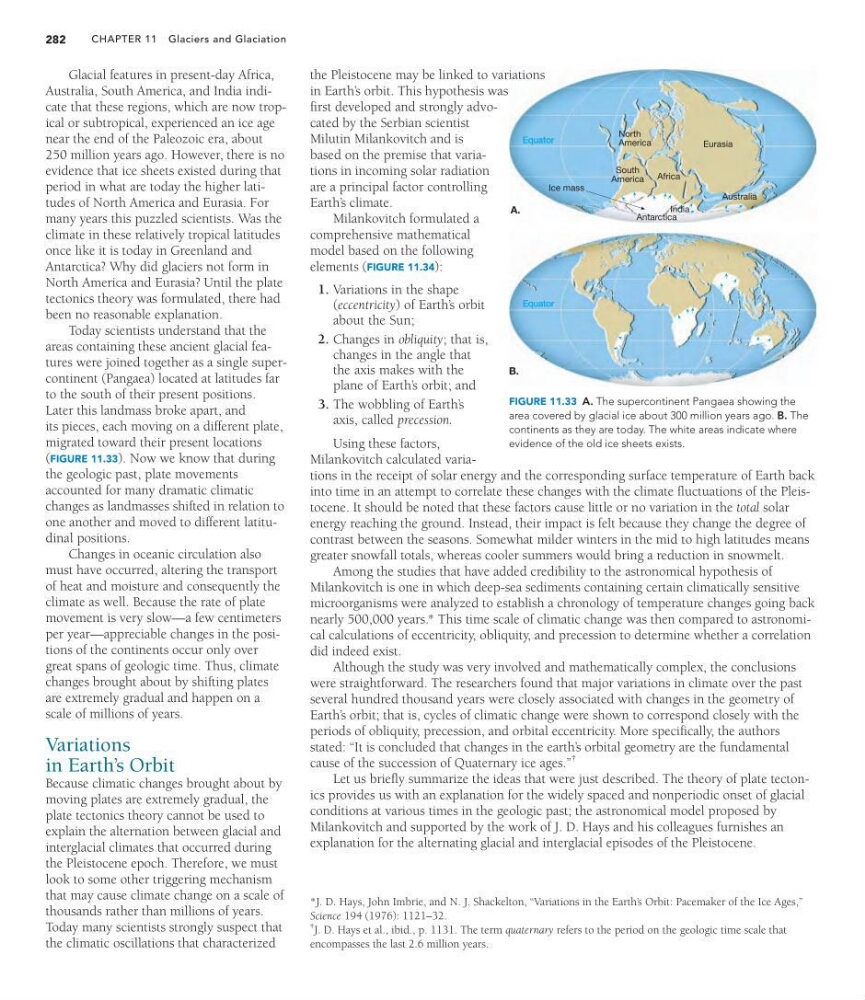
Today scientists understand that the
areas containing these ancient glacial features were joined together as a single supercontinent (Pangaea) located at latitudes far
to the south of their present positions.
Later this landmass broke apart, and
its pieces, each moving on a different plate,
migrated toward their present locations
(FIGURE 11.33). Now we know that during
the geologic past, plate movements
accounted for many dramatic climatic
changes as landmasses shifted in relation to
one another and moved to different latitudinal positions.
Changes in oceanic circulation also
must have occurred, altering the transport
of heat and moisture and consequently the
climate as well. Because the rate of plate
movement is very slow—a few centimeters
per year—appreciable changes in the positions of the continents occur only over
great spans of geologic time. Thus, climate
changes brought about by shifting plates
are extremely gradual and happen on a
scale of millions of years.
Variations
in Earth’ s Orbit
Because climatic changes brought about by
moving plates are extremely gradual, the
plate tectonics theory cannot be used to
explain the alternation between glacial and
interglacial climates that occurred during
the Pleistocene epoch. Therefore, we must
look to some other triggering mechanism
that may cause climate change on a scale of
thousands rather than millions of years.
Today many scientists strongly suspect that
the climatic oscillations that characterized
the Pleistocene may be linked to variations
in Earth’ s orbit. This hypothesis was
first developed and strongly advocated by the Serbian scientist
Milutin Milankovitch and is
based on the premise that variations in incoming solar radiation
are a principal factor controlling
Earth’ s climate.
Milankovitch formulated a
comprehensive mathematical
model based on the following
elements (FIGURE 11.34):
1. Variations in the shape
(eccentricity) of Earth’ s orbit
about the Sun;
2. Changes in obliquity; that is,
changes in the angle that
the axis makes with the
plane of Earth’ s orbit; and
3. The wobbling of Earth’ s
axis, called precession.
Using these factors,
Milankovitch calculated variations in the receipt of solar energy and the corresponding surface temperature of Earth back
into time in an attempt to correlate these changes with the climate fluctuations of the Pleistocene. It should be noted that these factors cause little or no variation in the total solar
energy reaching the ground. Instead, their impact is felt because they change the degree of
contrast between the seasons. Somewhat milder winters in the mid to high latitudes means
greater snowfall totals, whereas cooler summers would bring a reduction in snowmelt.
Among the studies that have added credibility to the astronomical hypothesis of
Milankovitch is one in which deep-sea sediments containing certain climatically sensitive
microorganisms were analyzed to establish a chronology of temperature changes going back
nearly 500,000 years.* This time scale of climatic change was then compared to astronomical calculations of eccentricity, obliquity, and precession to determine whether a correlation
did indeed exist.
Although the study was very involved and mathematically complex, the conclusions
were straightforward. The researchers found that major variations in climate over the past
several hundred thousand years were closely associated with changes in the geometry of
Earth’ s orbit; that is, cycles of climatic change were shown to correspond closely with the
periods of obliquity, precession, and orbital eccentricity. More specifically, the authors
stated: “It is concluded that changes in the earth’ s orbital geometry are the fundamental
cause of the succession of Quaternary ice ages.”
†
Let us briefly summarize the ideas that were just described. The theory of plate tectonics provides us with an explanation for the widely spaced and nonperiodic onset of glacial
conditions at various times in the geologic past; the astronomical model proposed by
Milankovitch and supported by the work of J. D. Hays and his colleagues furnishes an
explanation for the alternating glacial and interglacial episodes of the Pleistocene.
FIGURE 11.33 A. The supercontinent Pangaea showing the
area covered by glacial ice about 300 million years ago. B. The
continents as they are today. The white areas indicate where
evidence of the old ice sheets exists.
*J. D. Hays, John Imbrie, and N. J. Shackelton, “Variations in the Earth’ s Orbit: Pacemaker of the Ice Ages,”
Science 194 (1976): 1121–32.
† J. D. Hays et al., ibid., p. 1131. The term quaternary refers to the period on the geologic time scale that
encompasses the last 2.6 million years.
America
Eurasia
Africa
South
America
India
Ice mass
Antarctica
Equator Equator
Equator Equator
Australia
A.
B.
CHAPTER 11 Glaciers and Glaciation
282
Glacial features in present-day Africa,
Australia, South America, and India indicate that these regions, which are now tropical or subtropical, experienced an ice age
near the end of the Paleozoic era, about
250 million years ago. However, there is no
evidence that ice sheets existed during that
period in what are today the higher latitudes of North America and Eurasia. For
many years this puzzled scientists. Was the
climate in these relatively tropical latitudes
once like it is today in Greenland and
Antarctica? Why did glaciers not form in
North America and Eurasia? Until the plate
tectonics theory was formulated, there had
been no reasonable explanation.
Today scientists understand that the
areas containing these ancient glacial features were joined together as a single supercontinent (Pangaea) located at latitudes far
to the south of their present positions.
Later this landmass broke apart, and
its pieces, each moving on a different plate,
migrated toward their present locations
(FIGURE 11.33). Now we know that during
the geologic past, plate movements
accounted for many dramatic climatic
changes as landmasses shifted in relation to
one another and moved to different latitudinal positions.
Changes in oceanic circulation also
must have occurred, altering the transport
of heat and moisture and consequently the
climate as well. Because the rate of plate
movement is very slow—a few centimeters
per year—appreciable changes in the positions of the continents occur only over
great spans of geologic time. Thus, climate
changes brought about by shifting plates
are extremely gradual and happen on a
scale of millions of years.
Variations
in Earth’ s Orbit
Because climatic changes brought about by
moving plates are extremely gradual, the
plate tectonics theory cannot be used to
explain the alternation between glacial and
interglacial climates that occurred during
the Pleistocene epoch. Therefore, we must
look to some other triggering mechanism
that may cause climate change on a scale of
thousands rather than millions of years.
Today many scientists strongly suspect that
the climatic oscillations that characterized
the Pleistocene may be linked to variations
in Earth’ s orbit. This hypothesis was
first developed and strongly advocated by the Serbian scientist
Milutin Milankovitch and is
based on the premise that variations in incoming solar radiation
are a principal factor controlling
Earth’ s climate.
Milankovitch formulated a
comprehensive mathematical
model based on the following
elements (FIGURE 11.34):
1. Variations in the shape
(eccentricity) of Earth’ s orbit
about the Sun;
2. Changes in obliquity; that is,
changes in the angle that
the axis makes with the
plane of Earth’ s orbit; and
3. The wobbling of Earth’ s
axis, called precession.
Using these factors,
Milankovitch calculated variations in the receipt of solar energy and the corresponding surface temperature of Earth back
into time in an attempt to correlate these changes with the climate fluctuations of the Pleistocene. It should be noted that these factors cause little or no variation in the total solar
energy reaching the ground. Instead, their impact is felt because they change the degree of
contrast between the seasons. Somewhat milder winters in the mid to high latitudes means
greater snowfall totals, whereas cooler summers would bring a reduction in snowmelt.
Among the studies that have added credibility to the astronomical hypothesis of
Milankovitch is one in which deep-sea sediments containing certain climatically sensitive
microorganisms were analyzed to establish a chronology of temperature changes going back
nearly 500,000 years.* This time scale of climatic change was then compared to astronomical calculations of eccentricity, obliquity, and precession to determine whether a correlation
did indeed exist.
Although the study was very involved and mathematically complex, the conclusions
were straightforward. The researchers found that major variations in climate over the past
several hundred thousand years were closely associated with changes in the geometry of
Earth’ s orbit; that is, cycles of climatic change were shown to correspond closely with the
periods of obliquity, precession, and orbital eccentricity. More specifically, the authors
stated: “It is concluded that changes in the earth’ s orbital geometry are the fundamental
cause of the succession of Quaternary ice ages.”
†
Let us briefly summarize the ideas that were just described. The theory of plate tectonics provides us with an explanation for the widely spaced and nonperiodic onset of glacial
conditions at various times in the geologic past; the astronomical model proposed by
Milankovitch and supported by the work of J. D. Hays and his colleagues furnishes an
explanation for the alternating glacial and interglacial episodes of the Pleistocene.
FIGURE 11.33 A. The supercontinent Pangaea showing the
area covered by glacial ice about 300 million years ago. B. The
continents as they are today. The white areas indicate where
evidence of the old ice sheets exists.
*J. D. Hays, John Imbrie, and N. J. Shackelton, “Variations in the Earth’ s Orbit: Pacemaker of the Ice Ages,”
Science 194 (1976): 1121–32.
† J. D. Hays et al., ibid., p. 1131. The term quaternary refers to the period on the geologic time scale that
encompasses the last 2.6 million years.