

iceberg
*A brief overview of the theory
appears in Chapter 1, and a
more extensive discussion is
presented in Chapter 15.
North Pole
North Pole
Iceland Iceland
Alps Alps
UNITED STATES
UNITED STATES
RUSSIA RUSSIA
North Pole
Iceland
Alps
UNITED STATES
RUSSIA
Arctic
Arctic
Ocean Ocean
Pacific Pacific
Ocean Ocean
Atlantic Atlantic
Ocean Ocean
Arctic
Ocean
Pacific
Ocean
Atlantic
Ocean
Sea ice
Glacial ice
Causes of Glaciation
A great deal is known about glaciers and glaciation. Much has been learned
about glacier formation and movement, the extent of glaciers past and present, and the features created by glaciers, both erosional and depositional.
However, the causes of glacial ages are not completely understood.
Although widespread glaciation has been rare in Earth’ s history, the
Pleistocene Ice Age is not the only glacial period for which a record exists.
Earlier glaciations are indicated by deposits called tillite, a sedimentary rock
formed when glacial till becomes lithified. Such strata usually contain striated rock fragments, and some overlie grooved and polished rock surfaces
or are associated with sandstones and conglomerates that show features
indicating they were deposited as stratified drift. Two Precambrian glacial
episodes have been identified in the geologic record, the first approximately
2 billion years ago and the second about 600 million years ago. Further, a
well-documented record of an earlier glacial age is found in late Paleozoic
rocks that are about 250 million years old and exist on several landmasses.
Any theory that attempts to explain the causes of glacial ages must successfully answer two basic questions: (1) What causes the onset of glacial conditions? For continental ice sheets to have formed, average temperatures
must have been somewhat lower than at present and perhaps substantially lower than
throughout much of geologic time. Thus, a successful theory would have to account for the
cooling that finally leads to glacial conditions. (2) What caused the alternation of glacial and
interglacial stages that have been documented for the Pleistocene epoch? The first question deals
with long-term trends in temperature on a scale of millions of years, but this second question relates to much shorter-term changes.
Although the literature of science contains many hypotheses relating to the possible
causes of glacial periods, we will discuss only a few major ideas to summarize current
thought.
Plate Tectonics
Probably the most attractive proposal for explaining the fact that extensive glaciations have
occurred only a few times in the geologic past comes from the theory of plate tectonics.*
Because glaciers can form only on land, we know that landmasses
must exist somewhere in the higher latitudes before
an ice age can commence. Many scientists suggest that ice ages have occurred only
when Earth’ s shifting crustal plates
have carried the continents from
tropical latitudes to more
poleward positions.
281
Causes of Glaciation
FIGURE 11.32 Maximum extent
of glaciation in the Northern Hemisphere during
the Ice Age.
During the glacial age, ice left its
imprint on almost 30 percent of Earth’ s
land area, including about 10 million
square kilometers of North America, 5 million square kilometers of Europe, and 4
million square kilometers of Siberia (FIGURE
11.32). The amount of glacial ice in the
Northern Hemisphere was roughly twice
that in the Southern Hemisphere. The primary reason is that the Southern Hemisphere has little land in the middle
latitudes, and therefore the southern polar
ice could not spread far beyond the margins of Antarctica. By contrast, North
America and Eurasia provided great
expanses of land for the spread of ice
sheets.
Today we know that the Ice Age began
between 2 million and 3 million years ago.
This means that most of the major glacial
episodes occurred during a division of the
geologic time scale called the Pleistocene
epoch. Although the Pleistocene is commonly used as a synonym for the Ice Age,
this epoch does not encompass it all.
The Antarctic ice sheet, for example,
formed at least 30 million years ago.
C O N C E P T C H E C K 1 1 . 7
About what percentage of Earth’s land surface was affected by Pleistocene glaciers?
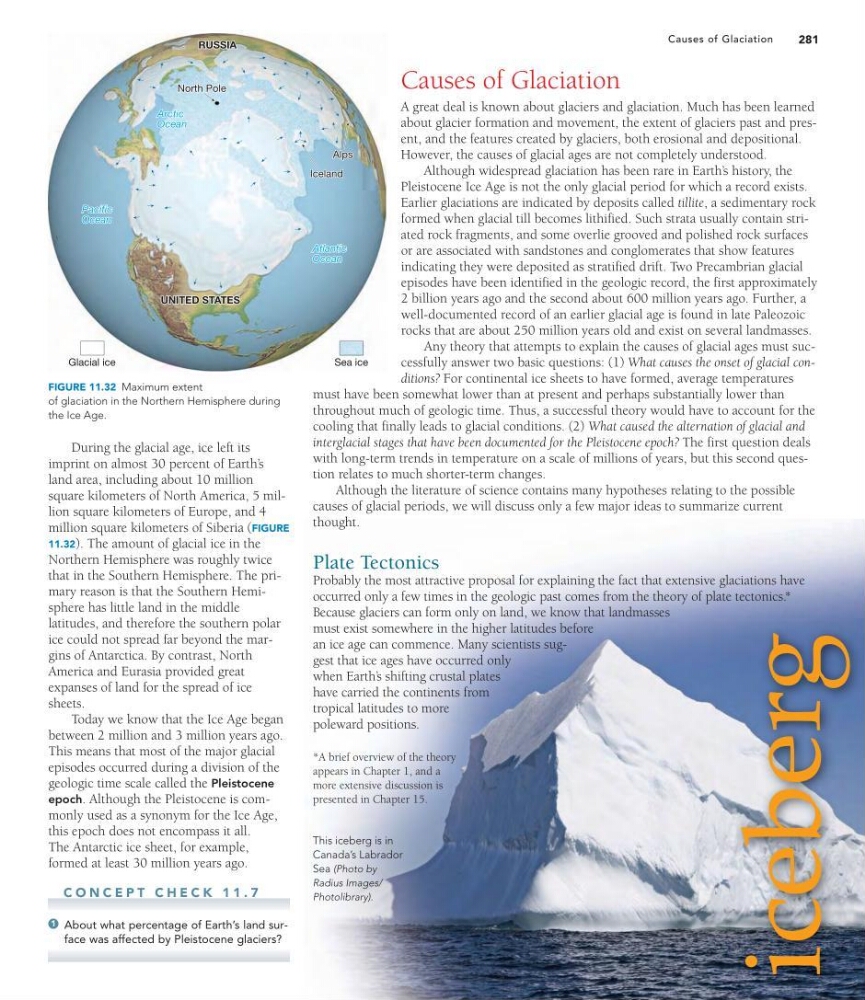
1
This iceberg is in
Canada’s Labrador
Sea (Photo by
Radius Images/
Photolibrary).
*A brief overview of the theory
appears in Chapter 1, and a
more extensive discussion is
presented in Chapter 15.
North Pole
North Pole
Iceland Iceland
Alps Alps
UNITED STATES
UNITED STATES
RUSSIA RUSSIA
North Pole
Iceland
Alps
UNITED STATES
RUSSIA
Arctic
Arctic
Ocean Ocean
Pacific Pacific
Ocean Ocean
Atlantic Atlantic
Ocean Ocean
Arctic
Ocean
Pacific
Ocean
Atlantic
Ocean
Sea ice
Glacial ice
Causes of Glaciation
A great deal is known about glaciers and glaciation. Much has been learned
about glacier formation and movement, the extent of glaciers past and present, and the features created by glaciers, both erosional and depositional.
However, the causes of glacial ages are not completely understood.
Although widespread glaciation has been rare in Earth’ s history, the
Pleistocene Ice Age is not the only glacial period for which a record exists.
Earlier glaciations are indicated by deposits called tillite, a sedimentary rock
formed when glacial till becomes lithified. Such strata usually contain striated rock fragments, and some overlie grooved and polished rock surfaces
or are associated with sandstones and conglomerates that show features
indicating they were deposited as stratified drift. Two Precambrian glacial
episodes have been identified in the geologic record, the first approximately
2 billion years ago and the second about 600 million years ago. Further, a
well-documented record of an earlier glacial age is found in late Paleozoic
rocks that are about 250 million years old and exist on several landmasses.
Any theory that attempts to explain the causes of glacial ages must successfully answer two basic questions: (1) What causes the onset of glacial conditions? For continental ice sheets to have formed, average temperatures
must have been somewhat lower than at present and perhaps substantially lower than
throughout much of geologic time. Thus, a successful theory would have to account for the
cooling that finally leads to glacial conditions. (2) What caused the alternation of glacial and
interglacial stages that have been documented for the Pleistocene epoch? The first question deals
with long-term trends in temperature on a scale of millions of years, but this second question relates to much shorter-term changes.
Although the literature of science contains many hypotheses relating to the possible
causes of glacial periods, we will discuss only a few major ideas to summarize current
thought.
Plate Tectonics
Probably the most attractive proposal for explaining the fact that extensive glaciations have
occurred only a few times in the geologic past comes from the theory of plate tectonics.*
Because glaciers can form only on land, we know that landmasses
must exist somewhere in the higher latitudes before
an ice age can commence. Many scientists suggest that ice ages have occurred only
when Earth’ s shifting crustal plates
have carried the continents from
tropical latitudes to more
poleward positions.
281
Causes of Glaciation
FIGURE 11.32 Maximum extent
of glaciation in the Northern Hemisphere during
the Ice Age.
During the glacial age, ice left its
imprint on almost 30 percent of Earth’ s
land area, including about 10 million
square kilometers of North America, 5 million square kilometers of Europe, and 4
million square kilometers of Siberia (FIGURE
11.32). The amount of glacial ice in the
Northern Hemisphere was roughly twice
that in the Southern Hemisphere. The primary reason is that the Southern Hemisphere has little land in the middle
latitudes, and therefore the southern polar
ice could not spread far beyond the margins of Antarctica. By contrast, North
America and Eurasia provided great
expanses of land for the spread of ice
sheets.
Today we know that the Ice Age began
between 2 million and 3 million years ago.
This means that most of the major glacial
episodes occurred during a division of the
geologic time scale called the Pleistocene
epoch. Although the Pleistocene is commonly used as a synonym for the Ice Age,
this epoch does not encompass it all.
The Antarctic ice sheet, for example,
formed at least 30 million years ago.
C O N C E P T C H E C K 1 1 . 7
About what percentage of Earth’s land surface was affected by Pleistocene glaciers?
1
This iceberg is in
Canada’s Labrador
Sea (Photo by
Radius Images/
Photolibrary).