

275
Glacial Deposits
Moraines, Outwash Plains, and Kettles
Perhaps the most widespread features created by glacial deposition
are moraines, which are simply layers or ridges of till. Several types
of moraines are identified; some are common only to mountain
valleys, and others are associated with areas affected by either ice
sheets or valley glaciers. Lateral and medial moraines fall in the first
category, whereas end moraines and ground moraines are in the
second.
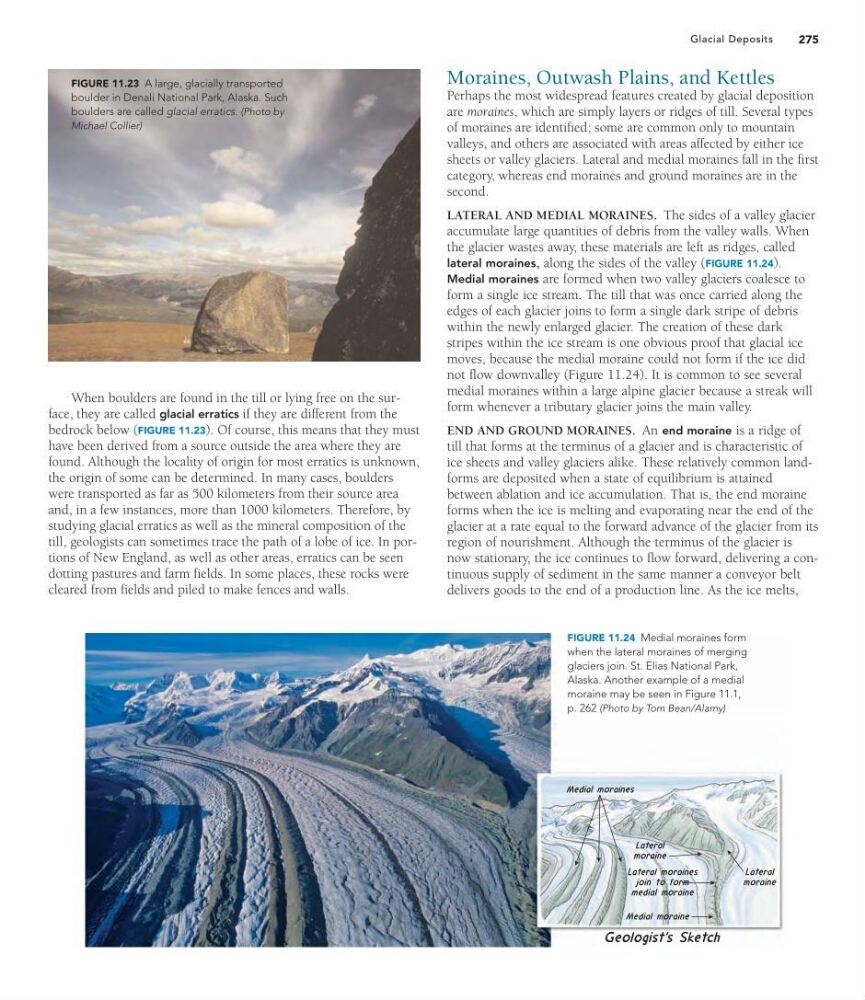
LATERAL AND MEDIAL MORAINES. The sides of a valley glacier
accumulate large quantities of debris from the valley walls. When
the glacier wastes away, these materials are left as ridges, called
lateral moraines, along the sides of the valley (FIGURE 11.24).
Medial moraines are formed when two valley glaciers coalesce to
form a single ice stream. The till that was once carried along the
edges of each glacier joins to form a single dark stripe of debris
within the newly enlarged glacier. The creation of these dark
stripes within the ice stream is one obvious proof that glacial ice
moves, because the medial moraine could not form if the ice did
not flow downvalley (Figure 11.24). It is common to see several
medial moraines within a large alpine glacier because a streak will
form whenever a tributary glacier joins the main valley.
END AND GROUND MORAINES. An end moraine is a ridge of
till that forms at the terminus of a glacier and is characteristic of
ice sheets and valley glaciers alike. These relatively common landforms are deposited when a state of equilibrium is attained
between ablation and ice accumulation. That is, the end moraine
forms when the ice is melting and evaporating near the end of the
glacier at a rate equal to the forward advance of the glacier from its
region of nourishment. Although the terminus of the glacier is
now stationary, the ice continues to flow forward, delivering a continuous supply of sediment in the same manner a conveyor belt
delivers goods to the end of a production line. As the ice melts,
FIGURE 11.23 A large, glacially transported
boulder in Denali National Park, Alaska. Such
boulders are called glacial erratics. (Photo by
Michael Collier)
When boulders are found in the till or lying free on the surface, they are called glacial erratics if they are different from the
bedrock below (FIGURE 11.23). Of course, this means that they must
have been derived from a source outside the area where they are
found. Although the locality of origin for most erratics is unknown,
the origin of some can be determined. In many cases, boulders
were transported as far as 500 kilometers from their source area
and, in a few instances, more than 1000 kilometers. Therefore, by
studying glacial erratics as well as the mineral composition of the
till, geologists can sometimes trace the path of a lobe of ice. In portions of New England, as well as other areas, erratics can be seen
dotting pastures and farm fields. In some places, these rocks were
cleared from fields and piled to make fences and walls.
FIGURE 11.24 Medial moraines form
when the lateral moraines of merging
glaciers join. St. Elias National Park,
Alaska. Another example of a medial
moraine may be seen in Figure 11.1,
p. 262 (Photo by Tom Bean/Alamy)
Glacial Deposits
Moraines, Outwash Plains, and Kettles
Perhaps the most widespread features created by glacial deposition
are moraines, which are simply layers or ridges of till. Several types
of moraines are identified; some are common only to mountain
valleys, and others are associated with areas affected by either ice
sheets or valley glaciers. Lateral and medial moraines fall in the first
category, whereas end moraines and ground moraines are in the
second.
LATERAL AND MEDIAL MORAINES. The sides of a valley glacier
accumulate large quantities of debris from the valley walls. When
the glacier wastes away, these materials are left as ridges, called
lateral moraines, along the sides of the valley (FIGURE 11.24).
Medial moraines are formed when two valley glaciers coalesce to
form a single ice stream. The till that was once carried along the
edges of each glacier joins to form a single dark stripe of debris
within the newly enlarged glacier. The creation of these dark
stripes within the ice stream is one obvious proof that glacial ice
moves, because the medial moraine could not form if the ice did
not flow downvalley (Figure 11.24). It is common to see several
medial moraines within a large alpine glacier because a streak will
form whenever a tributary glacier joins the main valley.
END AND GROUND MORAINES. An end moraine is a ridge of
till that forms at the terminus of a glacier and is characteristic of
ice sheets and valley glaciers alike. These relatively common landforms are deposited when a state of equilibrium is attained
between ablation and ice accumulation. That is, the end moraine
forms when the ice is melting and evaporating near the end of the
glacier at a rate equal to the forward advance of the glacier from its
region of nourishment. Although the terminus of the glacier is
now stationary, the ice continues to flow forward, delivering a continuous supply of sediment in the same manner a conveyor belt
delivers goods to the end of a production line. As the ice melts,
FIGURE 11.23 A large, glacially transported
boulder in Denali National Park, Alaska. Such
boulders are called glacial erratics. (Photo by
Michael Collier)
When boulders are found in the till or lying free on the surface, they are called glacial erratics if they are different from the
bedrock below (FIGURE 11.23). Of course, this means that they must
have been derived from a source outside the area where they are
found. Although the locality of origin for most erratics is unknown,
the origin of some can be determined. In many cases, boulders
were transported as far as 500 kilometers from their source area
and, in a few instances, more than 1000 kilometers. Therefore, by
studying glacial erratics as well as the mineral composition of the
till, geologists can sometimes trace the path of a lobe of ice. In portions of New England, as well as other areas, erratics can be seen
dotting pastures and farm fields. In some places, these rocks were
cleared from fields and piled to make fences and walls.
FIGURE 11.24 Medial moraines form
when the lateral moraines of merging
glaciers join. St. Elias National Park,
Alaska. Another example of a medial
moraine may be seen in Figure 11.1,
p. 262 (Photo by Tom Bean/Alamy)