

loose. In this manner sediment of all sizes, ranging from particles as fine as flour to blocks
as big as houses, becomes part of the glacier’ s load.
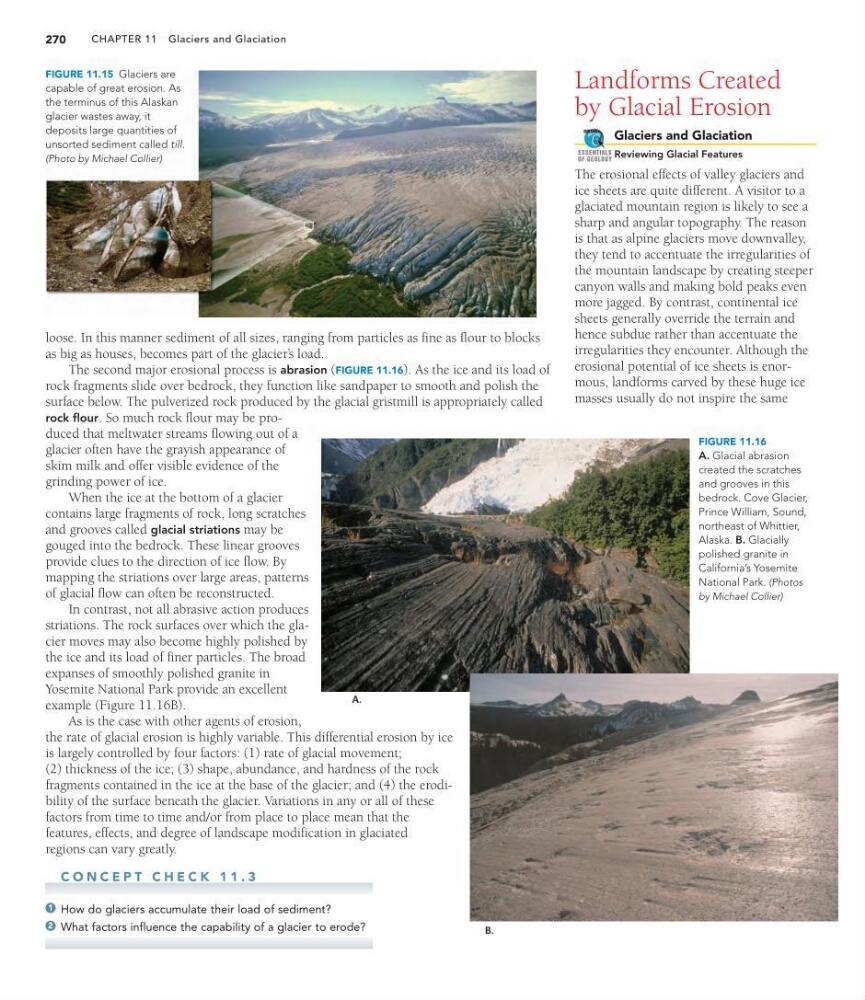
The second major erosional process is abrasion (FIGURE 11.16). As the ice and its load of
rock fragments slide over bedrock, they function like sandpaper to smooth and polish the
surface below. The pulverized rock produced by the glacial gristmill is appropriately called
rock flour. So much rock flour may be produced that meltwater streams flowing out of a
glacier often have the grayish appearance of
skim milk and offer visible evidence of the
grinding power of ice.
When the ice at the bottom of a glacier
contains large fragments of rock, long scratches
and grooves called glacial striations may be
gouged into the bedrock. These linear grooves
provide clues to the direction of ice flow. By
mapping the striations over large areas, patterns
of glacial flow can often be reconstructed.
In contrast, not all abrasive action produces
striations. The rock surfaces over which the glacier moves may also become highly polished by
the ice and its load of finer particles. The broad
expanses of smoothly polished granite in
Yosemite National Park provide an excellent
example (Figure 11.16B).
As is the case with other agents of erosion,
the rate of glacial erosion is highly variable. This differential erosion by ice
is largely controlled by four factors: (1) rate of glacial movement;
(2) thickness of the ice; (3) shape, abundance, and hardness of the rock
fragments contained in the ice at the base of the glacier; and (4) the erodibility of the surface beneath the glacier. Variations in any or all of these
factors from time to time and/or from place to place mean that the
features, effects, and degree of landscape modification in glaciated
regions can vary greatly.
C O N C E P T C H E C K 1 1 . 3
How do glaciers accumulate their load of sediment?
What factors influence the capability of a glacier to erode?
2
1
CHAPTER 11 Glaciers and Glaciation
270
FIGURE 11.15 Glaciers are
capable of great erosion. As
the terminus of this Alaskan
glacier wastes away, it
deposits large quantities of
unsorted sediment called till.
(Photo by Michael Collier)
A.
B.
FIGURE 11.16
A. Glacial abrasion
created the scratches
and grooves in this
bedrock. Cove Glacier,
Prince William, Sound,
northeast of Whittier,
Alaska. B. Glacially
polished granite in
California’s Yosemite
National Park. (Photos
by Michael Collier)
Landforms Created
by Glacial Erosion
Glaciers and Glaciation
Reviewing Glacial Features
The erosional effects of valley glaciers and
ice sheets are quite different. A visitor to a
glaciated mountain region is likely to see a
sharp and angular topography. The reason
is that as alpine glaciers move downvalley,
they tend to accentuate the irregularities of
the mountain landscape by creating steeper
canyon walls and making bold peaks even
more jagged. By contrast, continental ice
sheets generally override the terrain and
hence subdue rather than accentuate the
irregularities they encounter. Although the
erosional potential of ice sheets is enormous, landforms carved by these huge ice
masses usually do not inspire the same
GEODe
ESSENTIALS
OF GEOLOGY
as big as houses, becomes part of the glacier’ s load.
The second major erosional process is abrasion (FIGURE 11.16). As the ice and its load of
rock fragments slide over bedrock, they function like sandpaper to smooth and polish the
surface below. The pulverized rock produced by the glacial gristmill is appropriately called
rock flour. So much rock flour may be produced that meltwater streams flowing out of a
glacier often have the grayish appearance of
skim milk and offer visible evidence of the
grinding power of ice.
When the ice at the bottom of a glacier
contains large fragments of rock, long scratches
and grooves called glacial striations may be
gouged into the bedrock. These linear grooves
provide clues to the direction of ice flow. By
mapping the striations over large areas, patterns
of glacial flow can often be reconstructed.
In contrast, not all abrasive action produces
striations. The rock surfaces over which the glacier moves may also become highly polished by
the ice and its load of finer particles. The broad
expanses of smoothly polished granite in
Yosemite National Park provide an excellent
example (Figure 11.16B).
As is the case with other agents of erosion,
the rate of glacial erosion is highly variable. This differential erosion by ice
is largely controlled by four factors: (1) rate of glacial movement;
(2) thickness of the ice; (3) shape, abundance, and hardness of the rock
fragments contained in the ice at the base of the glacier; and (4) the erodibility of the surface beneath the glacier. Variations in any or all of these
factors from time to time and/or from place to place mean that the
features, effects, and degree of landscape modification in glaciated
regions can vary greatly.
C O N C E P T C H E C K 1 1 . 3
How do glaciers accumulate their load of sediment?
What factors influence the capability of a glacier to erode?
2
1
CHAPTER 11 Glaciers and Glaciation
270
FIGURE 11.15 Glaciers are
capable of great erosion. As
the terminus of this Alaskan
glacier wastes away, it
deposits large quantities of
unsorted sediment called till.
(Photo by Michael Collier)
A.
B.
FIGURE 11.16
A. Glacial abrasion
created the scratches
and grooves in this
bedrock. Cove Glacier,
Prince William, Sound,
northeast of Whittier,
Alaska. B. Glacially
polished granite in
California’s Yosemite
National Park. (Photos
by Michael Collier)
Landforms Created
by Glacial Erosion
Glaciers and Glaciation
Reviewing Glacial Features
The erosional effects of valley glaciers and
ice sheets are quite different. A visitor to a
glaciated mountain region is likely to see a
sharp and angular topography. The reason
is that as alpine glaciers move downvalley,
they tend to accentuate the irregularities of
the mountain landscape by creating steeper
canyon walls and making bold peaks even
more jagged. By contrast, continental ice
sheets generally override the terrain and
hence subdue rather than accentuate the
irregularities they encounter. Although the
erosional potential of ice sheets is enormous, landforms carved by these huge ice
masses usually do not inspire the same
GEODe
ESSENTIALS
OF GEOLOGY